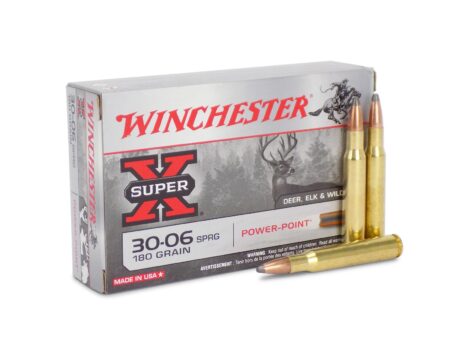
 Ammo Reports Team
| Feature | Detail |
|---|---|
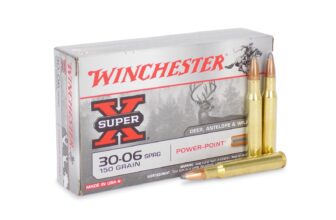
| Primary Use | Big game hunting (deer, elk, bear) |
| Bullet Type | Power-Point jacketed soft point |
| Bullet Weight | 180 grain |
| Case Material | Brass (Long Action cartridge) |
| Primer Type | Boxer (Large Rifle Primer) |
| Packaging | 20 rounds per box |
| Typical Price | $36.99/box · ~$1.85/round |
| Closest Competitors | Federal Power-Shok .30-06 180 gr SP, Remington Core-Lokt .30-06 180 gr PSP, Hornady American Whitetail .30-06 180 gr InterLock SP |
Official Specs
| Spec | Value | Source |
|---|---|---|
| Manufacturer | Winchester | Winchester product data and 2026 catalog, p. 31 |
| Cartridge | 30-06 Springfield | Winchester product data and 2026 catalog, p. 31 |
| Product Line | Super-X / Power-Point | Winchester product data and 2026 catalog, p. 31 |
| Muzzle Velocity (fps) | 2,700 | Winchester product data and 2026 catalog, p. 31 |
| Muzzle Energy (ft-lbs) | 2,913 | Winchester product data and 2026 catalog, p. 31 |
| Bullet Weight | 180 gr | Winchester product data and 2026 catalog, p. 31 |
| Bullet Type | Power-Point jacketed soft point | Winchester product data and 2026 catalog, p. 31 |
| BC G1 | 0.381 | Winchester product data and 2026 catalog, p. 31 |
| BC G7 | — | Not found in verified official manufacturer sources |
| Manufacturer SKU | X30064 | Winchester product data and 2026 catalog, p. 31 |
| UPC | — | Not found in verified official manufacturer sources |
| Reloadable | Yes | Brass case, Boxer primer |
| Case Material | Brass | Case construction |
| Primer | Boxer (Large Rifle Primer) | Primer configuration; factory primer model not verified |
| Test Barrel | 24 inches | Winchester product data and 2026 catalog, p. 31 |
Source labels refer to manufacturer publications; unpublished parameters remain unfilled.


Ballistics Table
Official manufacturer data. Winchester product data and 2026 catalog, p. 31. 200-yard zero.
| Distance (yards) | Velocity (fps) | Energy (ft-lbs) | Trajectory (inches) |
|---|---|---|---|
| 0 | 2700 | 2913 | — |
| 100 | 2468 | 2433 | 2.1 |
| 200 | 2247 | 2018 | 0 |
| 300 | 2038 | 1659 | -9.0 |
| 400 | 1840 | 1354 | -26.4 |
| 500 | 1657 | 1097 | -54.1 |
Factory trajectory uses the catalog's Long Range 200-yard zero. Factory sight height and atmospheric conditions were not specified in the verified catalog page; the separate calculation states its own assumptions.
Calculated reference table – not manufacturer data. 0-700 yards in 100-yard steps. G1 point-mass model; factory muzzle velocity 2700 fps, G1 BC 0.381, 200-yard zero, assumed sight height 1.5 inches, sea level, 59°F, 29.92 inHg, 0% humidity, no wind and level fire. These assumptions are not a claim about factory test conditions. Calculated energy and trajectory are separate estimates; the distance covered does not establish an effective hunting range.
| Distance (yards) | Calculated velocity (fps) | Calculated energy (ft-lbs) | Calculated trajectory (inches) |
|---|---|---|---|
| 0 | 2700 | 2913 | -1.5 |
| 100 | 2464 | 2427 | 2.1 |
| 200 | 2240 | 2006 | 0.0 |
| 300 | 2028 | 1644 | -9.1 |
| 400 | 1829 | 1336 | -26.6 |
| 500 | 1643 | 1079 | -54.6 |
| 600 | 1474 | 868 | -95.5 |
| 700 | 1324 | 701 | -152.5 |
The Power-Point Bullet Design
The Winchester Power-Point is a cup-and-core soft-point bullet distinguished by a ring of notches cut into the exposed lead tip area of the jacket. These notches are not decorative — they are engineered to initiate and direct jacket peel-back upon impact, promoting consistent, controlled expansion across a range of impact velocities. This matters particularly for a 180 grain .30-06 load, which may strike game at velocities ranging from around 2,700 fps at the muzzle down to under 1,800 fps at extended range. The notched jacket helps ensure the bullet opens reliably even at the lower end of that velocity window.
The core is a lead alloy, and the jacket is a drawn copper-alloy cup. This construction has been in continuous production since the Super-X line launched in 1922, making it one of the longest-running hunting bullet designs in American ammunition history. It is not a bonded bullet, meaning jacket and core can separate at very high impact velocities or when striking heavy bone directly — a known characteristic of cup-and-core designs generally. For most hunting applications within ethical range, this is not a practical concern.
Best Uses
Good fit:
- White-tailed deer hunting at ranges up to 250 yards in woodland or mixed terrain
- Elk and black bear hunting at moderate ranges where shot placement can be controlled
- Hunters seeking a proven, widely available load with a long field track record
- Hunters who reload brass and want a reusable case after firing
- Situations where a traditional soft-point bullet is legal (where lead projectiles are permitted)
Not the right tool for:
- Long-range shots beyond 300 yards where wind drift and drop become significant factors
- Jurisdictions or public lands requiring non-lead (copper or copper-alloy) projectiles
- Hunters who prioritize bonded or monolithic bullet construction for deep penetration on very large or dangerous game
- Varmint or predator hunting where the 180 grain weight is unnecessarily heavy and expensive
- Precision target shooting or competition — this is a hunting load, not a match-grade cartridge
Reliability Notes
No structured submissions yet.
The following observations are drawn from manufacturer claims and open sources — not structured field data.
- Winchester states this load is produced to consistent quality control standards across its Super-X line, which has been in continuous production since 1922.
- The brass case is described by Winchester as fully reloadable and manufactured to standard SAAMI dimensions, which is consistent with the general reputation of Winchester brass in the handloading community.
- Open-source field reports (hunting forums, retailer Q&A sections) consistently note that the Power-Point expands reliably on medium to large deer-sized game at typical hunting distances, though jacket-core separation has been noted anecdotally at close-range, high-velocity impacts on heavy bone — a characteristic common to non-bonded cup-and-core designs.
- No active recalls or safety notices are associated with this load at time of publication. Always verify current status with Winchester directly before purchase.
Competitors
| Load | Weight | Bullet | BC G1 | Adv. Velocity | Price/box | Notes |
|---|---|---|---|---|---|---|
| Federal Power-Shok .30-06 180 gr SP | 180 gr | Soft Point (cup-and-core) | ~0.381 | 2,700 fps | ~$28–$33 | Budget alternative; similar cup-and-core design; widely available |
| Remington Core-Lokt .30-06 180 gr PSP | 180 gr | Pointed Soft Point (cup-and-core) | ~0.383 | 2,700 fps | ~$30–$36 | Direct competitor; same bullet class; long field history comparable to Super-X |
| Hornady American Whitetail .30-06 180 gr InterLock | 180 gr | InterLock SP | ~0.391 | 2,700 fps | ~$32–$38 | InterLock ring mechanically locks core to jacket; slightly better BC claimed |
| Federal Trophy Bonded Tip .30-06 180 gr | 180 gr | Trophy Bonded Tip (bonded) | ~0.480 | 2,750 fps | ~$52–$60 | Premium alternative; bonded construction; superior weight retention on heavy game |
| Nosler Ballistic Tip .30-06 180 gr | 180 gr | Ballistic Tip (cup-and-core, polymer tip) | ~0.507 | 2,700 fps | ~$45–$55 | Higher BC; polymer tip initiates expansion; not bonded — potential for rapid expansion on light game |
| Barnes Vor-TX .30-06 180 gr TTSX | 180 gr | TTSX (monolithic copper) | ~0.392 | 2,700 fps | ~$48–$58 | Lead-free; suitable for non-lead regulations; monolithic construction; different terminal behavior than cup-and-core |
Price Reality
- Typical retail range: $33–$40 per 20-round box depending on retailer and market conditions; case pricing (typically 200 rounds / 10 boxes) generally runs $290–$380 when available.
- Per-round cost: At $36.99 MSRP, approximately $1.85 per round — mid-tier pricing for factory .30-06 hunting ammunition.
- Compared to Federal Power-Shok: The Power-Shok in the same weight typically runs $4–$8 less per box, making it the clear budget alternative for shooters prioritizing cost over brand preference.
- Compared to Remington Core-Lokt: Pricing is nearly identical — both loads occupy the same market segment and are often within $2–$3 of each other at any given retailer.
- Compared to Federal Trophy Bonded Tip or Nosler Ballistic Tip: Premium bonded and polymer-tipped loads run $15–$25 more per box, which is justified for hunters pursuing elk or bear where bullet integrity is a higher priority.
- Fair price benchmark: $36–$40 per box is fair market value for this load. Anything above $42 per box for a single box (outside of supply-shortage conditions) should be considered overpriced relative to available alternatives.
Prices change. Check the Where to Buy block for current listings.
Where to Buy
Winchester Super-X .30-06 Springfield 180 Grain Power-Point (Box)
Affiliate links. These do not influence ratings, data, or any editorial content on this page.
FAQ
What makes the Power-Point bullet different from a standard soft-point?
The Power-Point is a soft-point bullet, but it incorporates a series of notches cut into the jacket near the tip. These notches are designed to control how the jacket peels back on impact, promoting more uniform and repeatable expansion compared to a plain soft-point with no jacket scoring. In practice, this means the bullet is engineered to mushroom consistently across a range of impact velocities – which matters in a 180 grain .30-06 load that may strike game anywhere from 50 to 300 yards. It is not a bonded bullet, so jacket and core are held together mechanically rather than chemically or through a fusion process.
How does this load compare directly to the Remington Core-Lokt 180 grain in 30-06?
These two loads are the most direct competitors in the traditional cup-and-core hunting segment for 30-06 Springfield. Both are rated at 2,700 fps muzzle velocity with a 180 grain projectile, both use non-bonded cup-and-core construction, and both are priced within a few dollars of each other. The primary differences are bullet geometry – the Core-Lokt uses a tapered jacket that is thicker at the base – and brand heritage. Neither load has a meaningful ballistic advantage over the other at typical hunting distances. Choosing between them often comes down to personal preference, brand loyalty, or whichever is in stock.
Is this load suitable for elk hunting?
The 180 grain bullet weight is widely considered appropriate for elk, and the .30-06 Springfield cartridge has a long history of use on elk-sized game. The Power-Point’s cup-and-core construction will expand reliably on elk at typical hunting ranges. However, hunters pursuing elk – particularly large bulls or shots through heavy shoulder bone – may want to consider a bonded or monolithic bullet for better weight retention and deeper penetration. The Power-Point is a capable elk load at moderate ranges with good shot placement, but it is not the first choice for hunters who regularly take difficult angle shots or hunt in terrain where ranges exceed 250 yards.
Can this ammunition be used in a 30-06 with a shorter 20-inch barrel?
The published test barrel is 24 inches. Winchester publishes 2,700 fps muzzle velocity, 2,913 ft-lbs muzzle energy and a 0.381 G1 BC for X30064. Actual velocity can differ with the rifle and conditions; a fixed velocity loss per inch is not a verified specification. Follow the firearm manufacturer’s ammunition requirements.
Is this load legal for hunting in areas with non-lead ammunition requirements?
This load contains lead and does not meet a nonlead projectile requirement. California requires certified nonlead ammunition when taking wildlife with a firearm statewide, effective July 1, 2019. Verify the exact product against the current CDFW certification list and applicable hunting regulations.