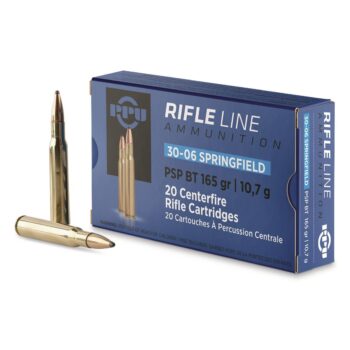
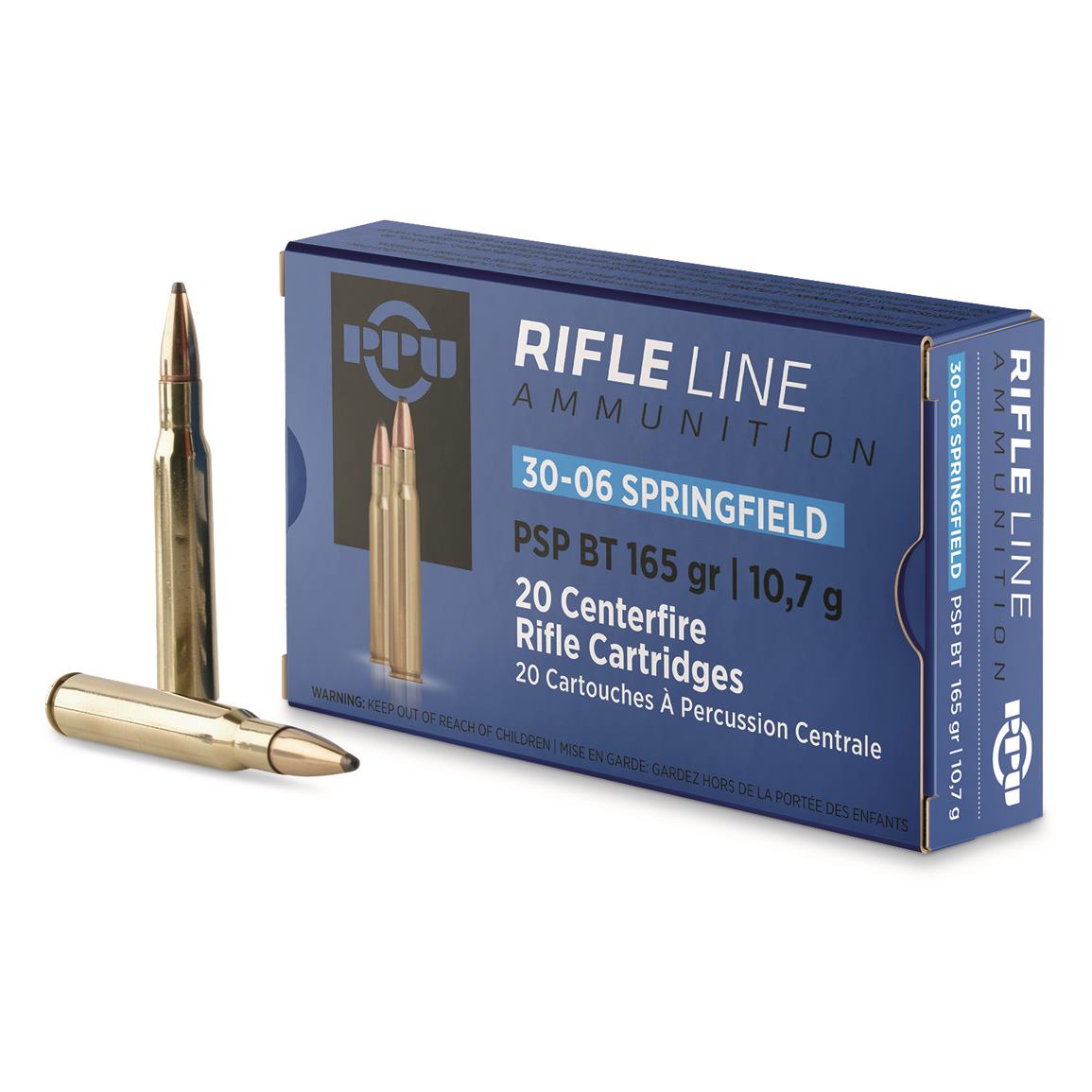
PPU, .30-06 Springfield, PSP-BT, 165 Grain
 Ammo Reports Team


| Field | Detail |
|---|---|
| Primary Use | Hunting (deer, elk, black bear), sport shooting |
| Bullet Type | Pointed Soft Point Boat Tail (PSPBT) |
| Bullet Weight | 165 grain |
| Case Material | Brass (Long Action cartridge) |
| Primer Type | Boxer (Large Rifle Primer) |
| Packaging | 20 rounds per box |
| Typical Price | $23.74/box — $1.19/round |
| Closest Competitors | Federal Power-Shok .30-06 165 gr SP, Remington Core-Lokt .30-06 165 gr PSP, Winchester Super-X .30-06 165 gr PP |
Official Specs
| Spec | Value | Source |
|---|---|---|
| Manufacturer | PPU | PPU 2024 catalog, p. 21 |
| Cartridge | 30-06 Springfield | PPU 2024 catalog, p. 21 |
| Product Line | Standard Rifle | PPU 2024 catalog, p. 21 |
| Muzzle Velocity (fps) | 2,805 | PPU 2024 catalog, p. 21 |
| Muzzle Energy (ft-lbs) | 2,882 | PPU 2024 catalog, p. 21 |
| Bullet Weight | 165 gr | PPU 2024 catalog, p. 21 |
| Bullet Type | Pointed Soft Point Boat Tail (PSPBT) | PPU 2024 catalog, p. 21 |
| BC G1 | 0.439 | PPU 2024 catalog, p. 21 |
| BC G7 | — | Not found in verified official manufacturer sources |
| Manufacturer SKU | PP30062 | PPU 2024 catalog, p. 21 |
| UPC | — | Not found in verified official manufacturer sources |
| Reloadable | Yes | Brass case, Boxer primer |
| Case Material | Brass | Case construction |
| Primer | Boxer (Large Rifle Primer) | Primer configuration; factory primer model not verified |
Source labels refer to manufacturer publications; unpublished parameters remain unfilled.

Ballistics Table
Official manufacturer data. PPU 2024 catalog, p. 21. 100-yard zero.
| Distance (yards) | Velocity (fps) | Energy (ft-lbs) | Trajectory (inches) |
|---|---|---|---|
| 0 | 2805 | 2882 | — |
| 100 | 2598 | 2473 | 0 |
| 200 | 2400 | 2111 | -3.1 |
| 300 | 2211 | 1792 | -12.3 |
The official catalog is used consistently here. The separate PPU web table differs in velocity and BC and has conflicting trajectory signs. Its figures have not been mixed into this catalog table.
Calculated reference table – not manufacturer data. 0-700 yards in 100-yard steps. G1 point-mass model; factory muzzle velocity 2805 fps, G1 BC 0.439, 100-yard zero, assumed sight height 1.5 inches, sea level, 59°F, 29.92 inHg, 0% humidity, no wind and level fire. These assumptions are not a claim about factory test conditions. Calculated energy and trajectory are separate estimates; the distance covered does not establish an effective hunting range.
| Distance (yards) | Calculated velocity (fps) | Calculated energy (ft-lbs) | Calculated trajectory (inches) |
|---|---|---|---|
| 0 | 2805 | 2882 | -1.5 |
| 100 | 2595 | 2466 | 0.0 |
| 200 | 2394 | 2100 | -3.7 |
| 300 | 2202 | 1777 | -13.4 |
| 400 | 2019 | 1494 | -30.4 |
| 500 | 1846 | 1248 | -55.9 |
| 600 | 1683 | 1037 | -91.6 |
| 700 | 1531 | 859 | -139.6 |
The PPU PSP-BT Bullet Design
Prvi Partizan (PPU) is a Serbian state-origin manufacturer with a long history of producing military and commercial ammunition to NATO and SAAMI standards. The PSP-BT (Pointed Soft Point – Boat Tail) is PPU’s core hunting projectile: a lead-core bullet with a thin gilding-metal jacket that is left open at the tip to expose a lead point. On impact, the exposed lead initiates rapid expansion while the jacket controls the expansion envelope to retain weight and penetrate. The boat tail base — a tapered rear section — reduces base drag, improving the bullet’s ballistic coefficient relative to a flat-base equivalent and making the projectile more stable at distance.
This construction is broadly comparable to bullets like the Remington Core-Lokt PSP and Federal Power-Shok SP in operating principle, though specific jacket thickness, core hardness, and crimp specifications are proprietary to PPU. The design is well-established in the hunting market and is not a lead-free or controlled-expansion premium bullet. It is intended for conventional soft-tissue game hunting, not for hard-barrier penetration or restricted lead-free zones.
Best Uses
Good fit:
- Whitetail and mule deer hunting at woods to moderate open-country distances
- Elk and black bear hunting where 165 gr .30-06 energy levels are appropriate
- General-purpose bolt-action practice where recoil characteristics of hunting loads should be replicated
- Budget-conscious hunters who want reloadable brass for subsequent handloading (note: this page covers factory ammunition only)
- Shooters seeking a non-premium price point without moving to a significantly different bullet construction
Not the right tool for:
- Jurisdictions with lead-free ammunition requirements (California deer zones, certain federal lands) — this is a lead-core bullet
- Precision long-range target competition where published BC data and lot-to-lot consistency documentation is required
- Dangerous game where controlled-expansion bonded or solid bullets are recommended
- Hunters who require documented terminal performance data from the manufacturer — PPU publishes limited ballistic detail for this line
Reliability Notes
No structured submissions yet.
Based on manufacturer claims and open-source distributor information: PPU ammunition is manufactured to SAAMI and CIP standards and has been distributed in North American and European markets for decades. The brass cases are described as reloadable and are noted by distributors to be dimensionally consistent. The Boxer primer configuration is standard for the North American market. No active recalls or known safety notices have been identified for this specific load at time of publication. Open-source user commentary across sporting forums generally describes consistent ignition and acceptable accuracy in standard bolt-action rifles, though no structured, controlled test data has been reviewed for this page. All notes reflect manufacturer claims or open-source community information, not structured submission data.
Competitors
| Load | Weight | Bullet | BC G1 | Muzzle Velocity | Price/box (approx.) | Notes |
|---|---|---|---|---|---|---|
| Federal Power-Shok .30-06 165 gr | 165 gr | SP (Flat Base) | ~0.390 | 2,800 fps | ~$24–$27 | Budget tier; flat base vs. PPU boat tail |
| Remington Core-Lokt .30-06 165 gr | 165 gr | PSP | ~0.393 | 2,800 fps | ~$26–$30 | Similar construction; long-standing market benchmark |
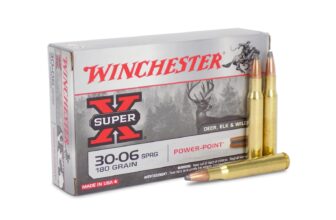
| Winchester Super-X .30-06 165 gr | 165 gr | Power-Point | ~0.390 | 2,800 fps | ~$25–$29 | Cup-and-core SP; comparable price tier |
| Hornady American Whitetail .30-06 165 gr | 165 gr | InterLock SP | ~0.447 | 2,800 fps | ~$28–$33 | Slightly higher BC; InterLock ring aids retention — mild premium |
| Federal Trophy Bonded Tip .30-06 165 gr | 165 gr | Trophy Bonded Tip | ~0.520 | 2,800 fps | ~$45–$55 | Premium alternative; bonded core, higher BC, significant price premium |
| Nosler Trophy Grade .30-06 165 gr | 165 gr | AccuBond | ~0.475 | 2,800 fps | ~$48–$58 | Premium alternative; bonded, higher retained weight — for larger game or longer shots |
Price Reality
- At $23.74 per box of 20, this load sits at the lower end of the centerfire hunting ammunition market for .30-06 Springfield.
- Per-round cost works out to approximately $1.19/round, which is competitive for a brass-cased, boat-tail hunting load.
- Federal Power-Shok and Winchester Super-X in comparable 165 gr configurations typically run $24–$29/box, placing PPU at or below those alternatives when available at the listed price.
- Remington Core-Lokt, the most common comparable load, typically runs $26–$30/box, making PPU a modest savings option.
- Premium bonded loads (Federal Trophy Bonded Tip, Nosler Trophy Grade) run $45–$58/box — roughly double the PPU price — for measurably different terminal performance characteristics.
- A price above $30/box for this specific load would represent a significant premium over typical market positioning and should prompt comparison shopping.
- Case pricing (typically 10 boxes / 200 rounds) is not consistently published for this load at time of writing; per-round savings at case quantity are not confirmed.
Prices change. Check the Where to Buy block for current listings.
Where to Buy
PPU, .30-06 Springfield, PSP-BT, 165 Grain, 20 Rounds
Affiliate links. These do not influence ratings, data, or any editorial content on this page.
FAQ
What does PSP-BT mean, and how does it affect terminal performance on deer-sized game?
PSP-BT stands for Pointed Soft Point – Boat Tail. The “pointed soft point” refers to a lead-core bullet with an exposed lead tip at the nose, which initiates expansion on impact without requiring a polymer tip or hollow cavity. The boat tail is the tapered rear section that reduces aerodynamic drag in flight. On deer-sized game, the exposed lead tip typically produces rapid initial expansion, creating a wider wound channel than a full metal jacket, while the jacket body helps moderate expansion depth. This construction is a conventional hunting design — effective at moderate velocities encountered at typical hunting ranges, but not a bonded bullet, meaning core-jacket separation is possible at very high impact velocities (close-range shots on large game).
How does this PPU load compare directly to Remington Core-Lokt in the same caliber and weight?
Both loads use a 165 grain soft point in .30-06 Springfield and are priced in a similar budget-to-mid tier. The Remington Core-Lokt PSP uses a flat base design in the standard offering, while the PPU uses a boat tail, which provides a modest ballistic coefficient advantage at longer distances. The Core-Lokt has extensive published terminal performance data and a long track record in North American hunting markets. PPU publishes velocity, energy and trajectory to 300 yards in its 2024 catalog; these figures are now reproduced above. In practical hunting use at ranges under 300 yards, the two loads are broadly comparable in construction philosophy, though shooters who want documented expansion data will find more published material on the Core-Lokt.
Is this ammunition legal for deer hunting in lead-restricted zones such as California?
This load contains lead and does not meet a nonlead projectile requirement. California requires certified nonlead ammunition when taking wildlife with a firearm statewide, effective July 1, 2019. Verify the exact product against the current CDFW certification list and applicable hunting regulations.
What rifle barrel length is the muzzle velocity estimate based on, and how much does barrel length matter?
The verified manufacturer source does not specify a test-barrel length for this load. PPU publishes 2,805 fps muzzle velocity, 2,882 ft-lbs muzzle energy and a 0.439 G1 BC for PP30062. Actual velocity can differ with the rifle and conditions; a fixed velocity loss per inch is not a verified specification. Follow the firearm manufacturer’s ammunition requirements.
Can the brass cases from this load be reloaded, and is the primer pocket standard?
Yes — this load uses brass cases with Boxer primers, which is the standard configuration for reloading in North America. Boxer primers are single, centrally located, and can be removed with a standard decapping pin. PPU brass has a general reputation in the reloading community for acceptable dimensional consistency and reasonable case life, though it is not considered a premium brass like Lapua or Norma. This page covers factory ammunition only and does not address specific reloading data, charge weights, or component recommendations. Consult published reloading manuals for load development with once-fired cases.