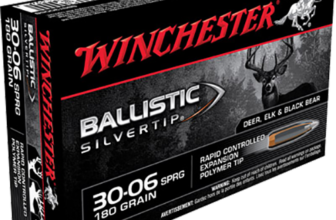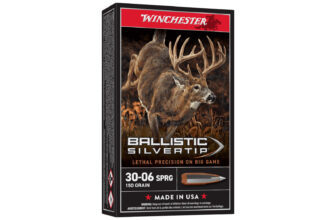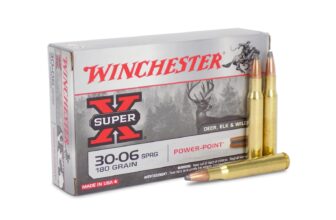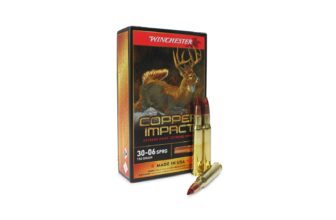
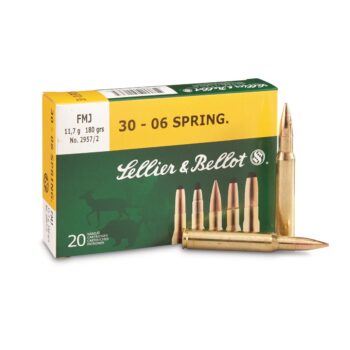
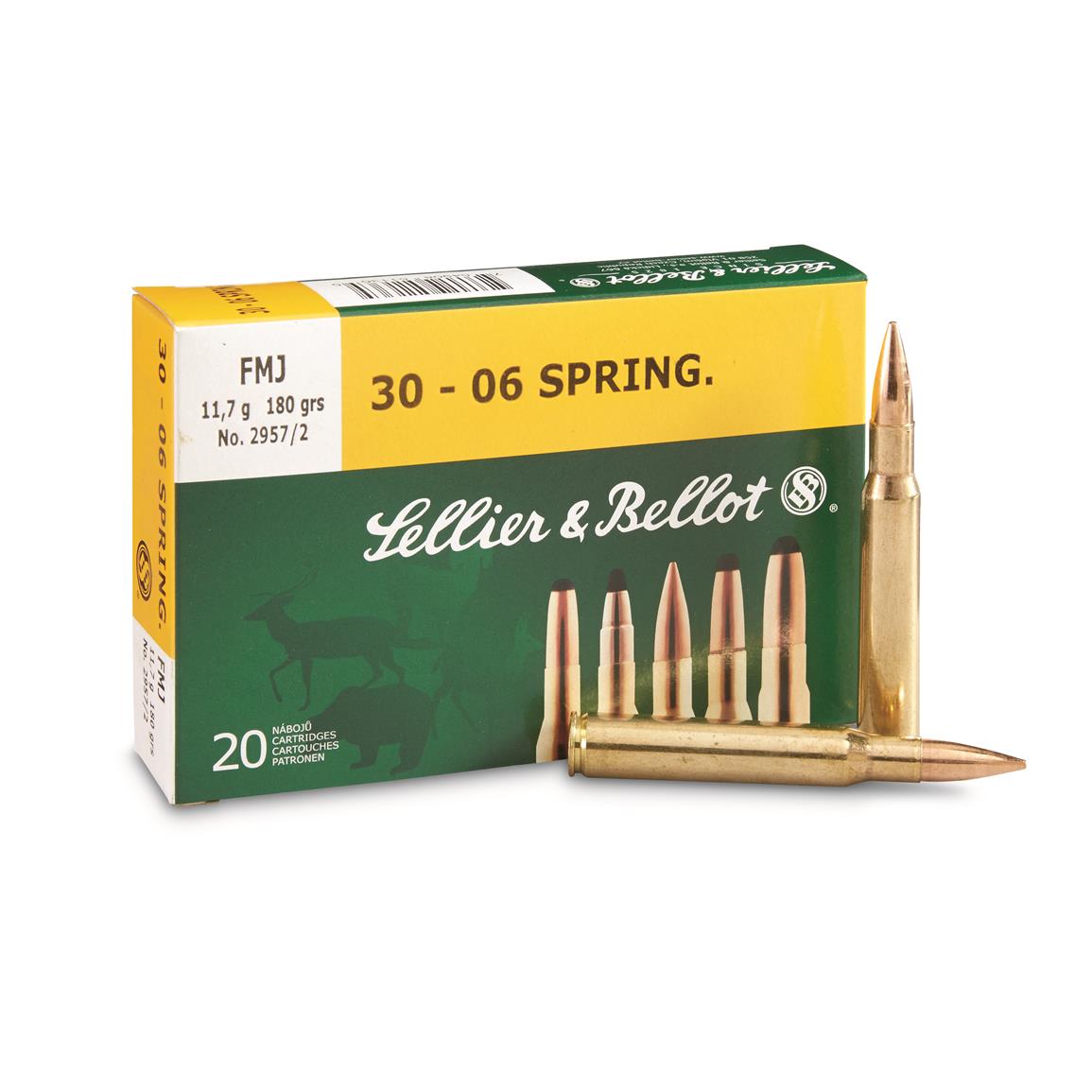
Sellier & Bellot, .30-06 Springfield, FMJ, 180 Grain
 Ammo Reports Team


| Field | Detail |
|---|---|
| Primary Use | Target shooting, military-style training, range practice |
| Bullet Type | Full Metal Jacket (FMJ) |
| Bullet Weight | 180 grain |
| Case Material | Brass (Long Action cartridge) |
| Primer Type | Boxer (Large Rifle Primer) |
| Packaging | 50 rounds per box (manufacturer UPC 754908511365) |
| Typical Price | $23.74/box — $1.19/round |
| Closest Competitors | Federal American Eagle .30-06 FMJ 150 gr, PMC Bronze .30-06 FMJ 147 gr, Fiocchi .30-06 FMJ 150 gr |
Official Specs
| Spec | Value | Source |
|---|---|---|
| Manufacturer | Sellier & Bellot | Sellier & Bellot product data |
| Cartridge | 30-06 Springfield | Sellier & Bellot product data |
| Product Line | Rifle Training FMJ | Sellier & Bellot product data |
| Muzzle Velocity (m/s) | 815 | Sellier & Bellot product data |
| Muzzle Energy (J) | 3,886 | Sellier & Bellot product data |
| Bullet Weight | 180 gr | Sellier & Bellot product data |
| Bullet Type | Full Metal Jacket (FMJ) | Sellier & Bellot product data |
| BC G1 | 0.498 | Sellier & Bellot product data |
| BC G7 | 0.250 | Sellier & Bellot product data |
| Manufacturer SKU | V331692 | Sellier & Bellot product data |
| UPC | 754908511365 | Sellier & Bellot product data |
| Reloadable | Yes | Brass case, Boxer primer |
| Case Material | Brass | Case construction |
| Primer | Boxer (Large Rifle Primer) | Primer configuration; factory primer model not verified |
| Test Barrel | 600 mm | Sellier & Bellot product data |
Source labels refer to manufacturer publications; unpublished parameters remain unfilled.

Ballistics Table
Official manufacturer data. Sellier & Bellot product data. 100-meter zero.
| Distance (m) | Velocity (m/s) | Energy (J) | Trajectory (cm) |
|---|---|---|---|
| 0 | 815 | 3886 | — |
| 100 | 755 | 3333 | 0 |
| 200 | 697 | 2843 | -12.3 |
| 300 | 642 | 2412 | -44.7 |
| 400 | 590 | 2035 | -101.1 |
The exact UPC identifies the manufacturer's 50-round V331692 package. The original 20-round packaging description was incorrect. Official distances, velocities, energy and trajectory below retain the manufacturer's metric units. The separate 169 m MRD trajectory is not mixed with the 100 m zero data.
Calculated reference table – not manufacturer data. 0-700 yards in 100-yard steps. G1 point-mass model; factory muzzle velocity 815 m/s, G1 BC 0.498, 100-meter zero, assumed sight height 1.5 inches, sea level, 59°F, 29.92 inHg, 0% humidity, no wind and level fire. These assumptions are not a claim about factory test conditions. Calculated energy and trajectory are separate estimates; the distance covered does not establish an effective hunting range.
| Distance (yards) | Calculated velocity (fps) | Calculated energy (ft-lbs) | Calculated trajectory (inches) |
|---|---|---|---|
| 0 | 2674 | 2857 | -1.5 |
| 100 | 2493 | 2484 | 0.1 |
| 200 | 2320 | 2151 | -3.9 |
| 300 | 2153 | 1853 | -14.3 |
| 400 | 1994 | 1588 | -32.3 |
| 500 | 1841 | 1355 | -59.0 |
| 600 | 1697 | 1151 | -96.0 |
| 700 | 1562 | 975 | -145.1 |
Best Uses
Good fit:
- High-volume range practice and positional shooting drills
- Training for recoil management with a full-power .30-06 load
- Feeding semi-automatic platforms such as the M1 Garand or civilian AR-10-pattern rifles chambered in .30-06 where FMJ feeds reliably
- Competitions or events that require non-expanding FMJ projectiles by rule
- Brass collection for reloaders who want Boxer-primed brass at a budget price point
Not the right tool for:
- Deer, elk, or any big-game hunting — FMJ is illegal for hunting in most U.S. states and is not designed for controlled expansion
- Long-range precision work where a published and verified ballistic coefficient is required for accurate firing solutions
- Situations requiring lead-free or copper solid projectiles (public lands, California, or other restricted areas)
- Self-defense — FMJ in a rifle caliber presents serious over-penetration concerns in civilian defensive contexts
Reliability Notes
No structured submissions yet.
Based on manufacturer claims and open-source information: Sellier & Bellot is a Czech manufacturer with over 185 years of production history, and their rifle ammunition is generally noted in open sources for consistent primer ignition and reliable cycling in both bolt-action and semi-automatic platforms. The brass case construction with Boxer primers is cited by users in public forums as feeding smoothly in M1 Garand actions, which are sensitive to bullet weight and crimp. No specific failure-to-feed or primer anomaly patterns for this load appear in available open sources. All notes here come from manufacturer claims or open sources — not structured test data.
Competitors
| Load | Weight | Bullet | BC G1 | Adv. Velocity | Price/box | Notes |
|---|---|---|---|---|---|---|
| Federal American Eagle .30-06 FMJ | 150 gr | FMJ-BT | ~0.409 | ~2,910 fps | ~$22–$26 | Lighter bullet, higher velocity; budget alternative |
| PMC Bronze .30-06 FMJ | 147 gr | FMJ-BT | ~0.393 | ~2,910 fps | ~$20–$24 | Budget alternative; lighter projectile |
| Fiocchi .30-06 FMJ | 150 gr | FMJ | ~0.400 | ~2,850 fps | ~$22–$26 | Similar price tier; lighter grain |
| Hornady American Whitetail .30-06 | 180 gr | InterLock SP | ~0.452 | ~2,700 fps | ~$28–$34 | Same weight, expanding bullet; premium hunting option |
| Winchester USA .30-06 FMJ | 147 gr | FMJ | ~0.390 | ~2,920 fps | ~$22–$26 | Common budget range load; lighter grain |
| Nosler Trophy Grade .30-06 | 180 gr | AccuBond | ~0.507 | ~2,700 fps | ~$45–$55 | Premium hunting load; significantly higher cost |
Note: The Hornady American Whitetail and Nosler Trophy Grade entries are included as premium alternatives with expanding bullets for buyers who may also be evaluating hunting loads alongside this range-use FMJ. The S&B 180 gr FMJ is the heaviest bullet in this comparison group, which affects trajectory and wind drift relative to the 147–150 gr competitors.
Price Reality
- At $23.74 per box of 20, this load costs approximately $1.19 per round
- Budget FMJ alternatives in .30-06 (147–150 gr) typically run $20–$26 per box, placing the S&B 180 gr load at the upper end of the budget FMJ range due to the heavier projectile
- PMC Bronze .30-06 and Federal American Eagle .30-06 frequently undercut this price by $2–$4 per box, though both use lighter 147–150 gr bullets
- Premium hunting loads in .30-06 (Nosler, Federal Premium) run $40–$55 per box, making this load significantly more economical for range use
- A fair price benchmark for this load is $20–$26 per box; pricing above $28 for a single box of 20 would represent poor value given available competition in the FMJ .30-06 market
- Case pricing (typically 500 rounds / 25 boxes) is not published in available sources for this SKU
Prices change. Check the Where to Buy block for current listings.
Where to Buy
Sellier & Bellot, .30-06 Springfield, FMJ, 180 Grain, 20 Rounds
Affiliate links. These do not influence ratings, data, or any editorial content on this page.
FAQ
Is the Sellier & Bellot 180 gr FMJ safe to use in an M1 Garand?
This is the 180 gr FMJ load V331692, not Sellier & Bellot’s separately identified 150 gr M1 Garand load. A matching caliber alone does not establish compatibility with a particular firearm. Follow the firearm manufacturer’s ammunition requirements; this page does not verify Garand compatibility for V331692.
Why does this load use a 180-grain FMJ instead of a lighter bullet like most 30-06 FMJ offerings?
Most commercial FMJ .30-06 training ammunition is produced in 147–150 grain weights, which mirrors NATO 7.62×51 ballistics and is cheaper to produce. The 180-grain FMJ is a less common weight class for range ammunition but mirrors the bullet weight used in many hunting loads, making it useful for shooters who want to practice with the same recoil impulse and point of impact as their hunting ammunition before switching to an expanding projectile in the field. It is also the weight class associated with older military-surplus-style loadings.
Can this ammunition be used for deer hunting?
No. FMJ projectiles do not expand on impact and are not designed for terminal performance on game animals. In most U.S. states, hunting deer or other big game with FMJ ammunition is illegal. For hunting applications, a soft point, bonded, or polymer-tipped expanding bullet in the same 180-grain weight class would be the appropriate choice. This load is strictly for range and training use.
How does the 180-grain S&B FMJ compare to the Federal American Eagle 150-grain FMJ for long-range target work?
Sellier & Bellot publishes G1 0.498 and G7 0.250 for this 180 gr FMJ load, with 815 m/s muzzle velocity. The official data are reproduced in metric units above. A comparison requires the exact competing product and consistent conditions; FMJ classification alone does not establish match-grade accuracy.
Is the brass from this load worth saving for reloading?
Sellier & Bellot uses Boxer-primed brass cases, which are fully compatible with standard reloading dies and U.S.-sourced primers. The brass is generally regarded in open-source reloading communities as serviceable and of consistent wall thickness, though it is typically considered a step below premium brass from manufacturers who specialize in reloading components. For a shooter who reloads .30-06 and is already buying this ammunition for range use, saving the brass is a reasonable secondary benefit — but this page covers factory ammunition only and does not include reloading data.