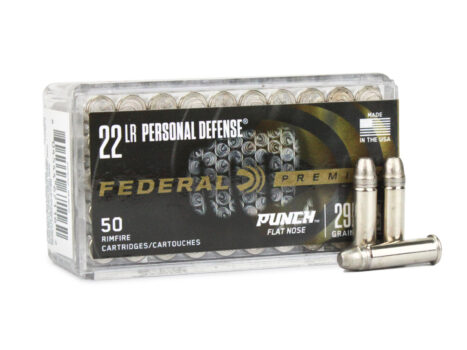
 Ammo Reports Team
| Official Spec | Value |
|---|---|
| Manufacturer | Federal Premium |
| Cartridge | 22 LR |
| Product Line | Personal Defense Punch Rimfire |
| Bullet Name / Bullet Type | Nickel Plated Flat Nose |
| Bullet Weight | 29 gr |
| SKU / Part Number / Item Number | PD22L1 |
| UPC | 604544671162 – retailer-listed |
| Rounds per Box | 50 |
| Muzzle Velocity | 1,080 fps |
| Muzzle Energy | 75 ft-lbs |
| Ballistic Coefficient G1 | .084 |
| Ballistic Coefficient G7 | Not found |
| Case Material | Nickel-plated case |
| Primer | Not found |
| Reloadable | Not found |
| Test Barrel Length | Not found |
| Zero Distance | 50 yards |
| Sight Height | 1.5" |
| Intended Use | Personal defense |
| Product Status | Current – currently unavailable |
| Closest Competitors | CCI Standard Velocity 40 gr LRN, Remington Golden Bullet 36 gr CPHP, Winchester Super-X 40 gr LFN, Federal Champion 40 gr LRN, Aguila Super Extra 38 gr CPHP, SK Standard Plus 40 gr LRN |
Data is based on official manufacturer sources. Found an error? Send us the source link.
Official Ballistics
Manufacturer-published values. “Not published” means the manufacturer does not provide a value at that distance.
| Yards | Velocity (fps) | Energy (ft-lbs) | Trajectory (in) | 10 mph Wind Drift (in) |
|---|---|---|---|---|
| 0 | 1,080 | 75 | -1.5 | 0.0 |
| 50 | 951 | 58 | 0.0 | 1.7 |
| 100 | 865 | 48 | -8.0 | 6.4 |
| 150 | 795 | 41 | -27.6 | 13.8 |
Product Overview
Federal Personal Defense Punch Rimfire uses a 29-grain nickel-plated flat-nose bullet. The load is designed for personal defense and uses a nickel-plated case for reliable extraction.
The official average-range trajectory is based on a 50-yard zero with sights 1.5 inches above the bore. Federal also publishes exact 10 mph wind-drift values, so that column is retained.
Best Uses
Good fit:
- Personal-defense use where 22 LR is the chosen platform
- Firearms that feed the flat-nose profile reliably
- Users who need manufacturer-published wind data
Not the right tool for:
- Long-range applications
- Firearms that have not been function-tested with this bullet profile
Reliability Notes
Federal engineered this load around reliable feeding and terminal performance. Verify function in the exact firearm and follow all applicable laws and safety guidance.
Competitors
The complete existing competitor set is retained. Specifications remain “Not verified” unless they were confirmed for the exact linked product.
| Competitor | Bullet Weight | Bullet Type | Muzzle Velocity | BC G1 |
|---|---|---|---|---|
| CCI Standard Velocity 40 gr LRN | Not verified | Not verified | Not verified | Not verified |
| Remington Golden Bullet 36 gr CPHP | Not verified | Not verified | Not verified | Not verified |
| Winchester Super-X 40 gr LFN | Not verified | Not verified | Not verified | Not verified |
| Federal Champion 40 gr LRN | Not verified | Not verified | Not verified | Not verified |
| Aguila Super Extra 38 gr CPHP | Not verified | Not verified | Not verified | Not verified |
| SK Standard Plus 40 gr LRN | Not verified | Not verified | Not verified | Not verified |
FAQ
Why does this load use a 29-grain bullet when most .22 LR ammunition is 36–40 grains?
The 29-grain flat nose is a lighter-than-standard bullet choice that Federal has positioned for applications where a clean, consistent hole and moderate recoil are priorities. Lighter bullets in .22 LR typically leave the muzzle at higher velocity, producing a somewhat flatter trajectory at close range. The trade-off is that a lighter bullet carries less sectional density and sheds velocity faster, reducing its effectiveness beyond 75–100 yards. This weight class is less common in the .22 LR market, which makes this load a somewhat specialized choice rather than a general-purpose option.
How does the flat nose bullet compare to a hollow point for small game hunting?
A hollow-point bullet is designed to expand on impact, creating a larger wound channel and transferring energy more rapidly — generally preferred for clean, humane kills on small game. The flat nose does not expand but creates a wider initial crush cavity than a round nose due to its meplat geometry. At the velocities typical of a 29 gr .22 LR load, hollow-point expansion can be inconsistent, so the flat nose offers more predictable terminal behavior. For squirrel or rabbit at close range, either design can work effectively with precise shot placement; the flat nose is not a significant disadvantage at distances under 50 yards.
Will this ammunition feed reliably in semi-automatic .22 LR rifles and pistols?
Flat nose bullets can occasionally present feeding issues in semi-automatic actions that were designed and optimized around the more common round-nose profile. The squared-off nose can catch on feed ramp angles that a round nose slides past easily. This is not a universal problem — many semi-automatic .22 LR platforms handle flat-nose ammunition without issue — but it is worth running a small test batch before committing to this load for a semi-auto application. Bolt-action and single-shot rifles are generally unaffected by bullet nose geometry.
Is this load appropriate for use in a suppressor?
Suppressor use with .22 LR typically favors subsonic ammunition — loads with muzzle velocity below approximately 1,100 fps — to avoid the supersonic crack that negates much of the sound reduction benefit. Without a published muzzle velocity for this load, it is not possible to confirm whether it is subsonic or transonic at the muzzle. Given the 29-grain bullet weight, it is plausible that this load exits the muzzle above 1,100 fps, which would produce a sonic crack when suppressed. Shooters intending suppressor use should seek a confirmed subsonic load — typically a 40 gr bullet rated at 1,050 fps or below — for best results.
How does this Federal load compare to the Winchester Super-X 40 gr Flat Nose?
Both loads share the flat nose bullet profile, which gives them similar target-punching characteristics and comparable feeding behavior. The primary difference is bullet weight: Winchester’s 40-grain offering carries significantly more mass and, at its advertised 1,300 fps, delivers approximately 150 ft-lbs of muzzle energy compared to the estimated 74 ft-lbs of this 29 gr Federal load. For small game hunting, the Winchester load provides a meaningful energy advantage. For casual target practice where recoil and cost are priorities, the lighter Federal load may be preferred. Neither load is a match-grade product, so precision benchrest shooters would be better served by dedicated match ammunition from either manufacturer.