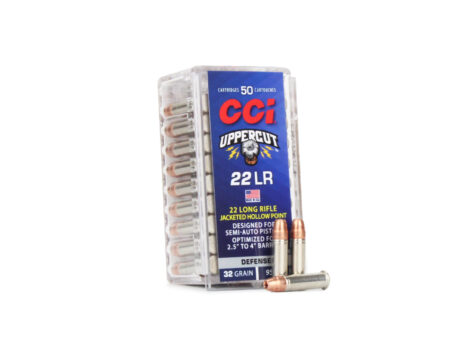
 Ammo Reports Team
| Official Spec | Value |
|---|---|
| Manufacturer | CCI |
| Cartridge | 22 LR |
| Product Line | Uppercut Defense |
| Bullet Name / Bullet Type | Jacketed Hollow Point |
| Bullet Weight | 32 gr |
| SKU / Part Number / Item Number | 960CC |
| UPC | 604544688849 – retailer-listed |
| Rounds per Box | 50 |
| Muzzle Velocity | 950 fps |
| Muzzle Energy | 64 ft-lbs |
| Ballistic Coefficient G1 | Not found |
| Ballistic Coefficient G7 | Not found |
| Case Material | Not found |
| Primer | CCI rimfire priming |
| Reloadable | Not found |
| Test Barrel Length | 3" |
| Zero Distance | 25 yards |
| Sight Height | 1.5" |
| Intended Use | Personal defense in compatible semi-automatic handguns |
| Product Status | Current in the 2024 official catalog |
| Closest Competitors | CCI Stinger 22 LR 32 gr HP, Federal Punch 22 LR 29 gr Nickel Plated Flat Nose, Remington Subsonic 22 LR 38 gr HP, Winchester Wildcat 22 LR 40 gr LRN, Aguila Interceptor 22 LR 40 gr CPSP, Hornady Critical Defense 22 WMR 45 gr FTX |
Data is based on official manufacturer sources. Found an error? Send us the source link.
Official Ballistics
Manufacturer-published values. “Not published” means the manufacturer does not provide a value at that distance.
| Yards | Velocity (fps) | Energy (ft-lbs) | Trajectory (in) |
|---|---|---|---|
| 0 | 950 | 64 | -1.5 |
| 25 | 910 | 58 | 0.0 |
| 50 | 963 | 53 | -1.2 |
The official 2024 CCI catalog prints 963 fps at 50 yards, which is higher than its 25-yard value. The figure is reproduced exactly as published and is not recalculated.
Product Overview
CCI Uppercut is a 32-grain jacketed hollow-point load designed around semi-automatic handguns with 2.5- to 4-inch barrels. Its nose skiving is intended to initiate uniform expansion at handgun velocities.
The official catalog reports the ballistic values below from a 3-inch test barrel. Its 50-yard velocity entry is anomalous but remains reproduced exactly rather than replaced with an estimate.
Best Uses
Good fit:
- Compatible semi-automatic 22 LR handguns
- Users seeking a purpose-built rimfire defense projectile
- Short-barrel testing and comparison
Not the right tool for:
- Rifles or handguns not confirmed compatible with the load
- Any application requiring an independently corrected trajectory model
Reliability Notes
CCI specifies semi-automatic handguns with 2.5- to 4-inch barrels for optimal performance. Test feeding and function in the exact firearm.
Competitors
The complete existing competitor set is retained. Specifications remain “Not verified” unless they were confirmed for the exact linked product.
| Competitor | Bullet Weight | Bullet Type | Muzzle Velocity | BC G1 |
|---|---|---|---|---|
| CCI Stinger 22 LR 32 gr HP | 32 gr | Copper Plated Hollow Point | 1,640 fps | .084 |
| Federal Punch 22 LR 29 gr Nickel Plated Flat Nose | 29 gr | Nickel Plated Flat Nose | 1,080 fps | .084 |
| Remington Subsonic 22 LR 38 gr HP | Not verified | Not verified | Not verified | Not verified |
| Winchester Wildcat 22 LR 40 gr LRN | Not verified | Not verified | Not verified | Not verified |
| Aguila Interceptor 22 LR 40 gr CPSP | Not verified | Not verified | Not verified | Not verified |
| Hornady Critical Defense 22 WMR 45 gr FTX | Not verified | Not verified | Not verified | Not verified |
FAQ
What makes the CCI Uppercut different from standard .22 LR hollow points like the Mini-Mag HP?
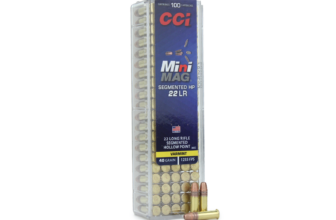
The core distinction is the skived jacket mouth on the Uppercut, which features pre-cut segments designed to initiate petal expansion more consistently at the lower impact velocities typical of .22 LR. Standard hollow points — including CCI’s own Mini-Mag HP — rely on hydraulic pressure alone to open the cavity, which can fail at sub-1,000 fps impact velocities or after passing through light barriers. The Uppercut was engineered specifically to address this failure mode. Buyers who have experienced inconsistent expansion from conventional .22 LR JHP loads will find the design rationale of the Uppercut directly relevant to that problem.
Is the CCI Uppercut 32 gr JHP suitable for squirrel or rabbit hunting?
Inside 75 yards, the Uppercut is a reasonable choice for small game where a clean, expanding projectile is preferred over a lead round-nose. The 32 gr JHP carries approximately 54 ft-lbs of energy at 50 yards, which is adequate for squirrel and rabbit-sized animals when shots are well-placed. Beyond 75–100 yards, the velocity drop reduces the likelihood of reliable expansion, and a heavier standard-velocity load may actually deliver more consistent terminal performance at those distances. Hunters should also verify that jacketed ammunition is compatible with their specific rimfire firearm before using it in the field.
How does the Uppercut compare to the Federal Punch 22 LR for self-defense use?
Both loads are purpose-built for terminal performance in rimfire self-defense contexts, and both occupy a similar price tier. The Federal Punch uses a nickel-plated lead hollow point at 29 gr and a higher stated muzzle velocity of approximately 1,070 fps, while the Uppercut offers 32 gr at 950 fps with its skived jacket design. Neither load has been independently verified through structured ballistic gel testing in the data reviewed for this page. The choice between them is largely a matter of platform compatibility and whether the shooter prioritizes slightly higher velocity (Punch) or the specific mechanical expansion assist of the Uppercut’s jacket construction.
Will the CCI Uppercut cycle reliably in semi-automatic .22 LR pistols?
CCI markets the Uppercut as semi-auto compatible, and the jacketed construction is generally more consistent in feeding than lead hollow points, which can deform slightly under magazine spring pressure. However, .22 LR semi-automatic reliability is highly platform-dependent — some pistols are tuned for standard-velocity loads, others for high-velocity, and the 950 fps rating of the Uppercut places it in the lower end of the velocity range that some semi-auto actions require for reliable cycling. Shooters should test a box through their specific firearm before relying on it for any application where function is critical.
Is the 950 fps velocity figure measured from a rifle barrel or a pistol barrel?
The product data reviewed for this page does not specify the test barrel length used to derive the 950 fps muzzle velocity figure. This is a meaningful gap, because .22 LR velocity is highly sensitive to barrel length — a 16" rifle barrel can produce 150–250 fps more than a 4" pistol barrel with the same load. Buyers using the Uppercut in a short-barreled pistol should expect meaningfully lower velocity than the stated figure, which may further reduce the likelihood of consistent hollow point expansion. Until CCI publishes barrel-length-specific data, this specification should be treated as a reference point rather than a guaranteed performance figure across all platforms.