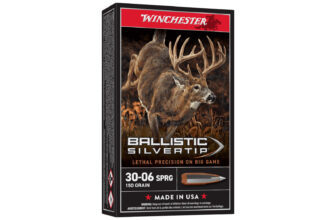
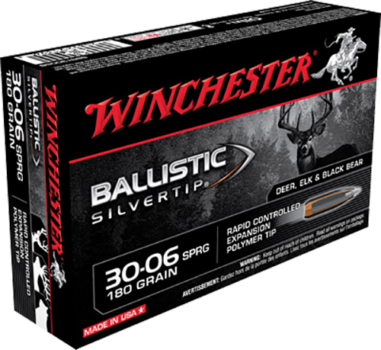
Winchester Ballistic Silvertip 30-06 Springfield 180 Grain Rapid Controlled Expansion Polymer Tip
 Ammo Reports Team
| Feature | Detail |
|---|---|
| Primary Use | Big game hunting at medium to long range |
| Bullet Type | Ballistic Silvertip, non-bonded polymer tip boat tail |
| Bullet Weight | 180 grain |
| Case Material | Brass (Long Action cartridge) |
| Primer Type | Boxer (Large Rifle Primer) |
| Packaging | 20 rounds per box |
| Typical Price | $43.99/box — $2.20/round |
| Closest Competitors | Federal Premium Trophy Bonded Tip 30-06 180 gr, Hornady Precision Hunter 30-06 178 gr ELD-X, Nosler Trophy Grade 30-06 180 gr Partition |
Official Specs
| Spec | Value | Source |
|---|---|---|
| Manufacturer | Winchester | Winchester product data and 2026 catalog, p. 31 |
| Cartridge | 30-06 Springfield | Winchester product data and 2026 catalog, p. 31 |
| Product Line | Ballistic Silvertip | Winchester product data and 2026 catalog, p. 31 |
| Muzzle Velocity (fps) | 2,750 | Winchester product data and 2026 catalog, p. 31 |
| Muzzle Energy (ft-lbs) | 3,022 | Winchester product data and 2026 catalog, p. 31 |
| Bullet Weight | 180 gr | Winchester product data and 2026 catalog, p. 31 |
| Bullet Type | Ballistic Silvertip, non-bonded polymer tip boat tail | Winchester product data and 2026 catalog, p. 31 |
| BC G1 | 0.507 | Winchester product data and 2026 catalog, p. 31 |
| BC G7 | — | Not found in verified official manufacturer sources |
| Manufacturer SKU | SBST3006B | Winchester product data and 2026 catalog, p. 31 |
| UPC | — | Not found in verified official manufacturer sources |
| Reloadable | Yes | Brass case, Boxer primer |
| Case Material | Brass | Case construction |
| Primer | Boxer (Large Rifle Primer) | Primer configuration; factory primer model not verified |
| Test Barrel | 24 inches | Winchester product data and 2026 catalog, p. 31 |
Source labels refer to manufacturer publications; unpublished parameters remain unfilled.


Ballistics Table
Official manufacturer data. Winchester product data and 2026 catalog, p. 31. 200-yard zero.
| Distance (yards) | Velocity (fps) | Energy (ft-lbs) | Trajectory (inches) |
|---|---|---|---|
| 0 | 2750 | 3022 | — |
| 100 | 2572 | 2644 | 1.9 |
| 200 | 2402 | 2305 | 0 |
| 300 | 2237 | 2001 | -7.9 |
| 400 | 2080 | 1728 | -22.8 |
| 500 | 1928 | 1486 | -45.7 |
Factory trajectory uses the catalog's Long Range 200-yard zero. Factory sight height and atmospheric conditions were not specified in the verified catalog page; the separate calculation states its own assumptions.
Calculated reference table – not manufacturer data. 0-700 yards in 100-yard steps. G1 point-mass model; factory muzzle velocity 2750 fps, G1 BC 0.507, 200-yard zero, assumed sight height 1.5 inches, sea level, 59°F, 29.92 inHg, 0% humidity, no wind and level fire. These assumptions are not a claim about factory test conditions. Calculated energy and trajectory are separate estimates; the distance covered does not establish an effective hunting range.
| Distance (yards) | Calculated velocity (fps) | Calculated energy (ft-lbs) | Calculated trajectory (inches) |
|---|---|---|---|
| 0 | 2750 | 3022 | -1.5 |
| 100 | 2570 | 2639 | 1.9 |
| 200 | 2396 | 2295 | 0.0 |
| 300 | 2230 | 1987 | -8.0 |
| 400 | 2069 | 1712 | -22.9 |
| 500 | 1916 | 1468 | -46.0 |
| 600 | 1771 | 1253 | -78.6 |
| 700 | 1633 | 1066 | -122.3 |
The Ballistic Silvertip Bullet Construction
The Ballistic Silvertip designation refers to a specific bullet architecture that Winchester developed to combine reliable expansion with controlled penetration. The polymer tip serves two functions: it protects the hollow point cavity during feeding and magazine storage, and it initiates expansion on impact by driving rearward into the lead core. The boat tail base reduces base drag and improves stability at extended range, contributing to the flat-shooting characteristics the design is known for.
The jacket is engineered to allow what Winchester describes as rapid controlled expansion — meaning the bullet is intended to open quickly at impact velocities typical of hunting ranges while retaining enough core integrity to penetrate to vitals. This contrasts with bonded-core designs, where the jacket is chemically or mechanically attached to the core throughout its length. The Ballistic Silvertip uses a conventional (non-bonded) construction, which generally produces faster expansion but may sacrifice some weight retention compared to bonded alternatives at close range or on heavy-boned animals.
Best Uses
Good fit:
- White-tailed deer and mule deer at ranges from 50 to 400 yards
- Pronghorn antelope where flat trajectory and long-range precision matter
- Black bear hunting where moderate penetration and reliable expansion are both priorities
- Elk at moderate ranges (under 250 yards) on broadside or quartering-away shots where penetration demands are manageable
- Hunters who need a versatile, widely available 30-06 load for mixed-game seasons
Not the right tool for:
- Large, heavy-boned game (bull elk, moose, brown bear) at close range where maximum penetration depth is critical — a bonded or partition-style bullet is better suited
- Shots at extreme angles where the bullet must transit a significant amount of material before reaching vitals
- Jurisdictions with lead-free ammunition requirements — this is a conventional lead-core bullet
- Varmint or predator use where over-penetration or pelt damage is a concern
Reliability Notes
No structured submissions yet.
Based on manufacturer claims and open-source information: Winchester describes the Ballistic Silvertip line as producing consistent accuracy from bolt-action hunting rifles, citing the sleek nose profile and boat tail as contributors to reduced group size at range. The polymer tip is engineered to remain intact during magazine feeding cycles, which has been noted as a practical advantage in lever-action or pump-action platforms where tip deformation can be an issue — though this load is optimized for bolt-action use. No active recalls or safety notices are associated with this product as of the time of writing. All notes here come from manufacturer claims and open sources, not structured field data.
Competitors
| Load | Weight | Bullet | BC G1 | Muzzle Velocity | Price/box | Notes |
|---|---|---|---|---|---|---|
| Federal Premium Trophy Bonded Tip 30-06 | 180 gr | Bonded polymer tip | ~0.480 | ~2,700 fps | ~$52–$58 | Bonded core — better weight retention on heavy game |
| Hornady Precision Hunter 30-06 ELD-X | 178 gr | ELD-X polymer tip | 0.552 | 2,700 fps | ~$48–$54 | Higher published BC; Heat Shield tip |
| Nosler Trophy Grade 30-06 Partition | 180 gr | Partition dual-core | ~0.474 | ~2,700 fps | ~$55–$62 | Premium dual-core partition; proven on elk and moose |
| Remington Core-Lokt 30-06 | 180 gr | PSP soft point | ~0.383 | 2,700 fps | ~$28–$34 | Budget alternative; lower BC, proven terminal performance |
| Barnes VOR-TX 30-06 TTSX | 168 gr | Lead-free TTSX | 0.447 | 2,800 fps | ~$52–$60 | Lead-free; lighter bullet; good for restricted zones |
| Winchester Power Point 30-06 | 180 gr | Soft point | 0.381 | 2,700 fps | ~$30–$36 | Budget Winchester alternative; simpler cup-and-core design |
Price Reality
- Typical retail range: $40–$48 per 20-round box; case pricing (typically 10 boxes/200 rounds) generally falls between $390–$460 when available
- Per-round cost: Approximately $2.20 at the $43.99 price point
- The Remington Core-Lokt 180 gr and Winchester Power Point 180 gr both come in at roughly $1.40–$1.70 per round — a meaningful savings for practice, though they offer a simpler bullet design
- The Hornady Precision Hunter ELD-X and Federal Trophy Bonded Tip run $2.40–$2.90 per round, offering published ballistic coefficients and (in the Federal’s case) bonded construction for the premium
- At $2.20/round, the Ballistic Silvertip sits in the mid-tier segment — priced above basic cup-and-core loads but below fully bonded or partition-style premium hunting ammunition
- A price above $52 per box for this specific load should prompt comparison shopping; at that level, bonded-core competitors become more cost-competitive
Prices change. Check the Where to Buy block for current listings.
Where to Buy
Winchester Ballistic Silvertip 30-06 Springfield 180 Grain Rapid Controlled Expansion Polymer Tip (Box)
Affiliate links. These do not influence ratings, data, or any editorial content on this page.
FAQ
Does the Ballistic Silvertip use a bonded core, and why does that matter for hunting?
No — the Ballistic Silvertip uses a conventional (non-bonded) lead core and gilding metal jacket. This construction is engineered for rapid expansion on impact, which works well on deer-sized game at typical hunting velocities. Bonded bullets, by contrast, mechanically or chemically fuse the jacket to the core to maximize weight retention through heavy bone and muscle. For most whitetail and mule deer applications, the Ballistic Silvertip’s construction is entirely adequate. Hunters pursuing elk, moose, or large bears — especially at close range with high impact velocities — may want to consider a bonded or partition-style alternative like the Federal Trophy Bonded Tip or Nosler Partition.
How does this load compare directly to the Hornady Precision Hunter 30-06 178 gr ELD-X?
Both loads use a polymer-tipped boat tail design and target the same hunting demographic, but they differ in key ways. Hornady publishes a G1 BC of 0.552 for the 178 gr ELD-X, which is notably higher than what is typical for the Ballistic Silvertip at this weight — that translates to less wind drift and drop at extended range. The ELD-X also uses Hornady’s Heat Shield tip, designed to resist aerodynamic deformation during flight. The Ballistic Silvertip is generally priced slightly lower and is widely available, making it a practical choice for hunters who shoot within 350 yards and don’t require the last degree of long-range precision.
Is the Winchester Ballistic Silvertip 30-06 180 gr legal for deer hunting in all U.S. states?
This load contains lead and does not meet a nonlead projectile requirement. California requires certified nonlead ammunition when taking wildlife with a firearm statewide, effective July 1, 2019. Verify the exact product against the current CDFW certification list and applicable hunting regulations.
What is “Rapid Controlled Expansion” and how does it differ from standard soft point performance?
Rapid Controlled Expansion is Winchester’s description of the Ballistic Silvertip’s terminal behavior — the bullet is designed to begin expanding quickly upon contact, driven by the polymer tip collapsing into the hollow point cavity. Compared to a traditional soft point, which relies on hydraulic pressure to fold the lead tip back, the polymer tip initiates expansion more consistently across a wider range of impact velocities. This can be an advantage at longer ranges where velocity has dropped, because the mechanical trigger is less dependent on a minimum impact speed threshold. The trade-off relative to a fully bonded bullet is that core and jacket may begin to separate at very high impact velocities (close-range shots), potentially reducing penetration depth.
What barrel length is this load optimized for, and will a shorter rifle give significantly different results?
The published test barrel is 24 inches. Winchester publishes 2,750 fps muzzle velocity, 3,022 ft-lbs muzzle energy and a 0.507 G1 BC for SBST3006B. Actual velocity can differ with the rifle and conditions; a fixed velocity loss per inch is not a verified specification. Follow the firearm manufacturer’s ammunition requirements.