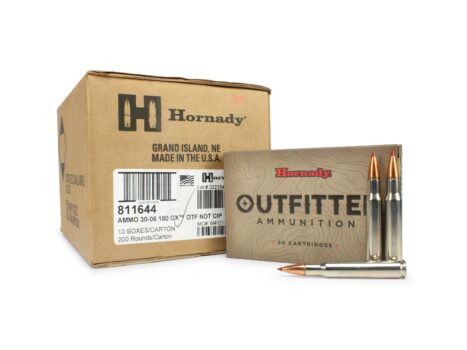
 Ammo Reports Team
| Feature | Detail |
|---|---|
| Primary Use | Big game hunting |
| Bullet Type | CX (copper-alloy, Heat Shield polymer tip) |
| Bullet Weight | 180 grain |
| Case Material | Nickel-plated brass (Long Action cartridge) |
| Primer Type | Boxer (Large Rifle Primer) |
| Packaging | 20 rounds per box (Case = 10 boxes / 200 rounds) |
| Typical Price | ~$46.10/box · ~$2.31/round (based on $460.99/case) |
| Closest Competitors | Federal Trophy Copper 30-06 Springfield 180 gr Trophy Copper, Barnes VOR-TX 30-06 Springfield 180 gr TTSX BT, Browning BXS 30-06 Springfield 185 gr Solid Copper |
Official Specs
| Spec | Value | Source |
|---|---|---|
| Manufacturer | Hornady | Hornady product data and 2026 catalog |
| Cartridge | 30-06 Springfield | Hornady product data and 2026 catalog |
| Product Line | Outfitter | Hornady product data and 2026 catalog |
| Muzzle Velocity (fps) | 2,700 | Hornady product data and 2026 catalog |
| Muzzle Energy (ft-lbs) | 2,914 | Hornady product data and 2026 catalog |
| Bullet Weight | 180 gr | Hornady product data and 2026 catalog |
| Bullet Type | CX (copper-alloy, Heat Shield polymer tip) | Hornady product data and 2026 catalog |
| BC G1 | 0.469 | Hornady product data and 2026 catalog |
| BC G7 | 0.236 | Hornady 2026 bullet catalog |
| Manufacturer SKU | 811644 | Hornady product data and 2026 catalog |
| UPC | — | Not found in verified official manufacturer sources |
| Reloadable | Yes | Brass case, Boxer primer |
| Case Material | Nickel-plated brass | Case construction |
| Primer | Boxer (Large Rifle Primer) | Primer configuration; factory primer model not verified |
| Test Barrel | 24 inches | Hornady product data and 2026 catalog |
Source labels refer to manufacturer publications; unpublished parameters remain unfilled.


Ballistics Table
Official manufacturer data. Hornady product data and 2026 catalog. 100-yard zero.
| Distance (yards) | Velocity (fps) | Energy (ft-lbs) | Trajectory (inches) |
|---|---|---|---|
| 0 | 2700 | 2914 | -1.5 |
| 100 | 2511 | 2520 | 0 |
| 200 | 2330 | 2169 | -4 |
| 300 | 2156 | 1857 | -14.5 |
| 400 | 1989 | 1582 | -32.4 |
| 500 | 1831 | 1340 | -59.2 |
Calculated reference table – not manufacturer data. 0-700 yards in 100-yard steps. G1 point-mass model; factory muzzle velocity 2700 fps, G1 BC 0.469, 100-yard zero, assumed sight height 1.5 inches, sea level, 59°F, 29.92 inHg, 0% humidity, no wind and level fire. These assumptions are not a claim about factory test conditions. Calculated energy and trajectory are separate estimates; the distance covered does not establish an effective hunting range.
| Distance (yards) | Calculated velocity (fps) | Calculated energy (ft-lbs) | Calculated trajectory (inches) |
|---|---|---|---|
| 0 | 2700 | 2913 | -1.5 |
| 100 | 2507 | 2513 | 0.0 |
| 200 | 2323 | 2156 | -4.0 |
| 300 | 2146 | 1841 | -14.5 |
| 400 | 1977 | 1562 | -32.6 |
| 500 | 1817 | 1319 | -59.6 |
| 600 | 1665 | 1108 | -97.1 |
| 700 | 1525 | 929 | -147.2 |
The Hornady CX Bullet and Outfitter Line
The CX (Copper alloy eXpanding) bullet is Hornady’s current-generation lead-free monolithic projectile, introduced as a direct evolution of the older GMX design. It is machined from a solid copper alloy bar stock and features a polymer ballistic tip that initiates rapid, controlled expansion on impact. Unlike cup-and-core bullets, the CX retains nearly all of its original weight through the target because there is no lead core to separate. The grooved shank — a defining external feature — reduces bore friction and fouling compared to earlier monolithic designs, which were frequently criticized for pressure spikes and copper fouling.
The Outfitter line surrounds the CX bullet with a case specification built for harsh field conditions. The nickel-plated brass case resists corrosion in wet environments and feeds reliably in cold-stiffened actions. The primer pocket is sealed against moisture intrusion — a meaningful feature for hunters packing ammunition into backcountry environments where rain, snow, or stream crossings are realistic hazards. This is factory ammunition with a specific environmental durability mission, not simply a lead-free compliance load.
Lead-free construction makes this load compliant with California’s Proposition 65 restrictions on lead ammunition for hunting on state lands, as well as applicable regulations in other jurisdictions that restrict or prohibit lead projectiles in certain hunting zones. Hunters planning trips to areas with such restrictions should verify current local regulations, as rules vary by species and management unit.
Best Uses
Good fit:
- Hunting elk, mule deer, whitetail, and black bear at ranges from close timber shots to 300+ yard open country opportunities
- Backcountry and wilderness hunts where ammunition may be exposed to sustained moisture, rain, or temperature extremes
- Hunting in states or regions with lead-free ammunition requirements (California, specific federal lands, waterfowl-adjacent zones)
- Hunters who prefer maximum weight retention and deep penetration for heavy-boned or large-bodied game
- Situations where a single load must serve multiple species or hunt types within one trip
Not the right tool for:
- Varmint or predator hunting where lead-free construction adds cost without meaningful benefit
- Budget-conscious target shooters — at ~$2.31/round, this is a hunting-specific premium load not suited for volume practice
- Hunters using older rifles with tight or shallow rifling twist rates that may not stabilize heavier monolithic projectiles — function should be verified before field use
- Jurisdictions that restrict copper or solid-alloy projectiles (rare but verify locally)
- Reloaders seeking a case for high-volume reuse — while the brass is reloadable, the sealed primer pocket requires decapping with more force than standard Boxer brass
Reliability Notes
No structured submissions yet.
From manufacturer claims and open sources: Hornady states the Outfitter line is built to function reliably in adverse environmental conditions, with sealed, nickel-plated cases that resist corrosion and feed smoothly in bolt-action and semi-automatic platforms. The CX bullet design is described by the manufacturer as producing controlled expansion across a broad velocity range, which is relevant for 30-06 Springfield loads used at both close and extended distances. The grooved shank design is claimed to reduce copper fouling relative to earlier monolithic designs such as the GMX. No active recalls or documented safety issues have been identified for this product from available public sources. All notes here come from manufacturer claims or open sources, not structured data.
Competitors
| Load | Weight | Bullet | BC G1 | Adv. Velocity | Price/box | Notes |
|---|---|---|---|---|---|---|
| Federal Trophy Copper 30-06 Springfield | 180 gr | Trophy Copper (monolithic) | ~0.480 | ~2,700 fps | ~$52–$58 | Lead-free; comparable monolithic design |
| Barnes VOR-TX 30-06 Springfield | 180 gr | TTSX BT (triple-shock X) | ~0.430 | ~2,700 fps | ~$55–$62 | Lead-free; well-established monolithic line |
| Browning BXS 30-06 Springfield | 185 gr | Solid copper (BXS) | ~0.420 | ~2,650 fps | ~$42–$48 | Lead-free; budget-friendlier monolithic option |
| Winchester Expedition Big Game 30-06 | 180 gr | Nosler AccuBond | ~0.507 | ~2,700 fps | ~$45–$52 | Lead-core bonded; not lead-free; higher BC |
| Nosler Trophy Grade 30-06 Springfield | 180 gr | AccuBond | ~0.507 | ~2,700 fps | ~$48–$56 | Lead-core bonded; premium accuracy reputation |
| Remington Core-Lokt 30-06 Springfield | 180 gr | Core-Lokt PSP | ~0.383 | ~2,700 fps | ~$28–$35 | Budget alternative; lead-core; lower BC; not lead-free |
All competitor velocities and BCs are approximate, sourced from manufacturer published data or established ballistic references. Price ranges reflect typical retail at time of writing and will vary.
Price Reality
- The case price of $460.99 breaks down to approximately $46.10 per box of 20 rounds and $2.31 per round
- This positions the Hornady Outfitter 30-06 180 gr CX at the upper-middle tier of the lead-free hunting ammunition market for this caliber
- Federal Trophy Copper in 30-06 180 gr typically runs $52–$58/box — slightly more expensive per box but often sold only in 20-round quantities without case pricing
- Barnes VOR-TX 30-06 180 gr runs $55–$62/box, making the Outfitter competitive when purchased by the case
- Remington Core-Lokt 30-06 180 gr at $28–$35/box represents the budget baseline — roughly $1.40–$1.75/round — for hunters not requiring lead-free construction
- A fair price benchmark: above $50/box for this load in 20-round packaging should be considered overpriced given the case pricing available; case purchases offer meaningful savings over single-box retail
Prices change. Check the Where to Buy block for current listings.
Where to Buy
Hornady Outfitter 30-06 Springfield 180 Grain CX (Case)
Affiliate links. These do not influence ratings, data, or any editorial content on this page.
FAQ
Is the Hornady CX bullet the same as the older Hornady GMX?
The CX and GMX are related but not identical. Both are monolithic copper alloy projectiles designed for lead-free performance, but the CX is a newer design featuring an updated grooved shank geometry intended to reduce bore friction and copper fouling — two criticisms frequently directed at the GMX in certain rifles. The CX also incorporates a polymer tip from the factory, whereas early GMX bullets were open-tip designs. Hunters who had mixed results with the GMX in their specific rifle may find the CX behaves differently, and the two are not interchangeable in terms of seating depth or pressure behavior.
Does the sealed primer on the Outfitter case affect reloadability?
The nickel-plated brass case is technically reloadable using standard Boxer decapping equipment, but the sealed primer pocket — added for moisture resistance — requires more decapping force than an unsealed case and may leave adhesive residue that requires cleaning before repriming. Most reloaders report the cases are usable after the first firing once the sealant is displaced, but they are not as straightforward to process as standard Hornady brass. If reloading is a priority, dedicated unprimed brass is a more practical starting point.
Is this load legal for hunting in California and other lead-restricted areas?
This load uses a lead-free projectile. California requires certified nonlead ammunition when taking wildlife with a firearm statewide, effective July 1, 2019. Verify the exact product against the current CDFW certification list and applicable hunting regulations.
How does this load compare to Federal Trophy Copper for elk hunting specifically?
Both the Hornady Outfitter CX and Federal Trophy Copper are 180 grain lead-free monolithic loads in 30-06 Springfield with similar advertised velocity envelopes. The primary practical differences are bullet construction details — the CX uses a polymer tip and grooved shank, while the Trophy Copper uses a boat-tail design with a polymer tip — and brand-specific expansion characteristics at reduced impact velocities (relevant for longer shots). Neither load has a documented performance disadvantage for elk at standard hunting ranges. Case construction differs: the Outfitter features a sealed, nickel-plated case specifically marketed for environmental durability, which may be a deciding factor for wet-weather or backcountry elk hunts.
What rifle barrel length was used to establish the velocity baseline for this load?
The published test barrel is 24 inches. Hornady publishes 2,700 fps muzzle velocity, 2,914 ft-lbs muzzle energy and a 0.469 G1 BC for 811644. Actual velocity can differ with the rifle and conditions; a fixed velocity loss per inch is not a verified specification. Follow the firearm manufacturer’s ammunition requirements.