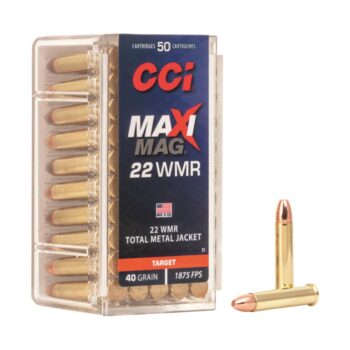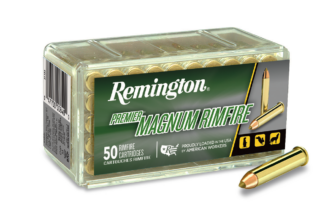
CCI Maxi-Mag, .22 WMR, TMJ, 40 Grain
| Field | Detail |
|---|---|
| Primary Use | Small game hunting, pest control, target shooting |
| Bullet Type | Total Metal Jacket (TMJ) โ fully encapsulated lead core |
| Bullet Weight | 40 grain |
| Case Material | Brass |
| Primer Type | Rimfire |
| Packaging | 50 rounds per box |
| Typical Price | $15.67/box โ $0.31/round |
| Closest Competitors | Winchester Super-X .22 WMR 40 gr JHP, Hornady Critical Defense .22 WMR 45 gr FTX, Federal Game-Shok .22 WMR 50 gr JHP |
Official Specs
| Spec | Value | Source |
|---|---|---|
| Muzzle Velocity (fps) | 1875 | CCI / retailers |
| Muzzle Energy (ft-lbs) | 312 | CCI / retailers |
| Bullet Weight | 40 gr | Manufacturer |
| Bullet Type | Total Metal Jacket (TMJ) | Manufacturer |
| BC G1 | 0.127* | CCI / retailer |
| BC G7 | โ | Not published |
| Manufacturer SKU | 23 | CCI / retailer |
| UPC | 076683000231 | CCI / retailers |
| Reloadable | No | Rimfire โ not reloadable |
Note: CCI does not publish muzzle velocity or muzzle energy for this specific TMJ variant of the Maxi-Mag line in the source data provided. Typical CCI Maxi-Mag 40 gr loads in other configurations (e.g., JHP) are commonly listed at 1,875 fps from a 22″ test barrel, but that figure cannot be applied here without manufacturer confirmation for the TMJ version. The ballistics table below uses a conservative, clearly labeled estimated velocity. BC values are not published by CCI for this product and cannot be assumed.
Ballistics Table
Calculated estimate. Real-world results vary by barrel length, temperature, altitude, and lot. Community submissions will provide measured muzzle velocity for comparison.Estimated muzzle velocity of 1,875 fps used as a working figure based on typical CCI Maxi-Mag 40 gr performance in similar configurations. This has not been confirmed by the manufacturer for this TMJ load. All values marked with ~ are estimates.
Zero: 50 yards | Sight height: 1.5″ above bore | G1 BC estimated: 0.110
| Yards | ~Velocity (fps) | ~Energy (ft-lbs) | ~Trajectory (in) |
|---|---|---|---|
| 0 | ~1,875 | ~312 | -1.5 |
| 25 | ~1,717 | ~262 | +0.5 |
| 50 | ~1,572 | ~220 | 0.0 โ zero |
| 75 | ~1,441 | ~184 | -2.1 |
| 100 | ~1,325 | ~156 | -6.3 |
| 125 | ~1,228 | ~134 | -13.1 |
| 150 | ~1,149 | ~117 | -22.9 |
| 175 | ~1,087 | ~105 | -36.0 |
| 200 | ~1,038 | ~96 | -52.8 |
| 225 | ~997 | ~88 | -73.6 |
| 250 | ~962 | ~82 | -98.8 |
Key takeaway: At a 50-yard zero, this load holds a workable trajectory out to roughly 100 yards before drop becomes a significant practical factor. The TMJ bullet retains velocity reasonably well through 100 yards for a rimfire cartridge, making it effective for small game at typical field distances. Beyond 125 yards, the combination of subsonic transition and increasing drop demands precise holdover knowledge. Shooters using handguns or carbines with shorter barrels should expect meaningfully lower actual velocities than the estimates shown here.
The TMJ Bullet in a Rimfire Context
The Total Metal Jacket construction used in this Maxi-Mag load is less common in the .22 WMR category than hollow point or soft point designs. A TMJ bullet fully encapsulates the lead core โ including the base โ distinguishing it from a standard full metal jacket, which typically leaves the base exposed. This design reduces airborne lead particulate at the firing line, making it a practical choice for indoor ranges where ventilation is a concern.
The tradeoff is terminal performance: a TMJ bullet does not expand upon impact the way a hollow point does. For pest control and varminting, where rapid energy transfer and expansion are often desirable, a JHP variant of the Maxi-Mag may be a more purpose-matched choice. The TMJ load is better positioned as a training and target round that shares the same 40-grain weight as the hunting-oriented loads in the Maxi-Mag line, allowing shooters to practice with functionally similar ballistics before switching to an expanding bullet for field use.
Best Uses
Good fit:
- Indoor range practice where reduced lead exposure at the firing line is a priority
- Plinking and informal target shooting where expansion is not required
- Training with .22 WMR firearms using a load that mirrors the weight and approximate velocity of hunting loads
- Pest control at close to moderate range where penetration rather than expansion is acceptable
- Firearms function testing and break-in where consistent cycling matters more than terminal performance
Not the right tool for:
- Hunting applications where humane, rapid energy transfer requires an expanding bullet
- Varminting at extended range where BC and terminal performance are both critical
- Self-defense use โ non-expanding TMJ construction is not appropriate for defensive applications
- Situations where the shooter needs confirmed, published ballistic data for precision work
Reliability Notes
No structured submissions yet.
Based on manufacturer claims and open-source product information: CCI has a long-standing reputation for consistent rimfire priming, which is one of the most technically demanding aspects of rimfire ammunition production. The Maxi-Mag line is frequently cited in open sources as exhibiting reliable ignition across a range of firearm types, including both rifles and revolvers chambered in .22 WMR. The TMJ construction is noted to feed reliably in semi-automatic platforms due to the smooth, fully enclosed bullet profile. No specific failure-to-feed or ignition complaints have been identified for this load in available open-source data. All reliability characterizations here come from manufacturer claims and general open-source observations โ not structured test data.
Competitors
| Load | Weight | Bullet | BC G1 | Adv. Velocity | Price/box | Notes |
|---|---|---|---|---|---|---|
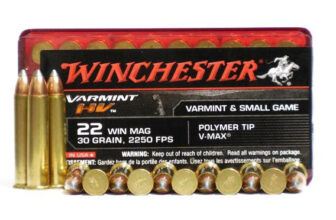
| Winchester Super-X .22 WMR | 40 gr | JHP | ~0.110 | 1,910 fps | ~$14โ$17 | Expanding JHP; better terminal performance for hunting |
| Federal Game-Shok .22 WMR | 50 gr | JHP | ~0.118 | 1,530 fps | ~$13โ$16 | Heavier bullet; lower velocity; better for small game |
| Hornady Critical Defense .22 WMR | 45 gr | FTX | ~0.150 | 1,000 fps (pistol) | ~$18โ$22 | Premium defensive design; higher BC; higher price |
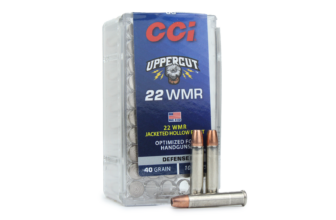
| CCI Maxi-Mag JHP .22 WMR | 40 gr | JHP | ~0.110 | 1,875 fps | ~$14โ$17 | Same line, expanding bullet; preferred for hunting |
| Remington Premier .22 WMR | 33 gr | AccuTip-V | ~0.140 | 2,000 fps | ~$17โ$22 | Lighter, faster; varmint-optimized; premium tier |
| Fiocchi .22 WMR | 40 gr | JHP | ~0.110 | 1,850 fps | ~$12โ$15 | Budget alternative; widely available; expanding bullet |
Fiocchi represents the most direct budget alternative at a similar weight. Hornady Critical Defense is the clearest premium alternative with a published higher BC and purpose-built expanding design. The CCI Maxi-Mag JHP in the same 40-grain weight is the most direct sibling load โ buyers choosing between the two should consider whether TMJ or expanding performance better fits their application.
Price Reality
- At $15.67 per 50-round box, this load runs approximately $0.31 per round
- Case pricing (typically 500 rounds / 10 boxes) is not confirmed in available data; expect approximately $150โ$160 if purchased in case quantity at similar per-box pricing
- The Fiocchi .22 WMR 40 gr JHP is available at roughly $12โ$15/box, making it a lower-cost alternative โ though it uses an expanding bullet rather than TMJ
- Winchester Super-X .22 WMR 40 gr JHP typically runs $14โ$17/box, putting it at near-parity with this CCI load while offering expansion
- The Hornady Critical Defense .22 WMR runs $18โ$22/box, representing a meaningful premium for its FTX expanding design
- $0.31/round is a competitive and fair price point for .22 WMR TMJ ammunition from a major manufacturer; pricing above $0.38/round for this load would represent a premium worth questioning without added value (e.g., bulk discount, free shipping)
Prices change. Check the Where to Buy block for current listings.
Where to Buy
CCI Maxi-Mag, .22 WMR, TMJ, 40 Grain, 50 Rounds
Affiliate links. These do not influence ratings, data, or any editorial content on this page.
FAQ
Why does this Maxi-Mag load use a TMJ bullet instead of a hollow point?
The Total Metal Jacket construction fully encapsulates the lead core, which reduces lead vapor and particulate at the muzzle and firing line โ a meaningful advantage in enclosed or indoor shooting environments. CCI offers the Maxi-Mag line in multiple configurations, and the TMJ variant is positioned as a practice and target load rather than a terminal-performance hunting load. Shooters who want to train with the same platform and approximate ballistics they use in the field can use this TMJ load indoors, then transition to a JHP variant for actual hunting or pest control without significant changes to point of impact at typical ranges.
Is this load suitable for hunting squirrel or rabbit?
The 40-grain TMJ bullet will produce adequate penetration at close range, but it does not expand on impact. For small game hunting where a clean, humane harvest is the goal, an expanding bullet โ such as a hollow point or soft point โ is generally the more appropriate choice. The TMJ design is not optimized for terminal energy transfer. If this is the only .22 WMR load available, it will function, but a JHP load from the same Maxi-Mag line or a comparable competitor would be a better selection for hunting applications.
Can this ammunition be used in a .22 WMR revolver?
Yes. The .22 WMR cartridge is chambered in both rifles and revolvers, and this load is compatible with either platform. Revolvers will typically produce lower muzzle velocities than the 22″ rifle test barrel figures that manufacturers use as reference points โ expect a reduction of roughly 200โ400 fps depending on barrel length. The TMJ bullet profile is also well-suited to revolver cylinder throats, as the fully enclosed base reduces the potential for leading that can occur with exposed-lead-base designs.
How does the TMJ bullet compare to a standard FMJ in this caliber?
In practical terms, the difference between a TMJ and a standard full metal jacket is the base construction. A conventional FMJ leaves the lead base of the bullet exposed, which can contribute to lead fouling in the barrel and lead particulate in the air at the firing line. The TMJ design closes that base with a jacket layer. In .22 WMR applications, this distinction matters most in high-volume shooting sessions or indoor environments. Externally and ballistically, the two designs behave very similarly downrange.
Why isn’t muzzle velocity published for this specific load?
CCI publishes velocity data for many loads in the Maxi-Mag line, but the available product data for this specific TMJ configuration does not include a confirmed muzzle velocity figure. This is not unusual for practice-oriented variants of established lines, where manufacturers sometimes prioritize publishing data for their hunting or defensive configurations. The ballistics table on this page uses a clearly labeled estimated figure based on comparable loads in the same weight class. Until CCI publishes confirmed data or community members submit chronograph results for this load, the estimated figures should be treated as approximations rather than specifications.