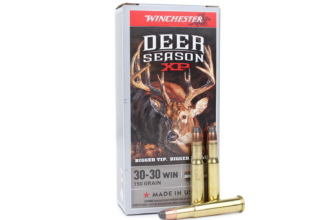
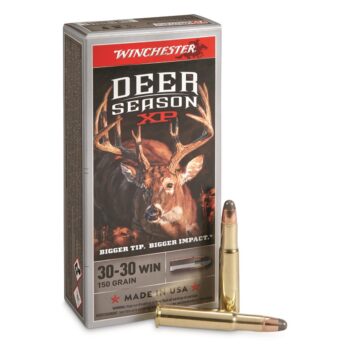
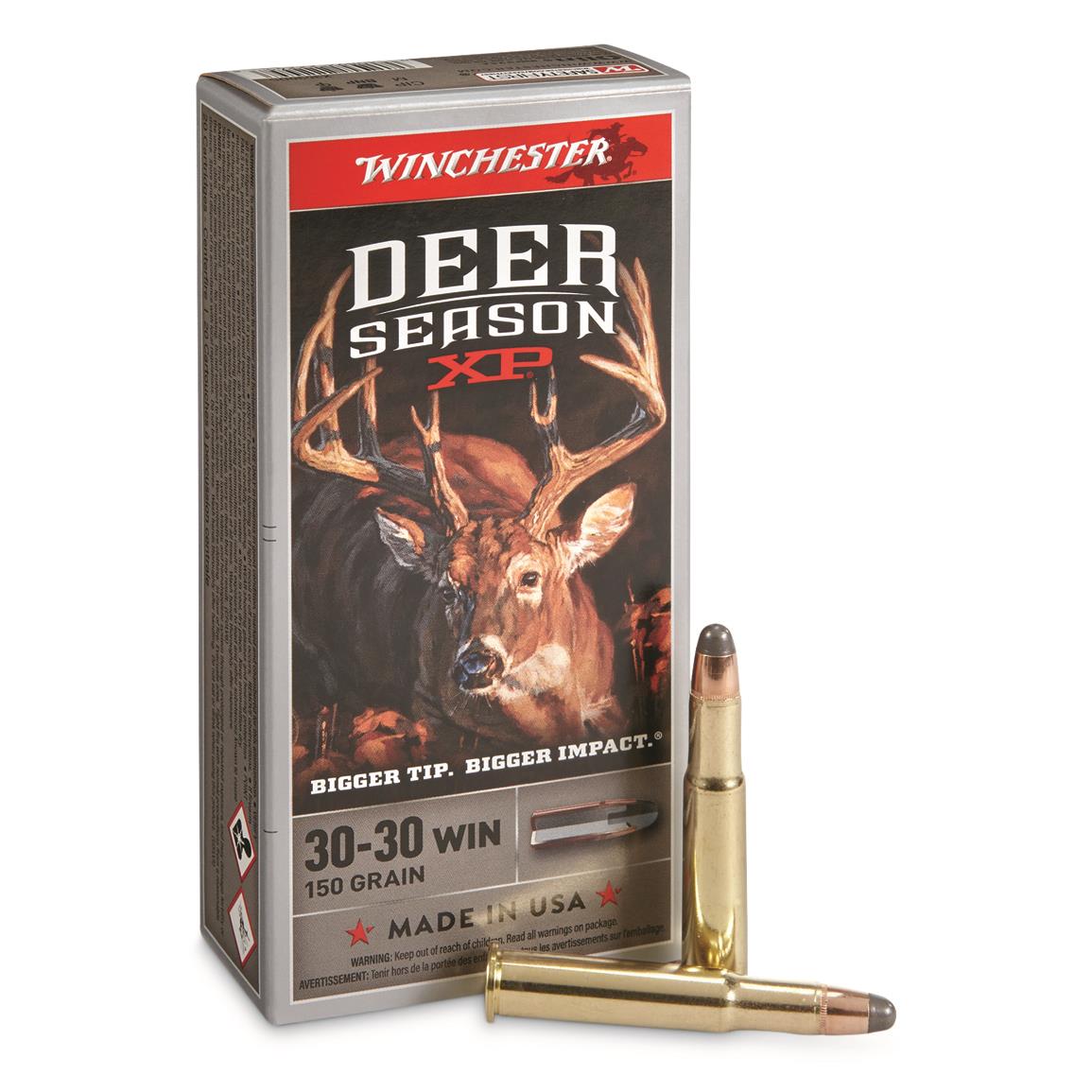
Winchester Deer Season XP, .30-30 Winchester, Polymer-Tipped Extreme Point, 150 Grain
 Ammo Reports Team


| Feature | Detail |
|---|---|
| Primary Use | Whitetail deer hunting |
| Bullet Type | Polymer-Tipped Extreme Point (lead-core with polymer tip) |
| Bullet Weight | 150 grain |
| Case Material | Brass |
| Primer Type | Boxer (factory primer size not verified) |
| Packaging | 20 rounds per box |
| Typical Price | $31.34/box — $1.57/round |
| Closest Competitors | Hornady LEVERevolution 160 gr FTX, Federal Fusion .30-30 150 gr, Remington Core-Lokt .30-30 170 gr PSP |
Official Specs
| Spec | Value | Source |
|---|---|---|
| Muzzle Velocity (fps) | 2320 | Winchester 2026 catalog, p. 31 |
| Muzzle Energy (ft-lbs) | 1792 | Winchester 2026 catalog, p. 31 |
| Bullet Weight | 150 gr | Winchester 2026 catalog, p. 31 |
| Bullet Type | Extreme Point polymer tip | Winchester 2026 catalog, p. 31 |
| BC G1 | 0.215 | Winchester 2026 catalog, p. 31 |
| BC G7 | – | Not found in verified official manufacturer sources |
| Manufacturer SKU | X3030DS | Winchester 2026 catalog, p. 31 |
| UPC | – | Not found in verified official manufacturer sources |
| Reloadable | Yes – brass case | Case/primer construction; exact primer specification unverified |
| Case Material | Brass | Case/primer construction; exact primer specification unverified |
| Primer | Boxer; factory primer size not verified | Case/primer construction; exact primer specification unverified |
Verified factory load: Winchester X3030DS, .30-30 Winchester, 150 gr. Source: Winchester 2026 catalog, p. 31. G7 BC and UPC were not found in the verified official sources. Source discrepancy: the 2026 Winchester catalog lists 2320 fps and 1792 ft-lb; the current online product list lists 2390 fps and 1902 ft-lb. The catalog values are used here. Its published trajectory is reproduced without recalculation; the separate model may differ.

Ballistics Table
Manufacturer data and calculated estimates are separated below. All trajectories shown use a 100-yard zero.
Official manufacturer ballistics. Winchester 2026 catalog, p. 31. Original published distances through 300 yards; unlisted distances are not interpolated. Test barrel: 24 inches. Sight height is not specified in the cited Winchester table.
| Yards | Official velocity (fps) | Official energy (ft-lb) | Official trajectory (in) |
|---|---|---|---|
| 0 | 2320 | 1792 | – |
| 100 | 1951 | 1267 | 0 |
| 200 | 1621 | 875 | -7.2 |
| 300 | 1343 | 601 | -26.9 |
Calculated estimate – not manufacturer data. 0-300 yards, 50-yard increments. G1 point-mass model (py-ballisticcalc); 150 gr, muzzle velocity 2320 fps, G1 BC 0.215, 100-yard zero, sight height 1.5 inches, sea level, 59°F, 29.92 inHg, 0% humidity, no wind. Sight height is an explicitly assumed model input. Actual results vary with firearm, ammunition lot and conditions.
| Yards | Calculated velocity (fps) | Calculated energy (ft-lb) | Calculated trajectory (in) |
|---|---|---|---|
| 0 | 2320 | 1793 | -1.5 |
| 50 | 2128 | 1508 | 0.2 |
| 100 | 1945 | 1260 | -0.0 |
| 150 | 1772 | 1046 | -2.5 |
| 200 | 1611 | 864 | -7.8 |
| 250 | 1463 | 713 | -16.5 |
| 300 | 1331 | 590 | -29.2 |
Key takeaway: The manufacturer table and the 50-yard model serve different purposes and should not be treated as interchangeable measurements. Energy alone does not establish a guaranteed hunting range or terminal performance.
The Extreme Point Bullet and Why It Matters for .30-30
The .30-30 version must be identified by its exact factory SKU. Its tip geometry and magazine compatibility must not be inferred from other bullets in the product family or from Hornady FTX. Follow the firearm manual and the ammunition manufacturer’s instructions for tubular-magazine use.
The oversized polymer tip drives into the lead core on impact, accelerating the expansion of the copper jacket and producing a wider wound channel than a conventional soft-point at similar velocities. This is a meaningful engineering distinction for hunters who want the ballistic advantages of a tipped bullet without abandoning the lever-action platform. The .30-30 Winchester has harvested more North American whitetail deer than arguably any other cartridge, and the Deer Season XP load is a direct attempt to modernize that legacy without requiring hunters to change rifles.
Best Uses
Good fit:
- Whitetail deer hunting at ranges under 175 yards in wooded or brushy terrain
- Lever-action rifles with tubular magazines (the polymer tip is specifically safe for this application)
- Hunters seeking faster expansion than traditional flat-nose soft-point .30-30 loads
- Short-range hunting situations from treestands, blinds, or dense cover where shot distances are predictable
- Hunters transitioning from older .30-30 loads who want a modern tipped bullet without changing platforms
Not the right tool for:
- Shots beyond 200 yards, where the moderate ballistic coefficient of .30-30 projectiles results in significant drop and velocity loss
- Elk or large bear hunting — the .30-30 cartridge as a whole is generally considered marginal for animals significantly larger than deer
- Varmint or target shooting — this is a purpose-built deer hunting load priced accordingly
- Jurisdictions that prohibit lead-core projectiles — this is a lead-core bullet and is not legal for hunting in California or other areas with lead restrictions
- Semi-automatic or bolt-action rifles where a standard spitzer-tipped bullet would be a better choice ballistically
Reliability Notes
No structured submissions yet.
Based on manufacturer claims and open-source information, the Deer Season XP line is described by Winchester as producing a large-diameter mushroom on impact due to the oversized polymer tip initiating expansion. Winchester markets the line specifically for deer hunters who want consistent terminal performance across a range of shot distances and angles. No active recalls or safety notices have been identified for this load at time of writing. Open-source hunting forum discussions generally indicate consistent feeding and extraction in lever-action rifles, which is expected given the .30-30’s long manufacturing history. All notes here reflect manufacturer claims or open-source community observations, not structured chronograph or terminal performance data.
Competitors
| Load | Weight | Bullet | BC G1 | Adv. Velocity | Price/box | Notes |
|---|---|---|---|---|---|---|
| Hornady LEVERevolution .30-30 | 160 gr | FTX (Flex Tip) | 0.330 | 2400 fps | ~$32–$36 | Manufacturer reference: 82730. |
| Federal Fusion .30-30 | 150 gr | Fusion bonded SP | 0.268 | 2390 fps | ~$28–$33 | Manufacturer reference: F3030FS1. |
| Remington Core-Lokt .30-30 | 170 gr | PSP (Pointed Soft Point) | – | – | ~$22–$28 | Exact factory identity/specifications not verified. Original price estimate is not verified. |
| Winchester Power-Point .30-30 | 150 gr | Power-Point SP | 0.218 | 2390 fps | ~$24–$29 | Manufacturer reference: X30306. |
| Browning BXR .30-30 | 140 gr | Matrix Tip | – | – | ~$29–$34 | Exact factory identity/specifications not verified. Original price estimate is not verified. |
| HSM Trophy Gold .30-30 | 150 gr | Ballistic Tip | – | – | ~$34–$42 | Exact factory identity/specifications not verified. Original price estimate is not verified. |
Price Reality
- Typical retail price: $28–$35 per 20-round box depending on retailer and market conditions; the reference price here is $31.34/box
- Per-round cost: approximately $1.57/round at the reference price
- Remington Core-Lokt in .30-30 typically runs $5–$10 less per box, making it the clear budget baseline for this caliber
- Hornady LEVERevolution typically runs $1–$5 more per box and is the primary premium competitor; the price gap is narrow enough that the choice generally comes down to bullet design preference rather than cost
- Federal Fusion sits in roughly the same price tier as the Deer Season XP, making those two loads direct value comparisons
- A price above $38–$40 per box for this load should be considered overpriced under normal market conditions; at that point Hornady LEVERevolution becomes a better value proposition
Prices change. Check the Where to Buy block for current listings.
Where to Buy
Winchester Deer Season XP, .30-30 Winchester, Polymer-Tipped Extreme Point, 150 Grain, 20 Rounds
Affiliate links. These do not influence ratings, data, or any editorial content on this page.
FAQ
Is the Winchester Deer Season XP .30-30 150 gr safe to use in tubular-magazine lever-action rifles?
This review concerns the exact .30-30 Winchester factory load identified in Official Specs. Follow the firearm manual and the ammunition manufacturer’s compatibility instructions for tubular magazines. Bullet-tip material alone does not prove magazine compatibility; this conclusion must not be generalized to other tipped bullets or other calibers.
How does this load compare to Hornady LEVERevolution 160 gr FTX for deer hunting?
This load’s verified specifications are 150 gr, 2320 fps and G1 BC 0.215. Compare factory tables only when their zero and test conditions are stated. The Ballistics Table separates published manufacturer values from the 50-yard calculated model; it does not establish comparative terminal performance.
Is this ammunition legal for deer hunting in California or other lead-restricted states?
No. The Deer Season XP Extreme Point uses a lead-core bullet and is therefore not compliant with California’s Ingestion Lead Regulations, which require non-lead projectiles for all hunting on California state and federal lands. Hunters in California or other jurisdictions with similar restrictions should look at lead-free alternatives such as the Federal Trophy Copper or Barnes VOR-TX lines in .30-30. Always verify current regulations with your state wildlife agency before purchasing ammunition for a specific hunt.
What kind of terminal performance should I expect from the 150 gr Extreme Point on whitetail deer?
Winchester’s design goal with the Extreme Point is to produce a large-diameter mushroom rapidly upon impact, creating a wide wound channel through the vitals. The oversized polymer tip is intended to initiate expansion even at the reduced velocities typical of .30-30 at 100–150 yards, where standard soft-points can sometimes under-expand. For broadside or quartering-away shots on deer-sized animals within 150 yards, the load should perform as intended. No structured terminal performance data from independent ballistic gelatin testing is currently available for this specific load on this page; that section will be updated as community submissions are received.
Can this ammunition be used in a .30-30 bolt-action or single-shot rifle, or is it lever-action only?
The Deer Season XP will function in any firearm chambered in .30-30 Winchester, including bolt-action, single-shot, and lever-action platforms. The polymer tip is specifically safe for tubular magazines, but there is no disadvantage to using it in a box-magazine or single-shot action. Hunters using a bolt-action .30-30 might also consider standard spitzer-tipped loads, which can offer higher ballistic coefficients, but the Deer Season XP is a fully functional and appropriate choice regardless of action type.