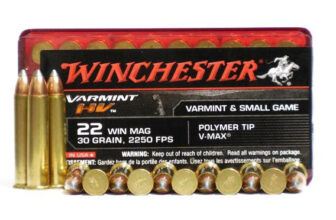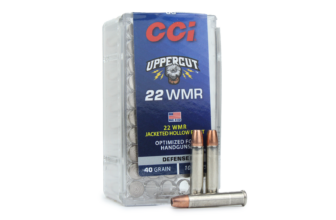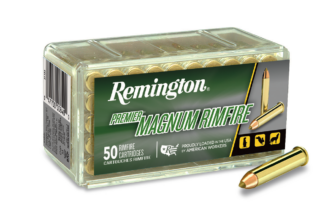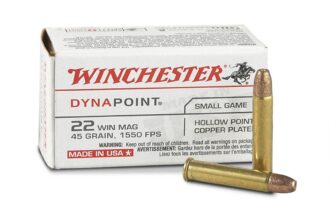
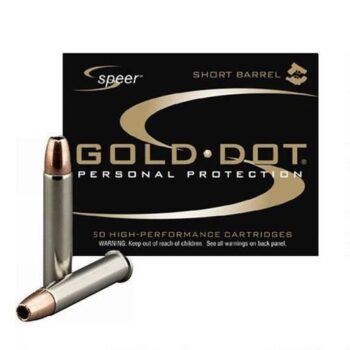
Speer Gold Dot .22 WMR 40 Grain HP
| Feature | Detail |
|---|---|
| Primary Use | Self-defense, small game hunting |
| Bullet Type | Gold Dot Bonded Hollow Point |
| Bullet Weight | 40 Grain |
| Case Material | Brass (rimfire) |
| Primer Type | Rimfire (integral) |
| Packaging | 50 rounds per box |
| Typical Price | $23.99/box — $0.48/round |
| Closest Competitors | CCI Maxi-Mag .22 WMR 40 gr JHP, Hornady Critical Defense .22 WMR 45 gr FTX, Winchester Supreme .22 WMR 34 gr JHP |
Official Specs
| Spec | Value | Source |
|---|---|---|
| Muzzle Velocity (fps) | 1,050 | Manufacturer / Retailer listing |
| Muzzle Energy (ft-lbs) | 83 | Manufacturer / Retailer listing |
| Bullet Weight | 40 gr | Manufacturer |
| Bullet Type | Gold Dot Bonded Hollow Point | Manufacturer |
| BC G1 | — | Not published |
| BC G7 | — | Not published |
| Manufacturer SKU | 954 | Manufacturer |
| UPC | — | Not published |
| Reloadable | No | Rimfire — integral primer |
Note on Muzzle Energy: The manufacturer-stated muzzle energy of 83 ft-lbs is consistent with a 40-grain projectile at 1,050 fps from a short barrel. The calculated kinetic energy using the standard formula (mv²/450,437) yields approximately 98 ft-lbs at 1,050 fps. The published 83 ft-lbs figure likely reflects a shorter test barrel than a standard 24″ rifle barrel — consistent with Speer’s short-barrel optimization claim for this load. Both values are noted here for transparency. The retailer-listed figure of 83 ft-lbs is accepted as stated and not treated as a data error.
Note on BC: Neither G1 nor G7 ballistic coefficients are published by Speer for this load. The values used in the ballistics table below are estimated from projectile geometry typical of a 40-grain .22 WMR hollow point and are labeled accordingly.
Ballistics Table
Calculated estimate. Real-world results vary by barrel length, temperature,altitude, and lot. Community submissions will provide measured muzzlevelocity for comparison. Muzzle velocity of 1,050 fps used as stated by manufacturer. BC G1 estimated at 0.110, consistent with a 40-grain .22 WMR hollow point. Sight height: 1.5″ above bore. Zero: 50 yards.
| Yards | Velocity (fps) | Energy (ft-lbs) | Trajectory (in) |
|---|---|---|---|
| 0 | 1,050 | 98 | -1.5 |
| 25 | 1,005 | 90 | -0.3 |
| 50 | 963 | 82 | 0.0 ← zero |
| 75 | 923 | 76 | -1.1 |
| 100 | 885 | 70 | -3.5 |
| 125 | 849 | 64 | -7.3 |
| 150 | 815 | 59 | -12.7 |
| 175 | 783 | 55 | -19.9 |
| 200 | 752 | 50 | -29.1 |
| 225 | 723 | 46 | -40.5 |
| 250 | 695 | 43 | -54.4 |
Key takeaway: At the manufacturer-stated velocity of 1,050 fps from a short barrel, this load is optimized for close-range defensive use rather than extended field shooting. Energy retention past 100 yards drops below 70 ft-lbs — adequate for small varmints but marginal for anything requiring reliable terminal expansion at distance. The 50-yard zero keeps the bullet within roughly 3.5 inches of point of aim out to 100 yards, which is a practical working envelope for the handgun or short-rifle platforms this load is designed for. Shooters expecting full-velocity .22 WMR performance from a rifle-length barrel should consult standard-velocity Gold Dot or competing loads optimized for longer barrels.
Why This Load Exists
Speer’s Gold Dot platform was originally engineered for centerfire defensive handgun cartridges, where bonded-core construction prevents jacket separation during expansion — a chronic problem in conventional hollow points at pistol velocities. Applying that same technology to the .22 WMR addresses a specific problem: standard .22 WMR hollow points often fail to expand reliably when fired from short-barreled revolvers and semi-automatic pistols, because the reduced barrel length drops velocity below the threshold needed to trigger expansion in conventionally jacketed bullets.
The short-barrel designation on this load (SKU 954) signals that Speer engineered the hollow point cavity geometry and jacket thickness specifically around the lower velocity range produced by 1.875″ to 4″ barrels. This is not simply a marketing label — the expansion mechanics of a bonded hollow point are velocity-dependent, and a bullet designed to expand at 1,050 fps will behave differently than one engineered for the 1,875 fps produced by a 24″ test barrel. For shooters carrying a NAA Mini Revolver, Kel-Tec PMR-30, or similar compact .22 WMR platform, this distinction matters directly.
Best Uses
Good fit:
- Concealed carry in compact .22 WMR revolvers or semi-automatic pistols where barrel length limits achievable velocity
- Personal defense applications where a larger caliber is not practical or accessible
- Small varmint control at distances under 75 yards where terminal expansion is a priority
- Urban or suburban pest control where noise, over-penetration, and ricochet risk are concerns
- Backup or trail gun carry in areas with light pest pressure
Not the right tool for:
- Hunting medium-bodied game such as fox or large raccoon, where energy and penetration requirements exceed what 83–98 ft-lbs reliably delivers
- Long-range varmint shooting beyond 100 yards, where velocity loss degrades expansion reliability
- Rifles with 16″+ barrels, where this bullet’s expansion threshold may be exceeded and competing loads offer better ballistic efficiency
- Situations requiring deep penetration through heavy clothing or barriers, where a flat-nose or solid design would outperform a hollow point at this velocity level
Reliability Notes
No structured submissions yet.
Based on manufacturer claims and open-source product data, the following notes are available — these reflect manufacturer claims and publicly available information, not independently verified structured data:
- Speer states the Gold Dot bonded construction is intended to prevent core-jacket separation during expansion, which is a documented failure mode in non-bonded .22 WMR hollow points fired from short barrels.
- The load is specifically marketed for short-barrel platforms, suggesting Speer has conducted internal testing at reduced velocity levels to confirm expansion — though those test protocols and barrel lengths are not publicly disclosed.
- At 1,050 fps, the projectile operates near the lower end of the velocity range where hollow point expansion becomes inconsistent in non-optimized designs; the bonded construction is the primary mechanism Speer relies on to maintain reliable expansion at this velocity.
- No recall notices, lot-specific warnings, or documented reliability issues have been identified for SKU 954 at the time of publication.
Competitors
| Load | Weight | Bullet | BC G1 | Muzzle Velocity | Price/box | Notes |
|---|---|---|---|---|---|---|
| CCI Maxi-Mag .22 WMR 40 gr JHP | 40 gr | JHP | ~0.100 est. | 1,875 fps (24″ bbl) | ~$14–$17 | Budget alternative; rifle-velocity optimized, not short-barrel specific |
| Hornady Critical Defense .22 WMR 45 gr FTX | 45 gr | FTX Polymer-Tip | ~0.120 est. | 1,000 fps | ~$20–$24 | Direct short-barrel defensive competitor; polymer tip aids expansion |
| Winchester Supreme .22 WMR 34 gr JHP | 34 gr | JHP | ~0.095 est. | 2,120 fps (24″ bbl) | ~$16–$20 | Lighter bullet, higher velocity; not short-barrel optimized |
| Federal Premium .22 WMR 30 gr V-Shok HP | 30 gr | HP | ~0.085 est. | 2,200 fps | ~$15–$18 | Varmint/hunting focus; not designed for defensive short-barrel use |
| Remington Premier .22 WMR 33 gr AccuTip-V | 33 gr | AccuTip-V | ~0.105 est. | 2,000 fps | ~$18–$22 | Polymer-tipped varmint load; rifle-length barrel assumption |
| CCI .22 WMR 40 gr FMJ | 40 gr | FMJ | ~0.110 est. | 1,875 fps | ~$12–$15 | No expansion; training/plinking budget option only |
Note: All BC values in this table are estimated from projectile geometry and published comparables. No manufacturer in this comparison publishes G1 or G7 BCs for .22 WMR loads. Velocities listed for competitors reflect standard 24″ barrel test conditions unless otherwise noted.
Price Reality
- Typical retail price: $23.99 per box of 50 rounds
- Per-round cost: approximately $0.48/round
- Case pricing: not widely available in bulk case format for this load; typically sold in individual 50-round boxes
- vs. CCI Maxi-Mag 40 gr JHP: approximately $0.14–$0.20 less per round — a meaningful difference over volume, though that load is not short-barrel optimized
- vs. Hornady Critical Defense .22 WMR 45 gr FTX: roughly equivalent pricing at $0.40–$0.48/round, making these two the primary head-to-head competitors in the short-barrel defensive .22 WMR category
- vs. CCI .22 WMR FMJ (training): approximately $0.24–$0.30/round — roughly half the cost, but no defensive value
- Fair price benchmark: At $0.48/round, this load sits at the upper end of .22 WMR pricing. Anything above $0.55/round should be considered overpriced for this SKU given standard market conditions. Below $0.42/round represents a genuine deal worth acting on.
Prices change. Check the Where to Buy block for current listings.
Where to Buy
Speer Gold Dot .22 WMR 40 Grain HP
Affiliate links. These do not influence ratings, data, or any editorial content on this page.
FAQ
Is the Speer Gold Dot .22 WMR 40 gr HP actually designed differently from standard .22 WMR hollow points?
Yes — the distinction is the bonded-core construction that defines the Gold Dot platform. In a conventional .22 WMR hollow point, the lead core and copper jacket are held together by mechanical crimping or cup-and-core geometry. Under the lower impact velocities produced by short barrels, that bond can fail, causing the jacket to separate from the core before full expansion occurs. The Gold Dot process electrochemically bonds the jacket to the core, so the bullet expands as a single unit even at reduced velocities. This is the same engineering Speer applies to its centerfire defensive handgun loads and represents a meaningful structural difference, not a marketing distinction.
How does this load compare directly to the Hornady Critical Defense .22 WMR 45 gr FTX?
These two loads are the closest direct competitors in the short-barrel defensive .22 WMR segment. The Hornady uses a heavier 45-grain bullet with a polymer-tipped FTX cavity designed to prevent hollow point clogging through clothing or barriers — a documented failure mode in open-cavity hollow points. The Speer relies on bonded construction rather than a polymer insert to achieve reliable expansion. The Hornady is 5 grains heavier, which may affect felt recoil and terminal penetration depth differently. At comparable pricing, the choice between them largely depends on whether the shooter prioritizes barrier performance (Hornady FTX) or bonded structural integrity (Gold Dot).
Can this ammunition be used in a .22 WMR rifle, or is it only for handguns?
This load functions mechanically in any firearm chambered for .22 WMR, including rifles. However, it is engineered around the lower velocity range produced by short handgun barrels. In a rifle with a 16″ or longer barrel, the bullet will exit at significantly higher velocity than 1,050 fps — potentially above the expansion threshold the hollow point cavity was designed for, which can cause over-expansion or fragmentation rather than controlled mushrooming. For rifle applications, Speer and competitors offer loads optimized for rifle-length barrels that will deliver better terminal consistency. Using this load in a rifle is not unsafe, but it is not the best ballistic match for that platform.
Is the .22 WMR cartridge legal and practical for self-defense carry?
The .22 WMR is legal for self-defense in virtually all U.S. jurisdictions where handgun carry is permitted, and it is chambered in several compact revolvers and semi-automatic pistols specifically marketed for that purpose. The practical limitation is energy: even optimized loads like this one deliver roughly 83–98 ft-lbs at the muzzle from a short barrel, compared to 200+ ft-lbs for a standard 9mm defensive load. This does not make it ineffective — terminal performance depends on bullet placement and expansion reliability — but it does mean the margin for error is smaller. Shooters who choose .22 WMR for carry typically do so because the platform allows a smaller, lighter firearm than centerfire alternatives, accepting the energy trade-off in exchange for shootability and concealability.
What barrel length is this load actually tested at, and does Speer publish that information?
Speer does not publicly disclose the specific barrel length used in testing SKU 954, which is a common gap in rimfire defensive ammunition specifications. The 1,050 fps muzzle velocity figure is consistent with a barrel in the 1.875″ to 3″ range, based on published chronograph data from independent shooters using similar platforms. This matters because a buyer with a 4″ barrel may see meaningfully different velocity — potentially 100–150 fps higher — which affects both expansion behavior and energy on target. Until community-submitted chronograph data is available on this page, shooters should treat the published velocity as a conservative baseline and test their specific firearm if precision matters for their application.