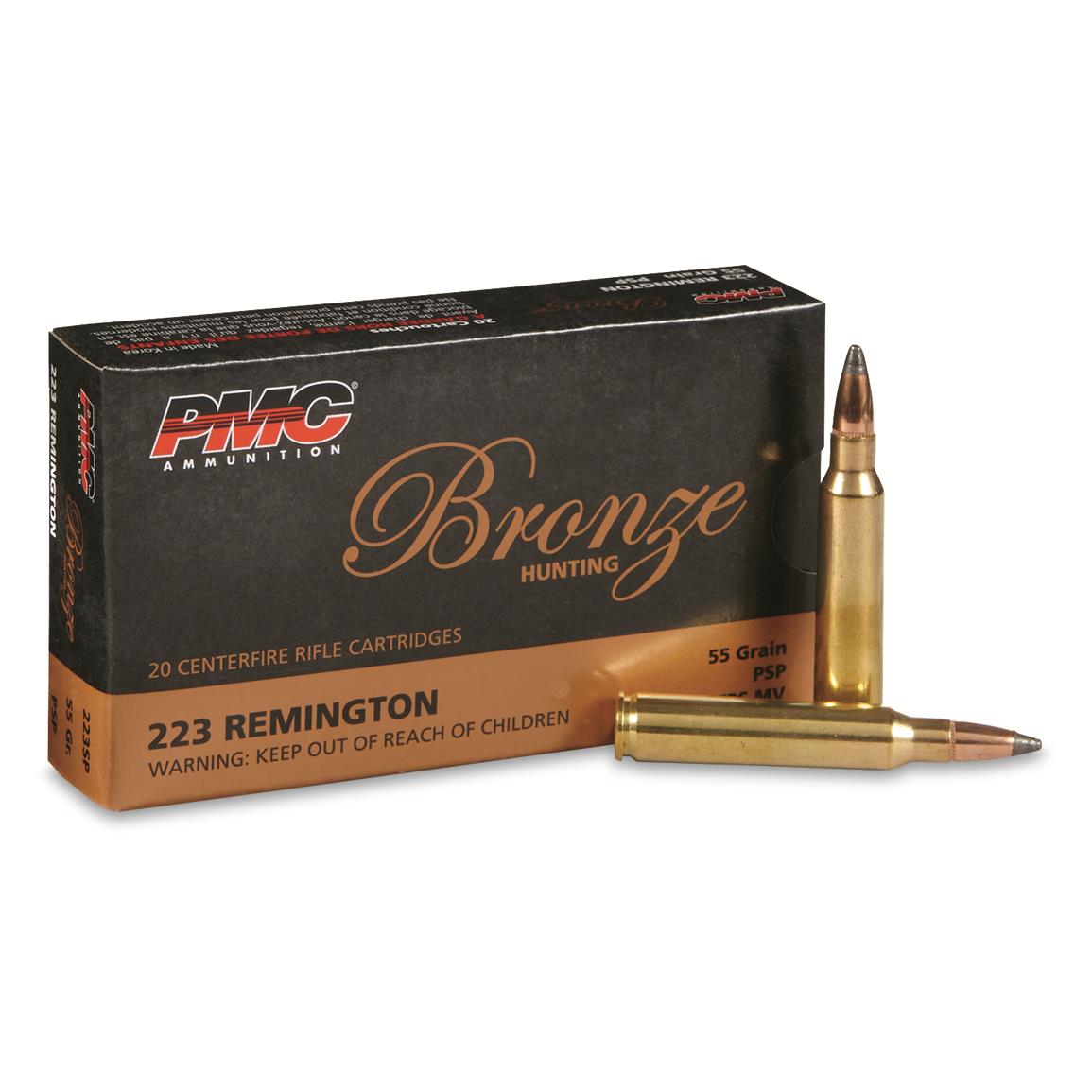
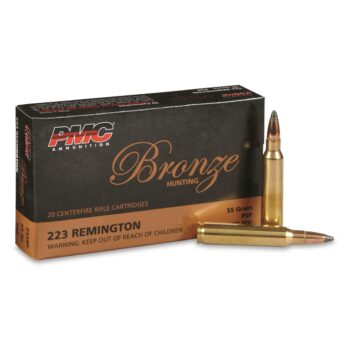
PMC Bronze, .223 Remington, PSP, 55 Grain
| Field | Detail |
|---|---|
| Primary Use | Target shooting, small game hunting, varmint control |
| Bullet Type | Pointed Soft Point (PSP) โ jacketed lead-core soft point with exposed tip |
| Bullet Weight | 55 grain |
| Case Material | Brass |
| Primer Type | Boxer |
| Packaging | 20 rounds per box |
| Typical Price | $13.29/box โ $0.66/round |
| Closest Competitors | Federal American Eagle .223 Rem 55gr SP, Hornady American Whitetail .223 Rem 55gr SP, Winchester Super-X .223 Rem 55gr PSP |
Official Specs
| Spec | Value | Source |
|---|---|---|
| Muzzle Velocity (fps) | โ | Not published by PMC for this SKU |
| Muzzle Energy (ft-lbs) | โ | Not published by PMC for this SKU |
| Bullet Weight | 55 gr | Manufacturer |
| Bullet Type | Pointed Soft Point (PSP) | Manufacturer |
| BC G1 | โ | Not published |
| BC G7 | โ | Not published |
| Manufacturer SKU | 223A | Manufacturer (standard PMC Bronze .223 55gr PSP SKU) |
| UPC | โ | Not confirmed from available data |
| Reloadable | Yes | Brass case, Boxer primer |
Note on missing velocity and energy: PMC does not publish muzzle velocity or muzzle energy data for this specific load on its U.S. product pages as of the time of this writing. This is a known documentation gap in PMC’s Bronze line for some SKUs. The ballistics table below uses an industry-standard estimate for a 55 gr .223 PSP load from a 24-inch test barrel (~3,240 fps), consistent with comparable loads from other manufacturers. All calculated values are clearly labeled.
Note on BC: PMC does not publish ballistic coefficient data for Bronze-line projectiles. The PSP bullet used in this load is a conventional jacketed soft point, not a high-BC match projectile. Estimated G1 BC for a 55 gr .223 PSP is approximately 0.267โ0.270, consistent with similar bullets from other manufacturers, but no manufacturer-confirmed value is available and none is used in the calculations below.
Ballistics Table
Calculated estimate. Real-world results vary by barrel length, temperature, altitude, and lot. Community submissions will provide measured muzzle velocity for comparison.
Calculation basis: 55 gr PSP, estimated G1 BC 0.268, estimated muzzle velocity 3,240 fps (24-inch barrel standard), sight height 1.5 inches above bore, 100-yard zero, sea level, standard atmosphere.
| Yards | Velocity (fps) | Energy (ft-lbs) | Trajectory (in) |
|---|---|---|---|
| 0 | ~3,240 | ~1,282 | -1.5 |
| 100 | ~2,954 | ~1,065 | 0.0 โ zero |
| 200 | ~2,681 | ~877 | -3.9 |
| 300 | ~2,421 | ~715 | -14.7 |
| 400 | ~2,174 | ~577 | -34.3 |
| 500 | ~1,941 | ~460 | -65.8 |
Key takeaway: At a 100-yard zero, this load remains relatively flat to approximately 200 yards, making it practical for varmint shooting and small game at common field distances without holdover. By 300 yards, nearly 15 inches of drop must be accounted for, which limits precise field use beyond that range without confirmed data and a dialed scope. The PSP bullet design is not optimized for long-range ballistic efficiency, so wind drift and velocity retention at 400โ500 yards are meaningfully inferior to higher-BC projectiles. For the intended use cases โ ranges inside 250 yards โ the trajectory is entirely manageable.
The PMC Bronze PSP Bullet
The Pointed Soft Point projectile used in this load occupies a specific design niche that is worth understanding. Unlike a full metal jacket, the PSP exposes a soft lead tip at the nose, which initiates controlled expansion upon impact with soft tissue or game. Unlike a hollow point, the pointed profile reduces aerodynamic drag compared to a flat or open cavity nose, providing a modest ballistic advantage over standard round-nose soft points while still delivering terminal deformation.
PMC sources its Bronze-line components from its own Korean manufacturing operation, which produces both the brass cases and projectiles in-house. The PSP bullet in this load is a conventional cup-and-core construction โ a lead core enclosed in a gilding metal jacket, with the jacket left open at the tip. This construction is well-established and predictable, though it does not include bonding, partitioning, or polymer tipping. For small game and varmint hunting at moderate distances, this is entirely appropriate. For larger game or deep-penetration requirements, the unbonded core limits performance, and this load is not positioned for that role.
The .223 Remington chambering with a 55 grain PSP also has a relevant legal dimension in some jurisdictions: several U.S. states prohibit or restrict the use of .223/5.56 for deer-sized game due to minimum caliber or energy thresholds. Buyers should verify local hunting regulations before using this load on any game animal.
Best Uses
Good fit:
- Prairie dog, ground squirrel, and varmint shooting at distances inside 250 yards
- Small game hunting where soft-point terminal performance is preferred over FMJ
- Plinking and informal target shooting where a soft-point load is acceptable or preferred over FMJ
- Training with a hunting-configured AR-15 or bolt-action .223 to replicate the weight and profile of a field load
- Situations where reloadable brass recovery is a priority and FMJ is not required
Not the right tool for:
- Precision long-range target competition, where match-grade hollow point boat tail bullets with published BC data are required
- Jurisdictions or ranges that prohibit soft-point or expanding ammunition (some indoor ranges restrict to FMJ only)
- Deer or larger game hunting, where the .223 caliber itself is legally prohibited in many states and the unbonded PSP construction may not provide adequate penetration
- Situations requiring published, verified ballistic data for external ballistics calculators, since PMC does not publish velocity or BC for this load
- Military or duty use, where FMJ is the standard and expanding projectiles are not appropriate
Reliability Notes
No structured submissions yet.
From manufacturer claims and open sources: PMC’s Bronze line has a long production history and is manufactured at PMC’s own facility in South Korea, which produces components to consistent dimensional tolerances. The brass cases are noted in open-source user reports as being of acceptable quality for reloading, with normal case life reported. Primer seating and crimp are described in general terms as consistent with standard commercial production. No specific failure modes โ such as misfires, case separations, or pressure anomalies โ are documented in publicly available sources for this load. These observations come from open sources and manufacturer background material, not structured test data.
Competitors
| Load | Weight | Bullet | BC G1 | Adv. Velocity | Price/box | Notes |
|---|---|---|---|---|---|---|
| Federal American Eagle .223 Rem 55gr SP | 55 gr | Soft Point | ~0.267 | ~3,240 fps | ~$12โ$14 | Budget tier; similar construction; widely available |
| Winchester Super-X .223 Rem 55gr PSP | 55 gr | Power-Point PSP | ~0.267 | ~3,240 fps | ~$14โ$17 | Same bullet class; Winchester’s established hunting line |
| Hornady American Whitetail .223 Rem 55gr SP | 55 gr | InterLock SP | ~0.267 | ~3,240 fps | ~$15โ$18 | InterLock ring adds some core-jacket retention; hunting-focused |
| Remington Core-Lokt .223 Rem 55gr PSP | 55 gr | Core-Lokt PSP | ~0.267 | ~3,240 fps | ~$15โ$19 | Core-Lokt bonding provides better retained weight; premium option |
| Federal Fusion .223 Rem 62gr | 62 gr | Fusion bonded SP | ~0.310 | ~3,020 fps | ~$18โ$22 | Premium bonded bullet; heavier; better for larger varmints |
| Fiocchi .223 Rem 55gr PSP | 55 gr | PSP | ~0.267 | ~3,240 fps | ~$12โ$14 | Budget alternative; Italian manufacture; similar spec profile |
Price Reality
- At $13.29 per box of 20, this load prices out at approximately $0.66 per round at typical retail.
- Case pricing (typically 500 or 1,000 rounds) is not confirmed from available data for this specific SKU; bulk pricing through distributors generally reduces per-round cost meaningfully.
- Federal American Eagle 55gr SP is a direct budget competitor at approximately $0.60โ$0.70 per round, making the PMC Bronze competitively positioned.
- Fiocchi 55gr PSP runs similarly at $0.60โ$0.65 per round and represents the closest budget alternative at this price tier.
- Premium bonded options such as Remington Core-Lokt or Federal Fusion run $0.75โ$1.10 per round, reflecting the added manufacturing cost of bonded or controlled-expansion designs.
- Fair price benchmark: At $0.66/round, this load is reasonably priced for a brass-cased, reloadable soft-point .223 load. Paying more than $0.80/round for this specific load at standard retail quantities would represent an above-market price unless supply conditions are unusual.
Prices change. Check the Where to Buy block for current listings.
Where to Buy
PMC Bronze, .223 Remington, PSP, 55 Grain, 20 Rounds
Affiliate links. These do not influence ratings, data, or any editorial content on this page.
FAQ
Is the PMC Bronze 55gr PSP legal for deer hunting in .223 Remington?
The answer depends entirely on your state’s hunting regulations, not on the ammunition itself. Many U.S. states prohibit .223 Remington or 5.56mm for deer-sized game due to minimum caliber, bullet diameter, or minimum energy requirements at a specified distance. In states where .223 is legal for deer, a soft-point bullet like the PSP is generally required or preferred over FMJ, and this load would meet that bullet-type requirement. However, the unbonded cup-and-core PSP construction may not provide the deep penetration and retained weight that bonded designs offer on larger game. Always verify your state regulations and consider a heavier, bonded .223 load if deer hunting is the intended application.
How does the PMC Bronze PSP differ from the PMC Bronze FMJ-BT in the same caliber and weight?
The primary difference is terminal performance. The FMJ-BT (Full Metal Jacket Boat Tail) is a closed-tip bullet that does not expand on impact, making it appropriate for target shooting and practice but generally prohibited for hunting in most jurisdictions. The PSP (Pointed Soft Point) exposes a lead tip that deforms and expands upon impact with soft tissue, making it suitable for hunting applications. Both bullets weigh 55 grains and are loaded in .223 Remington, so external ballistics at typical field distances are broadly similar. The PSP is the correct choice when terminal expansion is needed; the FMJ-BT is the correct choice for high-volume range use where cost per round and range rules are the priority.
Does PMC Bronze .223 55gr PSP work reliably in AR-15 platforms with standard 1:9 twist barrels?
A 1:9 twist rate is generally considered the practical minimum for stabilizing a 55 grain .223 projectile, and this load falls squarely within that compatibility range. The 55 grain PSP should stabilize reliably in 1:9, 1:8, and 1:7 twist barrels. Feeding reliability in semi-automatic platforms is not documented through structured testing for this specific load, but the conventional pointed soft-point profile is a standard shape that feeds reliably in most AR-15 magazine and chamber configurations. Shooters using rifles with 1:12 twist barrels โ an older configuration โ may experience marginal stability with 55 grain bullets at lower velocities from shorter barrels.
What small game is this load appropriate for, and at what distances?
The 55 grain PSP is well-matched to varmints and small game in the prairie dog, ground squirrel, fox, and coyote size range. At distances inside 200 yards, velocity is sufficient to ensure reliable soft-point expansion, which produces rapid energy transfer and clean terminal performance on animals in that size class. Beyond 250 yards, declining velocity may reduce expansion reliability, depending on impact velocity thresholds for this specific bullet construction โ which PMC does not publish. For coyote-sized game at moderate distances, this load is a practical choice. For animals smaller than a prairie dog, the .223 may produce excessive tissue damage; for animals larger than a coyote, a heavier or bonded bullet in a larger caliber is more appropriate.
Is the brass in PMC Bronze .223 worth saving for reloading?
PMC Bronze-line brass is Boxer-primed and made from brass alloy at PMC’s own facility, making it technically reloadable. Open-source reports from handloaders generally describe PMC brass as dimensionally consistent and serviceable for multiple reloading cycles, though it is not considered equivalent to premium brass from manufacturers such as Lapua or Norma. For high-volume practice reloading where cost efficiency matters more than absolute precision, PMC brass is a reasonable choice to retain. This page covers factory ammunition only and does not include reloading data; the note here is limited to confirming the brass is reloadable by design.