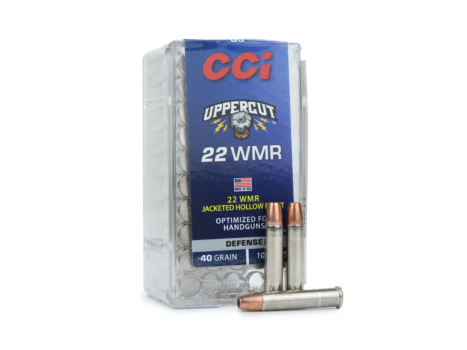
CCI Uppercut 22 WMR 40 Gr JHP
| Feature | Detail |
|---|---|
| Primary Use | Personal defense / concealed carry |
| Bullet Type | Jacketed Hollow Point with nose skiving (skived JHP) |
| Bullet Weight | 40 gr |
| Case Material | Brass |
| Primer Type | Rimfire |
| Packaging | 50 rounds per box |
| Typical Price | $23.99/box · $0.48/round |
| Closest Competitors | Hornady Critical Defense 22 WMR 45 gr FTX, Winchester PDX1 22 WMR 40 gr JHP, Speer Gold Dot 22 WMR 40 gr GDHP |
Official Specs
| Spec | Value | Source |
|---|---|---|
| Muzzle Velocity (fps) | 1,875 | Manufacturer (CCI — 16.5″ test barrel) |
| Muzzle Energy (ft-lbs) | — | Not published |
| Bullet Weight | 40 gr | Manufacturer |
| Bullet Type | Skived Jacketed Hollow Point | Manufacturer |
| BC G1 | — | Not published |
| BC G7 | — | Not published |
| Manufacturer SKU | 0069 | Manufacturer |
| UPC | — | Not published |
| Reloadable | No | Rimfire — not reloadable |
Note on Muzzle Energy: CCI does not publish a muzzle energy figure for this load on its product page. A calculated estimate based on 1,875 fps and a 40 gr bullet yields approximately 312 ft-lbs (labeled Calculated). This figure is not manufacturer-confirmed and is provided only for context.
Note on BC: Ballistic coefficient is not published by CCI for the Uppercut line. This is common for short-range defensive rimfire loads where aerodynamic efficiency beyond 100 yards is not the design priority.
Note on Test Barrel: The published velocity of 1,875 fps is derived from a 16.5-inch test barrel. Actual velocity from short-barreled revolvers or pistols (typically 4–6 inches) will be meaningfully lower — likely in the 1,200–1,500 fps range depending on platform.
Ballistics Table
Calculated estimate. Real-world results vary by barrel length, temperature, altitude, and lot. Community submissions will provide measured muzzle velocity for comparison.
Note: The ballistic table below uses a working muzzle velocity of ~1,875 fps (16.5″ barrel) as the only published reference point. Values marked with ~ reflect calculated estimates, not manufacturer-published data. Velocity from short defensive barrels will differ substantially. Zero set at 50 yards per rimfire standard. Sight height: 1.5″ above bore. BC G1 estimated at 0.120 for calculation purposes only.
| Yards | ~Velocity (fps) | ~Energy (ft-lbs) | ~Trajectory (in) |
|---|---|---|---|
| 0 | ~1,875 | ~312 | -1.5 |
| 25 | ~1,720 | ~263 | +0.5 |
| 50 | ~1,578 | ~221 | 0.0 ← zero |
| 75 | ~1,450 | ~187 | -2.1 |
| 100 | ~1,337 | ~159 | -6.4 |
| 125 | ~1,242 | ~137 | -13.4 |
| 150 | ~1,163 | ~120 | -23.4 |
| 175 | ~1,100 | ~107 | -37.0 |
| 200 | ~1,052 | ~98 | -54.4 |
| 225 | ~1,012 | ~91 | -76.0 |
| 250 | ~978 | ~85 | -102.0 |
Key takeaway: The CCI Uppercut 22 WMR is engineered for close-range defensive work, and the trajectory data reflects that reality. Out to 50 yards the bullet stays within a practical defensive window, but drop accelerates sharply beyond 75 yards. At 100 yards the projectile is already over six inches low, reinforcing that this is a 0–50 yard defensive load rather than a field cartridge. Buyers should also note that the table above reflects 16.5-inch barrel velocity — from a short-barreled revolver or pistol, all velocity and energy figures will be lower, and drop will increase correspondingly.
The Skived JHP Design — Why This Load Exists
The CCI Uppercut was developed specifically to address a long-standing weakness of rimfire defensive ammunition: inconsistent or incomplete hollow point expansion, particularly at the reduced velocities produced by short handgun barrels. Standard jacketed hollow points in 22 WMR have historically struggled to expand reliably when driven below approximately 1,400 fps, which is common in compact carry revolvers and semi-automatic pistols with barrels under six inches.
CCI’s solution is nose skiving — a series of pre-cut notches machined into the hollow point cavity of the bullet jacket before loading. These skives act as stress risers, initiating petal separation at lower impact velocities than a conventional unskirted JHP requires. The result is a bullet designed to begin expansion even when velocity has bled off through a short barrel, denser clothing layers, or both. This technology is directly analogous to what CCI applied in the Speer Gold Dot centerfire line, adapted here for rimfire constraints.
The 40-grain bullet weight is a deliberate balance point. Heavier bullets in 22 WMR tend to sacrifice velocity more aggressively through short barrels; lighter bullets may expand violently but offer reduced penetration depth. The 40 gr skived JHP is CCI’s stated optimum for achieving the FBI-recommended 12-inch minimum penetration in ballistic gelatin while still initiating reliable expansion from defensive-length barrels. Independent gelatin testing by several firearms media outlets has generally confirmed expansion, though penetration depth varies with barrel length and barrier type.
Best Uses
Good fit:
- Primary or backup defensive load in a 22 WMR revolver or semi-automatic pistol carried for personal protection
- Concealed carry situations where recoil management or physical limitations make a larger caliber impractical
- Urban or suburban self-defense contexts where over-penetration risk is a consideration
- Defensive use in compact platforms such as the Kel-Tec PMR-30 or North American Arms revolvers where 22 WMR is the chambered cartridge
- Short-range pest control where immediate expansion and limited penetration are both desired
Not the right tool for:
- Hunting medium or large game — energy levels and bullet construction are insufficient for ethical harvests on animals larger than small varmints
- Defensive use at distances beyond 50 yards, where velocity loss degrades expansion reliability and trajectory drop becomes a practical problem
- Situations requiring deep penetration through heavy clothing, automotive glass, or intermediate barriers — rimfire JHPs have documented limitations in barrier-blind testing
- Platforms with barrels shorter than approximately 3 inches, where velocity may fall below the threshold for reliable skived JHP expansion
- Any application where a centerfire option is physically accessible — 22 WMR remains a situational choice, not a first-preference defensive caliber
Reliability Notes
No structured submissions yet.
Based on manufacturer claims and open-source reporting: CCI states the Uppercut line was specifically validated in short-barrel platforms before release, with internal testing showing consistent expansion in ballistic gelatin from barrels as short as 4 inches. The skived nose design is described by CCI as the primary mechanism for achieving this short-barrel reliability, distinguishing it from earlier CCI defensive 22 WMR offerings. Several independent media outlets have published ballistic gelatin results showing expansion diameters in the range of 0.35–0.45 inches and penetration depths of 10–14 inches depending on barrel length and medium — these figures come from open-source testing, not structured community data, and should be treated as directional rather than definitive. Feeding reliability in semi-automatic platforms has been noted as generally consistent in informal reviews, though 22 WMR semi-autos vary significantly in sensitivity to bullet profile and crimp. No manufacturing defect notices or recall actions are associated with this load as of the time of publication.
Competitors
| Load | Weight | Bullet | BC G1 | Adv. Velocity | Price/box | Notes |
|---|---|---|---|---|---|---|
| Hornady Critical Defense 22 WMR | 45 gr | FTX (polymer-tipped) | ~0.130 | 1,000 fps (4″ bbl) | ~$22–$26 | Polymer tip initiates expansion; heavier bullet, lower velocity from short barrels |
| Winchester PDX1 22 WMR | 40 gr | Bonded JHP | ~0.115 | 1,295 fps (4″ bbl) | ~$20–$24 | Bonded construction resists jacket separation; similar weight to Uppercut |
| Speer Gold Dot 22 WMR | 40 gr | GDHP (electrochemically bonded) | ~0.115 | Not published | ~$24–$28 | Shares Gold Dot bonding technology; premium tier; limited availability |
| Federal Premium Punch 22 WMR | 40 gr | Nickel-plated JHP | ~0.110 | 1,010 fps (2″ bbl) | ~$18–$22 | Budget-accessible premium; nickel case for corrosion resistance; lower velocity claim |
| Remington Premier 22 WMR | 33 gr | AccuTip-V (polymer tip) | ~0.145 | 2,000 fps (24″ bbl) | ~$18–$22 | Lighter bullet, higher velocity; designed more for varmint than defense |
| CCI Maxi-Mag 22 WMR | 40 gr | TMJ / JHP | ~0.110 | 1,875 fps (16.5″ bbl) | ~$14–$16 | Budget CCI alternative; same platform, conventional JHP without skiving; lower cost |
Price Reality
- The CCI Uppercut 22 WMR 40 gr JHP typically retails at approximately $22–$26 per 50-round box, with $23.99 representing a competitive mid-range price point.
- Per-round cost at $23.99 is $0.48/round, placing it at the premium tier of the 22 WMR defensive category.
- By comparison, Hornady Critical Defense 22 WMR runs approximately $0.44–$0.52/round; Winchester PDX1 runs approximately $0.40–$0.48/round; and Federal Punch 22 WMR is typically $0.36–$0.44/round, making it the most accessible premium alternative.
- Budget-tier 22 WMR practice ammunition (CCI Maxi-Mag, Remington standard loads) runs $0.28–$0.36/round — the Uppercut carries a roughly 35–70% premium over standard loads, which is consistent with the skived JHP design and defensive-specific positioning.
- A price above approximately $28/box ($0.56/round) for a single box should be considered overpriced relative to the current market; case pricing (typically 10 boxes) may reduce per-round cost modestly when available.
Prices change. Check the Where to Buy block for current listings.
Where to Buy
CCI Uppercut 22 WMR 40 Gr JHP (Box)
Affiliate links. These do not influence ratings, data, or any editorial content on this page.
FAQ
Does the skived nose design actually improve expansion from a short barrel compared to a standard JHP?
The skiving process pre-scores the bullet jacket so that petal separation initiates at lower impact velocities than a conventional hollow point requires. In published and open-source ballistic gelatin tests, the CCI Uppercut has demonstrated measurable expansion from 4-inch barrels where some standard JHP loads failed to expand consistently. The practical difference depends heavily on the specific platform, velocity achieved, and what the bullet encounters before reaching the gelatin. It is a meaningful engineering improvement over earlier rimfire defensive designs, but it does not eliminate the fundamental velocity limitations of short-barreled 22 WMR platforms.
How does the Uppercut compare directly to the Hornady Critical Defense 22 WMR?
The Hornady Critical Defense uses a 45-grain FTX bullet with a polymer tip to prevent cavity clogging through clothing and to initiate expansion; the CCI Uppercut uses a lighter 40-grain skived JHP that relies on jacket geometry rather than a tip insert. The Hornady load is five grains heavier, which typically means slightly lower velocity from equivalent barrel lengths but potentially greater sectional density. Both loads target the same use case, and independent testing has shown both expand reliably under favorable conditions. The choice between them is largely platform-dependent — some semi-automatic actions feed one profile more reliably than the other.
Is the 22 WMR cartridge a viable primary self-defense round, or is the Uppercut compensating for an inadequate caliber?
The 22 WMR occupies a specific and limited defensive niche. It is not equivalent to centerfire defensive calibers in energy, wound channel, or barrier performance, and the CCI Uppercut does not change that fundamental reality. The load is best understood as optimizing the 22 WMR for defensive use rather than elevating it to centerfire performance levels. For individuals who cannot manage centerfire recoil, require an extremely compact platform, or are limited to 22 WMR by circumstance, the Uppercut represents the best available engineering within those constraints. It is not a general-purpose recommendation over 9mm or other centerfire options where those options are accessible.
Will this ammunition cycle reliably in a semi-automatic 22 WMR pistol like the Kel-Tec PMR-30?
The PMR-30 and similar semi-automatic 22 WMR platforms are generally sensitive to ammunition profile and crimp because the cartridge operates near the functional limits of rimfire semi-automatic design. CCI ammunition as a brand tends to have consistent dimensional tolerances and reliable ignition, which benefits cycling reliability. However, no factory load can guarantee function in every semi-automatic platform, and the only reliable method to confirm compatibility is to test a small quantity in the specific firearm before carrying it for defense. The Uppercut’s bullet profile is similar to other 40-grain 22 WMR JHPs and should not present unusual feeding challenges in platforms that handle standard loads reliably.
Can the CCI Uppercut be used for small game or varmint hunting, or is it strictly a defensive load?
The Uppercut is designed and marketed specifically for personal defense, and its bullet construction — optimized for rapid expansion at defensive velocities — is not ideal for clean, ethical small game harvests. Rapid expansion may reduce penetration depth in the context of field shooting angles and varying target sizes, and the premium price makes it a poor choice for volume varmint use. Standard 22 WMR loads with polymer-tipped varmint bullets or standard JHPs designed for hunting applications will generally produce more consistent field results at lower cost. The Uppercut should be reserved for its intended purpose.