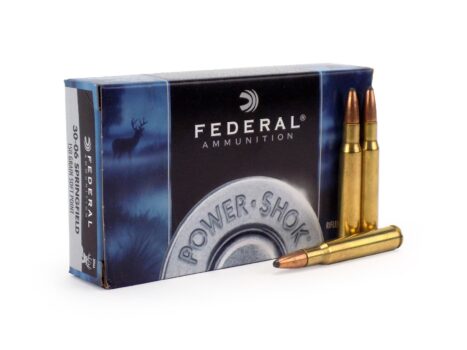
 Ammo Reports Team
| Feature | Detail |
|---|---|
| Primary Use | Medium to large game hunting |
| Bullet Type | Jacketed Soft Point |
| Bullet Weight | 150 gr |
| Case Material | Brass (Long Action cartridge) |
| Primer Type | Boxer (Large Rifle Primer) |
| Packaging | 20 rounds per box |
| Typical Price | $38.49/box · $1.92/round |
| Closest Competitors | Winchester Super-X 30-06 150 gr Power-Point, Remington Core-Lokt 30-06 150 gr SP, Hornady American Whitetail 30-06 150 gr InterLock SP |
Official Specs
| Spec | Value | Source |
|---|---|---|
| Manufacturer | Federal | Federal product data |
| Cartridge | 30-06 Springfield | Federal product data |
| Product Line | Power-Shok | Federal product data |
| Muzzle Velocity (fps) | 2,910 | Federal product data |
| Muzzle Energy (ft-lbs) | 2,820 | Federal product data |
| Bullet Weight | 150 gr | Federal product data |
| Bullet Type | Jacketed Soft Point | Federal product data |
| BC G1 | 0.313 | Federal product data |
| BC G7 | — | Not found in verified official manufacturer sources |
| Manufacturer SKU | 3006A | Federal product data |
| UPC | 029465084578 | Federal product data |
| Reloadable | Yes | Brass case, Boxer primer |
| Case Material | Brass | Case construction |
| Primer | Boxer (Large Rifle Primer) | Primer configuration; factory primer model not verified |
Source labels refer to manufacturer publications; unpublished parameters remain unfilled.


Ballistics Table
Official manufacturer data. Federal product data. 100-yard zero.
| Distance (yards) | Velocity (fps) | Energy (ft-lbs) | Trajectory (inches) |
|---|---|---|---|
| 0 | 2910 | 2820 | — |
| 100 | 2616 | 2279 | 0 |
| 200 | 2340 | 1823 | -3.6 |
| 300 | 2081 | 1442 | -13.6 |
| 400 | 1839 | 1126 | — |
| 500 | 1619 | 873 | — |
Factory trajectory shown is Federal's Average Range table: 100-yard zero and 1.5-inch sight height. Its separate Long Range table is not combined with this trajectory.
Calculated reference table – not manufacturer data. 0-700 yards in 100-yard steps. G1 point-mass model; factory muzzle velocity 2910 fps, G1 BC 0.313, 100-yard zero, assumed sight height 1.5 inches, sea level, 59°F, 29.92 inHg, 0% humidity, no wind and level fire. These assumptions are not a claim about factory test conditions. Calculated energy and trajectory are separate estimates; the distance covered does not establish an effective hunting range.
| Distance (yards) | Calculated velocity (fps) | Calculated energy (ft-lbs) | Calculated trajectory (inches) |
|---|---|---|---|
| 0 | 2910 | 2820 | -1.5 |
| 100 | 2611 | 2270 | 0.0 |
| 200 | 2331 | 1810 | -3.6 |
| 300 | 2069 | 1425 | -13.7 |
| 400 | 1824 | 1108 | -31.9 |
| 500 | 1601 | 853 | -60.6 |
| 600 | 1403 | 655 | -103.0 |
| 700 | 1237 | 510 | -163.1 |
Best Uses
Good fit:
- Whitetail deer hunting at ranges from close timber shots out to approximately 300 yards
- Mule deer and pronghorn in open country at moderate distances
- Black bear and wild hog where a controlled-expansion soft point is appropriate
- Hunters seeking a cost-effective, proven load for annual deer seasons without premium-bullet pricing
- Rifles chambered in 30-06 Springfield with standard twist rates of 1:10 or 1:11
- Hunters who prefer a traditional lead-core jacketed bullet with a long track record of field performance
Not the right tool for:
- Elk, moose, or large bears at extended ranges where deeper penetration from a bonded or premium bullet is advisable
- Jurisdictions or hunting areas with lead-free ammunition requirements — this is a lead-core design
- Precision long-range shooting beyond 400 yards where a higher published BC and verified data are needed
- Situations where the shooter requires manufacturer-verified ballistic data for competition or professional use, given the lack of published velocity specs for this specific SKU
Reliability Notes
No structured submissions yet.
Based on manufacturer claims and open-source product descriptions, this load is positioned as a budget-friendly hunting round within Federal’s lineup, intended to deliver consistent terminal performance through a conventional jacketed soft point construction. The soft point nose initiates expansion on impact while the lead core and copper jacket are designed to retain enough mass for adequate penetration on medium game. Federal’s brass cases are generally regarded in open-source discussions as well-formed and suitable for reloading, though this page covers factory ammunition only. No lot-specific accuracy data, chrono results, or terminal performance measurements have been submitted to this database. All reliability observations at this time come from manufacturer claims or open sources, not structured data.
Competitors
| Load | Weight | Bullet | BC G1 | Adv. Velocity | Price/box | Notes |
|---|---|---|---|---|---|---|
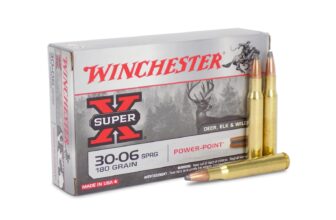
| Winchester Super-X 30-06 150 gr Power-Point | 150 gr | Lead-core JSP | 0.294 | 2,920 fps | ~$32–$36 | Budget alternative; similar design, widely available |
| Remington Core-Lokt 30-06 150 gr SP | 150 gr | Lead-core SP | ~0.383 | 2,910 fps | ~$30–$36 | Longest-running SP design in class; comparable construction |
| Hornady American Whitetail 30-06 150 gr InterLock SP | 150 gr | InterLock SP | ~0.415 | 2,910 fps | ~$35–$42 | Slightly higher published BC; InterLock ring aids jacket retention |
| Federal Premium 30-06 150 gr Nosler Partition | 150 gr | Non-bonded dual-core partition | ~0.387 | 2,910 fps | ~$52–$58 | Premium alternative; dual-core bonded construction for larger game |
| Hornady Precision Hunter 30-06 178 gr ELD-X | 178 gr | ELD-X polymer tip | ~0.552 | 2,750 fps | ~$42–$50 | Higher BC; better long-range performance but heavier bullet |
| Barnes Vor-TX 30-06 150 gr TTSX | 150 gr | Lead-free all-copper | ~0.395 | 2,910 fps | ~$48–$55 | Lead-free option; required in certain California hunting zones |
Price Reality
- Typical retail price runs approximately $36–$42 per 20-round box, with $38.49 representing a mid-range street price for this load
- Per-round cost works out to roughly $1.92 at the listed price, placing it in the mid-tier of the 30-06 market
- Winchester Super-X 150 gr Power-Point typically runs $4–$8 less per box, making it the clear budget alternative in this weight class
- Remington Core-Lokt 150 gr SP is frequently found at $30–$36, often undercutting this Federal load by a meaningful margin at standard retail
- Federal Premium loads with bonded bullets (Nosler Partition, Trophy Bonded Tip) run $12–$20 more per box, which is the meaningful premium tier step-up
- A price above $45 per box for this specific non-premium load should be considered overpriced unless supply is constrained; case pricing (typically 200 rounds) can bring the per-round cost down if available
Prices change. Check the Where to Buy block for current listings.
Where to Buy
Federal 30-06 Springfield 150 Grain SP (Box)
Affiliate links. These do not influence ratings, data, or any editorial content on this page.
FAQ
Is the Federal 150 gr SP a good choice for elk hunting?
The 150 gr jacketed soft point is a capable deer cartridge but sits at the lighter end of the recommended weight range for elk. Most experienced elk hunters prefer bullets in the 165–180 gr range with bonded construction to ensure adequate penetration through the larger bone structure and muscle mass of bull elk. At close range in timber, a well-placed shot with this load can be effective, but the conventional non-bonded soft point design carries some risk of jacket separation on heavy shoulder hits. For elk hunting, stepping up to a bonded premium bullet such as the Federal Trophy Bonded Tip or Nosler Partition in 165 gr or heavier is a more reliable choice.
How does this load compare to Remington Core-Lokt 150 gr SP in the same caliber?
Both loads use a traditional lead-core jacketed soft point at 150 grains with nearly identical advertised velocities of 2,910 fps, making them functionally very similar on paper. The Core-Lokt uses a tapered jacket that is thicker at the base to control expansion, while Federal’s design relies on a standard copper jacket and soft lead nose. Field performance differences between the two are difficult to quantify without controlled terminal tests, and both have long track records on deer-sized game. The primary practical difference for most buyers is price — Core-Lokt frequently retails several dollars less per box — and brand preference.
Does this ammunition require a lead-free bullet for hunting in California?
This load contains lead and does not meet a nonlead projectile requirement. California requires certified nonlead ammunition when taking wildlife with a firearm statewide, effective July 1, 2019. Verify the exact product against the current CDFW certification list and applicable hunting regulations.
What is the effective hunting range of this load for whitetail deer?
Federal publishes 2,910 fps muzzle velocity, 2,820 ft-lbs muzzle energy and a 0.313 G1 BC for 3006A. The factory table and separate calculated reference show retained velocity and energy, but neither alone establishes an effective hunting range. Bullet performance, conditions and demonstrated accuracy must all be considered.
Can the brass cases from this Federal load be reloaded?
Yes. Federal uses Boxer-primed brass cases, which are compatible with standard reloading dies and primer pocket tools. The cases are generally considered good quality for reloading, though this page covers factory ammunition only and provides no reloading data. Brass condition after firing depends on chamber dimensions, pressure levels, and how many times the case has been fired — standard inspection practices apply. Reloaders should consult a current published reloading manual for all charge weight, seating depth, and overall length data relevant to their specific setup.