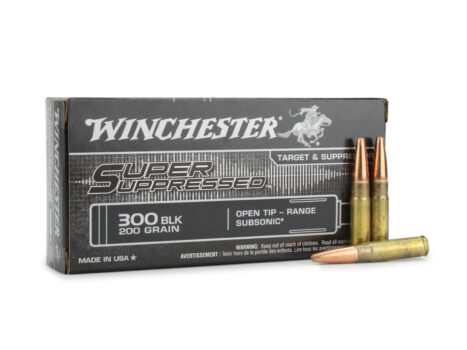
 Ammo Reports Team
| Official Spec | Value |
|---|---|
| Manufacturer | Winchester |
| Cartridge | 300 Blackout |
| Product Line | Super Suppressed |
| Bullet Name / Type | Open Tip Range |
| Bullet Weight | 200 gr |
| SKU / Part Number | SUP300BLK |
| UPC | 020892224483 (Retailer Listed) |
| Rounds per Box | 20 |
| Muzzle Velocity | 1060 fps |
| Muzzle Energy | Not found |
| Ballistic Coefficient G1 | Not found |
| Ballistic Coefficient G7 | Not found |
| Case Material | Not found |
| Primer | Not found |
| Reloadable | Not found |
| Test Barrel Length | Not found |
| Zero Distance | Not found |
| Sight Height | Not found |
| Intended Use | Suppressor use and quiet range training |
| Product Status | Current product listing verified |
| Closest Competitors | Remington Subsonic 300 BLK 220 Gr OTM, Hornady Sub-X 300 BLK 190 Gr FTX, SIG Sauer Elite Performance 300 BLK 220 Gr OTM, Fiocchi 300 BLK 220 Gr HPBT Subsonic, Sellier & Bellot 300 BLK 200 Gr FMJ Subsonic, Barnes Vor-TX 300 BLK 110 Gr TAC-TX |
Data is based on official manufacturer sources. Found an error? Send us the source link.
Manufacturer: Winchester. Exact official product pages and technical documents are recorded in the editorial verification log. Any retailer-listed field is labeled.
Ballistics Table
| Yards | Velocity (fps) | Energy (ft-lbs) | Trajectory (in) |
|---|---|---|---|
| Muzzle | 1060 | – | – |
| 100 | – | – | – |
| 200 | – | – | – |
| 300 | – | – | – |
| 400 | – | – | – |
| 500 | – | – | – |
Official-data note: Winchester publishes the exact symbol, bullet weight, Open Tip type, velocity, and box size. A complete factory distance table was not provided in the verified source.
Key takeaway: SUP300BLK is the 20-round package; SUP300BLK2 is the separate 150-round package. Both are listed at 1060 fps.
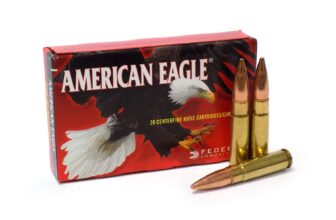
Related 300 Blackout factory loads on Ammo Reports: Federal American Eagle 150 Gr FMJ, Sellier & Bellot 147 Gr FMJ, and Hornady Subsonic 190 Gr Sub-X.
Why This Load Exists
Subsonic 300 Blackout occupies a specific niche that no other mainstream cartridge fills as neatly: a rifle-caliber round that is purpose-built to be fired suppressed, delivering heavy-bullet terminal performance without a supersonic crack. The 300 BLK cartridge was developed in collaboration with the U.S. military and special operations community specifically to allow an AR-15 platform to cycle reliably with both supersonic and subsonic loads using only a barrel change — no bolt, carrier, or lower receiver modifications required.
The 200 gr OTR bullet weight sits at the upper end of practical subsonic loadings for this caliber. Heavier bullets in the 200–220 gr range are preferred for subsonic use because they carry more momentum and resist transonic instability better than lighter projectiles pushed to the same velocity. Winchester markets the Super Suppressed line for suppressed firearms, but the official listing reviewed does not specify primer type or detailed propellant configuration.
The Open Tip Range designation distinguishes this projectile from hunting-oriented expanding bullets. The OTR bullet is a match-style construction where the open tip results from the manufacturing process (drawn from the base up), not from a hollow-point cavity designed for expansion. This makes it well-suited for high-volume range use and consistent accuracy, but it is not a terminal-performance hunting bullet.
Best Uses
Good fit:
- Suppressed range training and drills where noise reduction is the primary goal
- Backyard or indoor range environments with noise restrictions
- AR-platform rifles chambered in 300 Blackout with a suppressor already in the system
- Accuracy testing and load evaluation at distances of 100 yards and under
- Steel target shooting where a subsonic impact signature is preferred
- Shooters transitioning from 5.56 who want to explore the suppressed subsonic role without changing platforms
Not the right tool for:
- Hunting — the OTR bullet is not designed to expand reliably on game, and most states require expanding projectiles for deer-sized animals
- Long-range precision shooting beyond 150–200 yards, where the subsonic trajectory becomes impractically steep
- Unsuppressed use where the full ballistic potential of the 300 BLK platform is desired — supersonic loads deliver significantly more energy and a flatter trajectory
- Self-defense or duty use, where terminal performance standards require controlled expansion
- Gas-impingement AR builds that have not been tuned for subsonic cycling — reliable function is not guaranteed in all unsuppressed configurations
Reliability Notes
No structured submissions yet.
Based on manufacturer claims and open-source product information: Winchester describes this load as specifically engineered for reliable cycling in suppressed firearms, suggesting the powder charge and bullet seating pressure are tuned to the elevated back-pressure environment of a suppressed host. Open-tip range bullets of this construction type are generally associated with consistent concentricity and low variance in muzzle velocity, which supports the accuracy claims made in product materials. Some users in open forum discussions note that subsonic 300 Blackout loads — across brands — can exhibit cycling issues in unsuppressed gas-impingement rifles due to insufficient bolt carrier velocity; this is a platform-level variable, not necessarily a load defect. All notes above come from manufacturer claims or open sources, not structured submission data.
Competitors
This is the full comparison set preserved from the article’s existing competitor list. A link is added only when an exact Published review exists on Ammo Reports. Unverified competitor fields are labeled accordingly.
| Competitor | Bullet Type | Weight | Muzzle Velocity | Primary Use |
|---|---|---|---|---|
| Remington Subsonic 300 BLK 220 Gr OTM | Open Tip Match – Not verified | 220 gr – Not verified | Not verified | Not verified |
| Hornady Sub-X 300 BLK 190 Gr FTX | Sub-X expanding polymer-tip hollow point | 190 gr | 1050 fps | Suppressed shooting and short-range expanding-bullet applications |
| SIG Sauer Elite Performance 300 BLK 220 Gr OTM | Open Tip Match – Not verified | 220 gr – Not verified | Not verified | Not verified |
| Fiocchi 300 BLK 220 Gr HPBT Subsonic | HPBT – Not verified | 220 gr – Not verified | Not verified | Not verified |
| Sellier & Bellot 300 BLK 200 Gr FMJ Subsonic | FMJ – Not verified | 200 gr – Not verified | Not verified | Not verified |
| Barnes Vor-TX 300 BLK 110 Gr TAC-TX | TAC-TX (lead-free, expanding) – Not verified | 110 gr – Not verified | Not verified | Not verified |
Price Reality
Retail prices and availability change. Compare the current store listings below and verify SKU SUP300BLK and the exact 20-round package before purchase. Price is not used to determine the technical data or editorial conclusion.
Where to Buy
Affiliate links. These do not influence ratings, data, or any editorial content on this page.
FAQ
What is the correct symbol for the 20-round box?
It is SUP300BLK.
What velocity does Winchester publish?
Winchester lists 1,060 fps.
What bullet type is used?
Winchester identifies a 200 gr Open Tip rifle bullet.
How many rounds are in the box?
SUP300BLK contains 20 rounds.
Is SUP300BLK2 the same package?
No. SUP300BLK2 is the separate 150-round configuration.