 Ammo Reports Team
| Official Spec | Value |
|---|---|
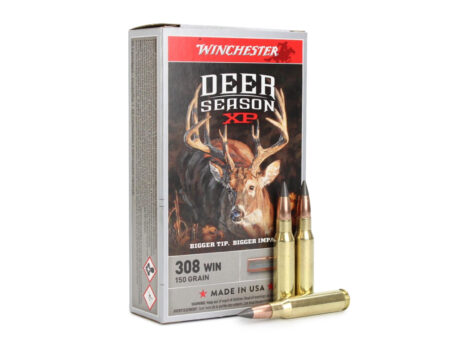
| Manufacturer | Winchester |
| Cartridge | 308 Winchester |
| Product Line | Deer Season XP |
| Bullet Name / Type | Extreme Point – polymer-tipped lead core |
| Bullet Weight | 150 gr |
| SKU / Part Number | X308DS |
| UPC | 020892221550 – retailer-listed |
| Rounds per Box | 20 |
| Muzzle Velocity | 2,820 fps |
| Muzzle Energy | 2,648 ft-lbs |
| Ballistic Coefficient G1 | 0.392 |
| Ballistic Coefficient G7 | Not found |
| Case Material | Brass – retailer-listed |
| Primer | Boxer – retailer-listed |
| Reloadable | Yes – retailer-listed |
| Test Barrel Length | Not found |
| Zero Distance | Not found |
| Sight Height | Not found |
| Intended Use | Deer hunting |
| Product Status | Current |
| Closest Competitors | Hornady American Whitetail .308 Win, Federal Power-Shok .308 Win, Remington Core-Lokt .308 Win, Hornady Precision Hunter .308 Win, Federal Trophy Bonded Tip .308 Win, Nosler Ballistic Tip Hunting .308 Win |
Data is based on official manufacturer sources. Found an error? Send us the source link.
Values labeled retailer-listed are retained only where the manufacturer does not publish the identifier or packaging detail.
Ballistics Table
Winchester manufacturer data. No calculated wind values are mixed into this table.
| Yards | Velocity (fps) | Energy (ft-lbs) |
|---|---|---|
| 0 | 2,820 | 2,648 |
The Extreme Point Bullet Design
The Extreme Point bullet is the defining feature of Winchester’s Deer Season XP line and warrants a dedicated explanation. Unlike standard polymer-tipped bullets where the tip primarily serves as a ballistic coefficient aid, the Extreme Point tip is engineered with a larger-diameter polymer tip than competing designs in its class. The intent is to initiate expansion immediately and aggressively upon impact, producing a wider initial wound channel before the lead core completes its mushroom.
The construction pairs this oversized tip with a lead alloy core and a relatively thin jacket, prioritizing rapid energy dump at hunting velocities rather than deep, controlled penetration. This philosophy is well-suited to shots taken at typical whitetail ranges — inside 300 yards — where velocity is high enough to drive the tip fully into the core. At extended ranges, as velocity drops, expansion initiation may become less consistent, which is a known trade-off with this bullet architecture. Hunters pursuing heavier game such as elk or bears should note that the rapid-expansion design is optimized for deer-class animals, not for the deep penetration typically required on larger, tougher species.
Best Uses
Good fit:
- White-tailed deer hunting at ranges from close timber shots out to approximately 300 yards
- Mule deer hunting in open terrain where a flat-shooting .308 load is appropriate
- Hunters seeking reliable terminal expansion from a mid-weight .308 bullet without stepping up to premium pricing
- Bolt-action and semi-automatic rifles chambered in .308 Winchester or 7.62×51 NATO where a hunting-specific load is preferred over FMJ
- Hunters who want a purpose-built deer load rather than a general-purpose soft point
Not the right tool for:
- Elk, moose, or large bear hunting — the rapid-expansion design lacks the penetration depth typically required for heavy, thick-shouldered game
- Very long-range shots beyond 400 yards where unconfirmed BC values and velocity loss make precise holdover difficult to calculate with confidence
- Hunting in jurisdictions that require lead-free ammunition — this is a lead-core bullet
- Target shooting or training where cost-per-round efficiency is a priority
Reliability Notes
No structured submissions yet.
Based on manufacturer claims and open-source user commentary, the following points are noted — these are not structured data and have not been independently verified by this database:
- Manufacturer describes the Extreme Point tip as producing consistent expansion across a range of impact velocities typical of deer hunting distances, though specific velocity thresholds for reliable expansion are not published.
- Open-source field reports from hunting forums frequently note clean one-shot harvests on whitetail at ranges under 200 yards, consistent with the bullet’s rapid-expansion design intent.
- Some users in open sources report that recovered bullets show significant jacket separation at close-range, high-velocity impacts — a characteristic of thin-jacketed rapid-expansion designs that may reduce retained weight compared to bonded alternatives.
- Brass quality is generally described in open sources as consistent and reloadable, though Winchester does not market this as a premium brass line.
- No active recalls or safety notices are associated with this product line as of the time of publication.
Competitors
The complete comparison set from the original report is preserved below. Internal links appear only where an exact published Ammo Reports review exists.
| Load | Weight | Bullet | BC G1 | Advertised Velocity | Notes |
|---|---|---|---|---|---|
| Hornady American Whitetail .308 Win | 150 gr | InterLock SP | 0.338 | 2,820 fps | Budget alternative; bonded-style InterLock cannelure; widely available |
| Federal Power-Shok .308 Win | 150 gr | Soft Point | 0.314 | 2,820 fps | Budget alternative; traditional cup-and-core; no polymer tip |
| Remington Core-Lokt .308 Win | 150 gr | PSP | 0.314 | 2,820 fps | Long-established deer load; controlled expansion via tapered jacket |
| Hornady Precision Hunter .308 Win | 178 gr | ELD-X | 0.552 | 2,600 fps | Premium alternative; higher BC; heavier bullet; better long-range performance |
| Federal Trophy Bonded Tip .308 Win | 150 gr | Trophy Bonded Tip | 0.440 | 2,820 fps | Premium; bonded core prevents jacket separation; better on larger game |
| Nosler Ballistic Tip Hunting .308 Win | 150 gr | Ballistic Tip | 0.435 | 2,820 fps | Similar polymer-tip concept; higher published BC; Nosler’s own tip diameter is narrower than Extreme Point |
Price and Availability
Retail availability changes by seller, location, and lot. Use the retailer links above to check current stock and checkout totals.
Where to Buy
FAQ
What makes the Extreme Point tip different from a standard polymer-tipped bullet?
The Extreme Point tip used in Winchester’s Deer Season XP line is engineered with a larger-diameter tip than most competing polymer-tipped hunting bullets. This oversized tip is intended to create a wider initial impact diameter at the moment of contact, theoretically producing more immediate trauma and a larger initial wound channel. Standard polymer tips on bullets like the Hornady SST or Nosler Ballistic Tip are primarily optimized for ballistic coefficient improvement, with expansion initiation as a secondary benefit. Winchester’s design prioritizes aggressive, immediate expansion over ballistic efficiency — a deliberate trade-off that makes the bullet well-suited for deer-range shots but less ideal for very long-range or heavy-game applications.
Is this load appropriate for elk or other large game?
The 150 gr Deer Season XP is not recommended for elk, moose, or large bear. The bullet’s design — a thin jacket and oversized polymer tip — is engineered for rapid, wide expansion on deer-sized animals. On heavier, larger-bodied game, this architecture can result in premature bullet breakup and insufficient penetration to reach the vitals through heavy shoulder muscle and bone. For elk-class hunting with a .308 Winchester, a bonded core or monolithic bullet such as the Federal Trophy Bonded Tip or Barnes TTSX would be a more appropriate choice, as these designs retain more weight and drive deeper.
How does this load compare to the Hornady American Whitetail 150 gr for whitetail deer hunting?
Both loads target the same primary use case — whitetail deer at typical hunting ranges — and share the same advertised muzzle velocity of 2,820 fps in .308 Winchester. The key difference is bullet construction: the Deer Season XP uses Winchester’s oversized polymer tip for aggressive initial expansion, while the American Whitetail uses Hornady’s InterLock, a cup-and-core design with a cannelure to improve jacket-core bonding and provide more controlled expansion. At close to moderate ranges, field performance on deer is broadly similar between the two. The American Whitetail typically retails for significantly less per box, making it the more economical choice if bullet design specifics are not a priority.
Does this ammunition work in semi-automatic .308 rifles such as the AR-10 platform?
The Winchester Deer Season XP 150 gr is a standard SAAMI-spec .308 Winchester load and functions in any firearm chambered for .308 Winchester, including semi-automatic platforms built around that cartridge. There are no known feeding or cycling issues specific to this load in properly functioning gas-operated .308 semi-automatics. Hunters using AR-10 or similar platforms for deer hunting in states where semi-automatic rifles are permitted should verify local regulations, as some jurisdictions restrict magazine capacity or firearm type during deer season regardless of ammunition choice.
Is this load legal for deer hunting in states with lead-free ammunition requirements?
No. The Extreme Point bullet uses a lead alloy core, which means this load does not qualify as lead-free ammunition. California’s Condor Zone and full-state lead-free regulations, as well as similar requirements in other states or specific wildlife management units, prohibit the use of lead-core bullets for hunting. Hunters in affected areas must use certified lead-free alternatives such as Barnes TSX, Federal Trophy Copper, or Hornady GMX loads. Always verify current ammunition regulations with your state wildlife agency before the season, as requirements can change and vary by zone, species, and land type.