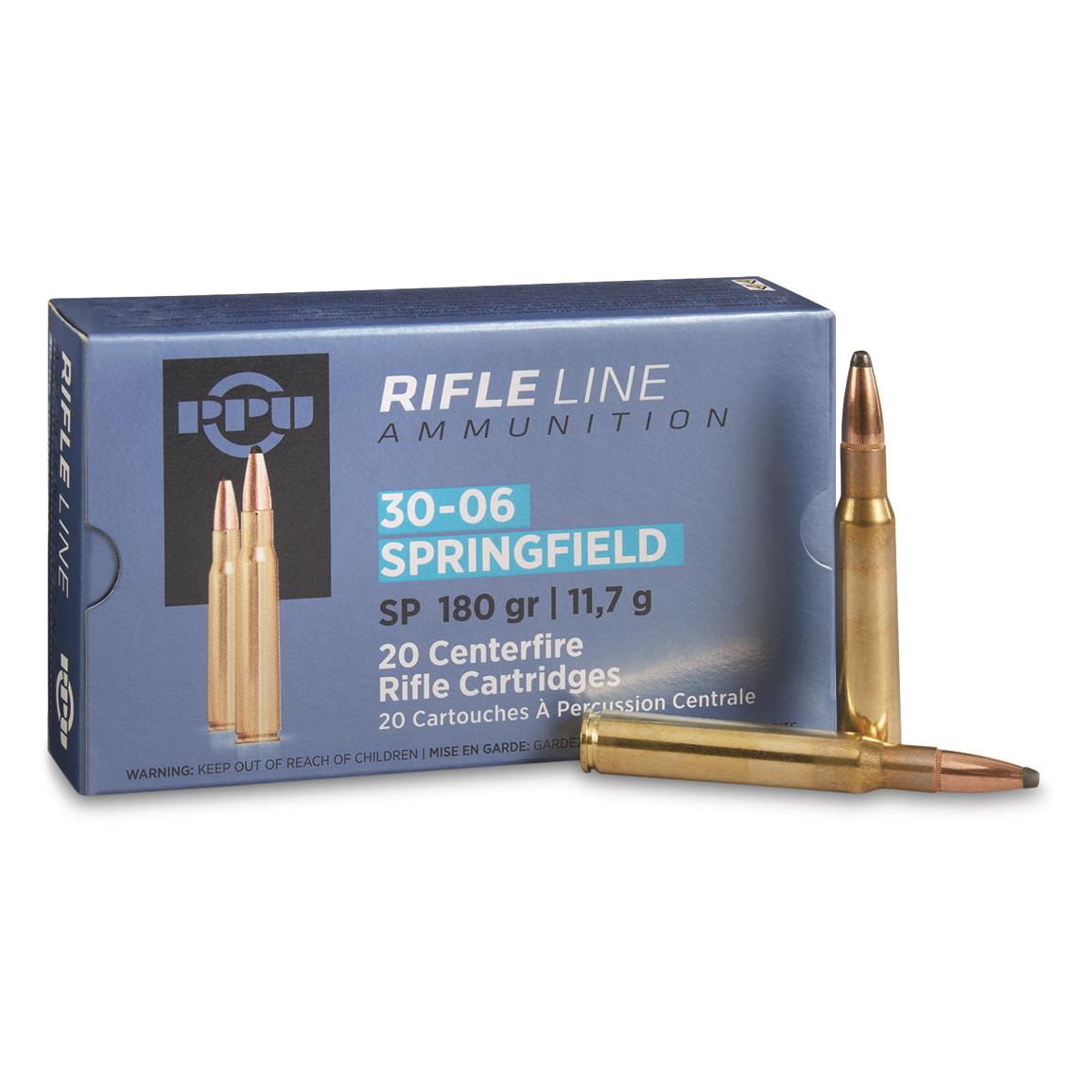
PPU, .30-06 Springfield, SP, 180 Grain
 Ammo Reports Team


| Field | Detail |
|---|---|
| Primary Use | Hunting medium to large game |
| Bullet Type | Soft Point (SP) |
| Bullet Weight | 180 grain |
| Case Material | Brass (Long Action cartridge) |
| Primer Type | Boxer (Large Rifle Primer) |
| Packaging | 20 rounds per box |
| Typical Price | $22.79/box — $1.14/round |
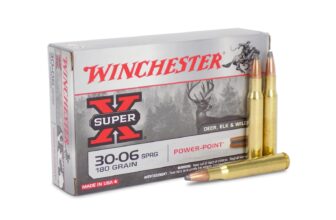
| Closest Competitors | Federal Power-Shok .30-06 SP 180 gr, Remington Core-Lokt .30-06 SP 180 gr, Winchester Super-X .30-06 SP 180 gr |
Official Specs
| Spec | Value | Source |
|---|---|---|
| Manufacturer | PPU | PPU 2024 catalog, p. 21 |
| Cartridge | 30-06 Springfield | PPU 2024 catalog, p. 21 |
| Product Line | Standard Rifle | PPU 2024 catalog, p. 21 |
| Muzzle Velocity (fps) | 2,690 | PPU 2024 catalog, p. 21 |
| Muzzle Energy (ft-lbs) | 2,892 | PPU 2024 catalog, p. 21 |
| Bullet Weight | 180 gr | PPU 2024 catalog, p. 21 |
| Bullet Type | Soft Point (SP) | PPU 2024 catalog, p. 21 |
| BC G1 | 0.413 | PPU 2024 catalog, p. 21 |
| BC G7 | — | Not found in verified official manufacturer sources |
| Manufacturer SKU | PP30063 | PPU 2024 catalog, p. 21 |
| UPC | — | Not found in verified official manufacturer sources |
| Reloadable | Yes | Brass case, Boxer primer |
| Case Material | Brass | Case construction |
| Primer | Boxer (Large Rifle Primer) | Primer configuration; factory primer model not verified |
Source labels refer to manufacturer publications; unpublished parameters remain unfilled.

Ballistics Table
Official manufacturer data. PPU 2024 catalog, p. 21. 100-yard zero.
| Distance (yards) | Velocity (fps) | Energy (ft-lbs) | Trajectory (inches) |
|---|---|---|---|
| 0 | 2690 | 2892 | — |
| 100 | 2476 | 2450 | 0 |
| 200 | 2272 | 2062 | -3.7 |
| 300 | 2077 | 1725 | -14.1 |
The official catalog is used consistently here. The separate PPU web table differs in velocity and BC and has conflicting trajectory signs. Its figures have not been mixed into this catalog table.
Calculated reference table – not manufacturer data. 0-700 yards in 100-yard steps. G1 point-mass model; factory muzzle velocity 2690 fps, G1 BC 0.413, 100-yard zero, assumed sight height 1.5 inches, sea level, 59°F, 29.92 inHg, 0% humidity, no wind and level fire. These assumptions are not a claim about factory test conditions. Calculated energy and trajectory are separate estimates; the distance covered does not establish an effective hunting range.
| Distance (yards) | Calculated velocity (fps) | Calculated energy (ft-lbs) | Calculated trajectory (inches) |
|---|---|---|---|
| 0 | 2690 | 2892 | -1.5 |
| 100 | 2472 | 2443 | 0.0 |
| 200 | 2265 | 2051 | -4.2 |
| 300 | 2068 | 1709 | -15.2 |
| 400 | 1881 | 1414 | -34.3 |
| 500 | 1705 | 1162 | -63.4 |
| 600 | 1543 | 952 | -104.4 |
| 700 | 1397 | 779 | -160.0 |
The PPU Soft Point Bullet
Prvi Partizan (PPU) is a Serbian ammunition manufacturer with roots dating to 1928, making it one of the older continuously operating cartridge producers in Europe. The company supplies both commercial and military markets and is well known in the budget-performance segment of the North American hunting ammunition market.
The soft point bullet used in this load features an exposed lead tip that initiates controlled expansion on impact, while the harder jacket around the shank is designed to retain mass and penetrate adequately through muscle and bone. This is a conventional, non-bonded soft point construction — meaning the lead core and copper jacket are mechanically formed together rather than chemically bonded. Under typical hunting impact velocities, non-bonded SP bullets perform reliably, though they can shed more jacket material than premium bonded designs at high-velocity impacts or when encountering heavy bone.
The 180-grain weight is the heaviest standard loading for .30-06 Springfield and is specifically chosen for its sectional density advantage, which supports deeper penetration on larger-bodied animals. This makes the combination well suited to elk, black bear, and large whitetail deer.
Best Uses
Good fit:
- Deer hunting at moderate ranges (inside 300 yards) where cost-per-round matters
- Elk and black bear hunting where the 180-grain weight provides sectional density advantage
- General-purpose hunting in situations where premium bonded bullets are not required by terrain or game size
- Practice and familiarization shooting with a hunting rifle prior to season, where ballistic profile matches a premium load
- Hunters seeking brass-cased, Boxer-primed, reloadable cases for subsequent handloading (note: this page covers factory loads only)
Not the right tool for:
- Long-range hunting beyond 400 yards, where unpublished BC values and non-bonded construction introduce uncertainty
- Situations requiring lead-free ammunition (California condor zones, certain public lands with lead restrictions)
- Hunters who require premium bonded or partition-style bullets for guaranteed weight retention on large, dangerous game
- Jurisdictions or ranges with restrictions on soft point or lead-core projectiles
Reliability Notes
No structured submissions yet.
Based on manufacturer claims and open-source product descriptions, this load is positioned as a reliable, general-purpose hunting round. PPU has a long-standing reputation in the budget hunting ammunition segment for consistent case dimensions and acceptable accuracy in bolt-action hunting rifles. The Boxer-primed brass cases are noted to be reloadable, which adds practical value for shooters who recover brass. No specific accuracy guarantees or lot-to-lot consistency data are published by the manufacturer for this load. All notes here reflect manufacturer claims or open-source reporting, not structured chronograph or accuracy submissions.
Competitors
| Load | Weight | Bullet | BC G1 | Adv. Velocity | Price/box | Notes |
|---|---|---|---|---|---|---|
| Federal Power-Shok .30-06 SP | 180 gr | Non-bonded SP | ~0.381 | ~2,700 fps | ~$24–$28 | Budget tier; same bullet class as PPU |
| Remington Core-Lokt .30-06 SP | 180 gr | Core-Lokt SP | ~0.383 | ~2,700 fps | ~$25–$30 | Long-established hunting standard; non-bonded |
| Winchester Super-X .30-06 SP | 180 gr | Power-Point SP | 0.381 | 2,700 fps | ~$26–$30 | Budget alternative; notched jacket design |
| Hornady American Whitetail .30-06 SP | 180 gr | InterLock SP | ~0.391 | ~2,700 fps | ~$28–$34 | Slight BC advantage; InterLock ring aids retention |
| Federal Trophy Bonded .30-06 | 180 gr | Trophy Bonded Tip | ~0.480 | ~2,700 fps | ~$45–$55 | Premium alternative; bonded construction for heavy game |
| Nosler Trophy Grade .30-06 AccuBond | 180 gr | AccuBond | ~0.507 | ~2,650 fps | ~$50–$60 | Premium alternative; bonded, high BC; best for long range |
Note: BC and velocity values for competitor loads are sourced from manufacturer-published data where available. The PPU load’s BC remains unpublished and is not estimated in this table.
Price Reality
- At $22.79 per box of 20, this load comes in at approximately $1.14 per round, placing it firmly in the budget hunting tier for .30-06 Springfield
- Federal Power-Shok 180 gr typically runs $24–$28/box (~$1.20–$1.40/round), making PPU slightly more affordable for comparable construction
- Remington Core-Lokt 180 gr typically runs $25–$30/box (~$1.25–$1.50/round)
- Premium bonded loads such as Federal Trophy Bonded or Nosler Trophy Grade run $45–$60/box (~$2.25–$3.00/round) — roughly double to triple the per-round cost
- A fair price benchmark for this load is under $25/box; prices above $30/box for this specific load would represent a significant premium over typical market value
- Case pricing (typically 10 boxes / 200 rounds) is not consistently published at a fixed price; check current listings for case availability
Prices change. Check the Where to Buy block for current listings.
Where to Buy
PPU, .30-06 Springfield, SP, 180 Grain, 20 Rounds
Affiliate links. These do not influence ratings, data, or any editorial content on this page.
FAQ
Is the PPU 180-grain 30-06 SP suitable for elk hunting?
The 180-grain bullet weight is widely recommended for elk due to its sectional density, which supports deep penetration through heavy muscle and bone. The PPU soft point construction will expand and penetrate adequately at typical hunting velocities inside 300 yards. However, the non-bonded design means some hunters prefer a premium bonded bullet for elk, particularly for shots at steep angles or through heavy shoulder bone. For broadside shots at moderate range, this load is a reasonable choice at its price point.
How does PPU compare to Remington Core-Lokt in the same weight and caliber?
Both loads use a non-bonded soft point design in the 180-grain .30-06 configuration and are expected to perform similarly at comparable velocities. Remington Core-Lokt has a longer documented track record in North American hunting markets and slightly more published ballistic data. PPU offers a modest price advantage. Neither load is bonded, and both are appropriate for deer and elk at hunting distances inside 300 yards. The practical difference in terminal performance between the two is likely minimal for most hunting scenarios.
Does this ammunition comply with lead-free requirements in California or other restricted zones?
This load contains lead and does not meet a nonlead projectile requirement. California requires certified nonlead ammunition when taking wildlife with a firearm statewide, effective July 1, 2019. Verify the exact product against the current CDFW certification list and applicable hunting regulations.
Does PPU publish muzzle velocity for this load?
PPU publishes 2,690 fps muzzle velocity, 2,892 ft-lbs muzzle energy and a 0.413 G1 BC for PP30063. These figures come from the official 2024 catalog. The separate website table differs, so the catalog dataset is used consistently above.
Is the brass case from PPU 30-06 worth saving for reloading?
PPU uses Boxer-primed brass cases, which are compatible with standard reloading dies and primer punches. The brass is generally regarded in open-source shooter forums as serviceable for reloading, with acceptable case dimensions and wall thickness. This page covers factory ammunition only and does not provide reloading data or charge weights. Whether the brass suits a specific reloading application depends on the shooter’s equipment and tolerance standards, and should be evaluated independently.