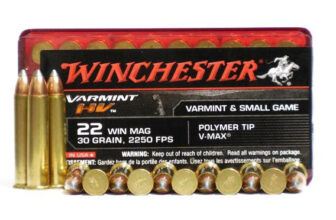
CCI Varmint, .22 Magnum, Speer VNT, 30 Grain
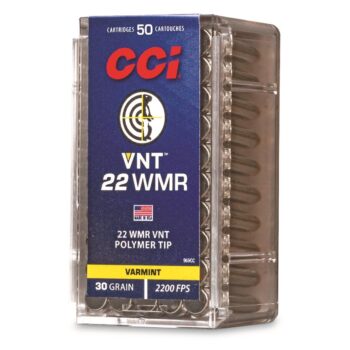
| Field | Detail |
|---|---|
| Primary Use | Varmint hunting, pest control, small game |
| Bullet Type | Speer VNT (Varmint No Turn) โ polymer-tipped lead-core flat-base |
| Bullet Weight | 30 grain |
| Case Material | Brass |
| Primer Type | Rimfire |
| Packaging | 50 rounds per box |
| Typical Price | $16.14/box ยท ~$0.32/round |
| Closest Competitors | CCI Maxi-Mag .22 WMR 40gr TMJ, Hornady Varmint Express .22 WMR 30gr V-MAX, Winchester Super-X .22 WMR 40gr JHP |
Official Specs
| Spec | Value | Source |
|---|---|---|
| Muzzle Velocity (fps) | โ | Not published by manufacturer for this SKU |
| Muzzle Energy (ft-lbs) | โ | Not published by manufacturer for this SKU |
| Bullet Weight | 30 gr | Manufacturer label |
| Bullet Type | Speer VNT polymer-tipped | Manufacturer label |
| BC G1 | โ | Not published |
| BC G7 | โ | Not published |
| Manufacturer SKU | โ | Not confirmed in available data |
| UPC | โ | Not confirmed in available data |
| Reloadable | No | Rimfire โ not reloadable |
Note: CCI does not publish muzzle velocity or muzzle energy for this specific 30-grain VNT load in available product documentation. The ballistics table below uses an estimated muzzle velocity derived from comparable 30-grain .22 WMR loads (approximately 2,200 fps from a 24″ test barrel). All ballistic values should be treated as calculated estimates until community-submitted chronograph data is available. Barrel length significantly affects realized velocity โ carbine-length barrels (16″โ18″) typically yield 100โ200 fps less than test barrel figures.
Ballistics Table
Calculated estimate. Real-world results vary by barrel length, temperature,altitude, and lot. Community submissions will provide measured muzzlevelocity for comparison.
Estimated muzzle velocity: ~2,200 fps | Bullet: 30 gr | BC G1: ~0.110 (estimated for class) | Sight height: 1.5″ above bore | Zero: 50 yards
| Yards | ~Velocity (fps) | ~Energy (ft-lbs) | ~Trajectory (in) |
|---|---|---|---|
| 0 | ~2,200 | ~323 | -1.5 |
| 25 | ~2,074 | ~287 | +0.5 |
| 50 | ~1,953 | ~254 | 0.0 โ zero |
| 75 | ~1,836 | ~225 | -1.6 |
| 100 | ~1,724 | ~198 | -4.7 |
| 125 | ~1,617 | ~174 | -9.5 |
| 150 | ~1,516 | ~153 | -16.3 |
| 175 | ~1,421 | ~135 | -25.3 |
| 200 | ~1,332 | ~118 | -36.8 |
| 225 | ~1,250 | ~104 | -51.2 |
| 250 | ~1,176 | ~92 | -68.8 |
Key takeaway: Zeroed at 50 yards, this 30-grain VNT load stays within roughly ยฑ2 inches of point of aim out to about 60 yards โ a practical maximum point-blank range for small varmints like ground squirrels and prairie dogs. By 100 yards the bullet has dropped nearly 5 inches below line of sight, which means holdover is required for any shot beyond 75 yards. The lightweight 30-grain bullet loses velocity faster than heavier .22 WMR loads, but the tradeoff is a higher initial velocity and more violent terminal expansion at closer ranges. Hunters working fields under 100 yards will find trajectory management straightforward; longer shots demand a dialed scope or practiced holdover.
The Speer VNT Bullet
The Speer VNT โ short for Varmint No Turn โ is a purpose-built varmint projectile developed by Speer and integrated into CCI’s Varmint line. Its defining feature is a thin-jacketed lead core topped with a red polymer tip that initiates rapid expansion on contact. Unlike conventional hollow-point rimfire bullets, the polymer tip protects the cavity during feeding and helps preserve the bullet’s ballistic coefficient during flight, even at the relatively modest velocities typical of rimfire cartridges.
The “No Turn” designation refers to the bullet’s manufacturing process, which eliminates the need for a cannelure groove that would otherwise be used to seat the tip. This results in a cleaner, more consistent ogive profile. At varmint-hunting velocities, the VNT is designed to expand aggressively and transfer energy rapidly โ a characteristic that makes it effective on small-bodied animals but limits its usefulness on anything larger than a jackrabbit. The combination of CCI’s rimfire priming technology and the VNT bullet gives this load a reputation for consistent ignition and repeatable accuracy.
Best Uses
Good fit:
- Prairie dog and ground squirrel control at ranges under 75 yards
- Coyote pup and fox hunting where regulations permit rimfire use
- Pest control on farms and ranches (rats, starlings, feral pigeons)
- Shooters using bolt-action or lever-action .22 WMR rifles where reliable feeding of polymer-tipped bullets is confirmed
- Training or familiarization shooting where the lower per-round cost of rimfire is a factor
Not the right tool for:
- Shots beyond 100 yards where drop and wind drift become significant and the lighter bullet’s retained energy drops below practical varmint thresholds
- Medium or large game โ the 30-grain VNT is not appropriate for deer, hog, or any animal requiring deep penetration
- Semi-automatic .22 WMR platforms that have documented feeding issues with polymer-tipped bullets โ confirm compatibility before field use
- Jurisdictions that restrict expanding ammunition for hunting โ check local regulations before use
- Target shooting or competition where flat-nose or FMJ profiles are required
Reliability Notes
No structured submissions yet.
Based on manufacturer claims and open-source user reports, the CCI Varmint VNT line is consistently noted for clean ignition across a range of temperatures โ a meaningful attribute for rimfire ammunition, which can be sensitive to cold-weather primer performance. CCI’s rimfire manufacturing reputation is well established, and the Varmint line is positioned as a higher-consistency offering compared to CCI’s bulk-pack products. The Speer VNT bullet’s polymer tip is reported to feed reliably in bolt-action platforms; semi-automatic compatibility should be verified per individual firearm. No recall notices are associated with this load as of the time of writing. All notes reflect manufacturer claims or open-source observations, not structured chronograph or accuracy data.
Competitors
| Load | Weight | Bullet | BC G1 | Adv. Velocity | Price/box | Notes |
|---|---|---|---|---|---|---|
| Hornady Varmint Express .22 WMR | 30 gr | V-MAX | ~0.200 | 2,200 fps | ~$17โ$19 | Direct weight competitor; higher published BC; same use case |
| CCI Maxi-Mag .22 WMR | 40 gr | TMJ | ~0.110 | 1,875 fps | ~$13โ$15 | Heavier, non-expanding; better penetration, less expansion |
| Winchester Super-X .22 WMR | 40 gr | JHP | ~0.110 | 1,910 fps | ~$12โ$15 | Budget alternative; expanding JHP; heavier bullet retains energy better at distance |
| Federal Premium .22 WMR | 30 gr | V-Shok Polymer Tip | ~0.190 | 2,200 fps | ~$17โ$20 | Premium alternative; similar bullet concept to VNT |
| Remington Premier .22 WMR | 33 gr | AccuTip-V | ~0.150 | 2,000 fps | ~$16โ$18 | Slightly heavier; AccuTip design; comparable terminal performance |
| Fiocchi .22 WMR | 40 gr | JHP | ~0.100 | 1,900 fps | ~$11โ$14 | Budget option; non-polymer-tipped; adequate for pest control |
Price Reality
- At $16.14 per box of 50, this load comes to approximately $0.32 per round โ competitive for a premium polymer-tipped .22 WMR varmint load
- Case pricing (typically 10 boxes / 500 rounds) is not confirmed from available data; bulk pricing may reduce per-round cost to approximately $0.28โ$0.30 when available
- The Hornady V-MAX 30-grain load typically runs $0.34โ$0.38/round, making the CCI VNT a slight value advantage in the same weight class
- Winchester Super-X 40gr JHP frequently retails at $0.24โ$0.30/round โ a meaningful savings, though the heavier non-polymer-tipped bullet serves a different terminal performance profile
- Federal V-Shok 30gr typically prices near or slightly above this CCI load; the two are essentially price-equivalent
- A fair price benchmark for this load is $14โ$18 per box; listings above $20 per box should be considered elevated unless supply conditions justify it
Prices change. Check the Where to Buy block for current listings.
Where to Buy
CCI Varmint, .22 Magnum, Speer VNT, 30 Grain, 50 Rounds
Affiliate links. These do not influence ratings, data, or any editorial content on this page.
FAQ
Does the Speer VNT bullet expand reliably at .22 WMR velocities?
The Speer VNT is specifically engineered for the velocity range produced by rimfire cartridges, which is lower than most centerfire varmint loads. The thin jacket and polymer tip are designed to initiate expansion at impact velocities achievable within typical .22 WMR ranges โ generally 100 yards and under. Beyond that distance, as velocity drops, expansion becomes less predictable and may be incomplete. For consistent terminal performance, shots should be kept within 75โ100 yards.
How does the 30-grain VNT compare to the Hornady 30-grain V-MAX in .22 WMR?
These two loads are the most direct competitors in the 30-grain .22 WMR segment. Both use polymer-tipped expanding bullets at similar advertised velocities. The Hornady V-MAX has a published BC of approximately 0.200, which is notably higher than typical estimates for the VNT in this weight class, suggesting a slight advantage in wind drift resistance at distance. Practical differences at 75 yards and under are likely minimal. Price and availability often determine which load a shooter chooses.
Is this ammunition suitable for use in semi-automatic .22 WMR rifles?
Polymer-tipped bullets can present feeding challenges in some semi-automatic .22 WMR platforms depending on the magazine design and feed ramp geometry. CCI does not specifically restrict this load to bolt-action use, but shooters with semi-automatic rifles should verify reliable feeding with their specific firearm before relying on this load in the field. Running a function-check with a small number of rounds before a hunting trip is a practical precaution.
Why is a 30-grain bullet used instead of the more common 40-grain in .22 WMR?
The 30-grain bullet weight allows for a higher muzzle velocity compared to 40-grain loads, which translates to a flatter trajectory at short to moderate ranges and more violent initial expansion at close distances. For varmint applications โ where the goal is rapid energy transfer on small-bodied animals โ the lighter, faster bullet is often preferred. The tradeoff is faster velocity loss downrange and reduced retained energy beyond 100 yards. Hunters targeting larger animals like coyotes at extended range may prefer the heavier 40-grain option.
Can this load be used for squirrel or rabbit hunting?
This depends on the intended use and local regulations. The VNT bullet is designed for rapid expansion and energy transfer, which produces significant tissue damage โ appropriate for pest control but potentially destructive for small game intended for table use. Hunters who want to preserve meat from squirrels or rabbits typically choose a non-expanding or FMJ load. Additionally, some states restrict the use of expanding ammunition for certain small game species; always verify local hunting regulations before selecting this load for game hunting.