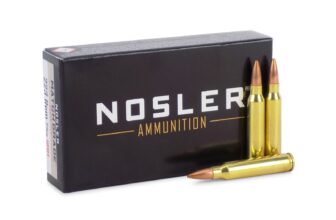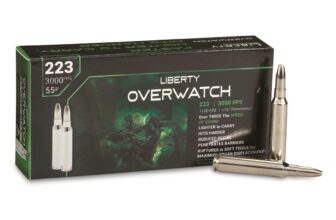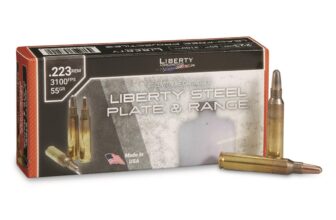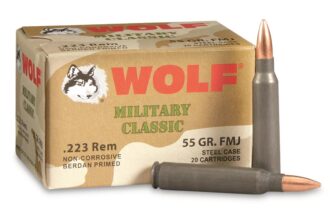
Patriot Sports, .223 Remington, FMJ, 55 Grain
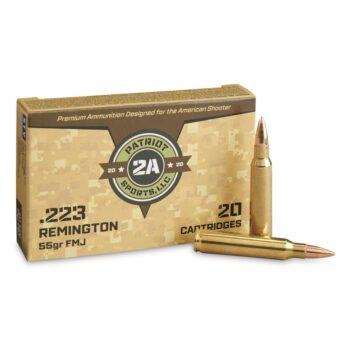
| Field | Detail |
|---|---|
| Primary Use | Target shooting, range practice, training |
| Bullet Type | Full Metal Jacket (FMJ) |
| Bullet Weight | 55 grain |
| Case Material | Not published |
| Primer Type | Not published |
| Packaging | 20 rounds per box |
| Typical Price | $9.02/box ยท $0.45/round |
| Closest Competitors | Federal American Eagle AE223J 55gr FMJ ยท PMC Bronze .223A 55gr FMJ ยท Blazer Brass 223 55gr FMJ |
Official Specs
| Spec | Value | Source |
|---|---|---|
| Muzzle Velocity (fps) | โ | Not published |
| Muzzle Energy (ft-lbs) | โ | Not published |
| Bullet Weight | 55 gr | Manufacturer label |
| Bullet Type | Full Metal Jacket (FMJ) | Manufacturer label |
| BC G1 | โ | Not published |
| BC G7 | โ | Not published |
| Manufacturer SKU | โ | Not published |
| UPC | โ | Not published |
| Reloadable | Not published | โ |
Note: Patriot Sports does not publish velocity, energy, or ballistic coefficient data for this load in available product listings. The ballistics table below uses a class-average muzzle velocity of 3,240 fps โ a widely cited figure for 55-grain .223 Remington FMJ loads from standard 20-inch barrels โ and all derived values are clearly labeled as calculated estimates. No manufacturer-stated velocity has been used.
Ballistics Table
Calculated estimate. Real-world results vary by barrel length, temperature, altitude, and lot. Community submissions will provide measured muzzle velocity for comparison.
Assumptions: 55 gr FMJ ยท G1 BC 0.243 (class average) ยท MV 3,240 fps (class average, 20โณ barrel) ยท Sight height 1.5โณ ยท Zero 100 yd ยท Standard atmosphere (59ยฐF, sea level)
| Yards | Velocity (fps) | Energy (ft-lbs) | Trajectory (in) |
|---|---|---|---|
| 0 | ~3,240 | ~1,282 | โ1.5 |
| 100 | ~2,931 | ~1,049 | 0.0 โ zero |
| 200 | ~2,641 | ~851 | โ3.4 |
| 300 | ~2,368 | ~685 | โ13.2 |
| 400 | ~2,112 | ~545 | โ30.8 |
| 500 | ~1,873 | ~428 | โ58.4 |
Key takeaway: At the 100-yard zero, this load holds a flat enough trajectory to make center-mass hits on a standard silhouette target straightforward out to roughly 250 yards with minimal hold-over adjustment. Beyond 300 yards, bullet drop accelerates meaningfully โ nearly 13 inches at that distance โ which is consistent with all standard 55-grain .223 FMJ loads. For a range training round, the first 200 yards represent its practical sweet spot. Shooters using shorter-barreled rifles (16โณ or less) should expect muzzle velocity 100โ200 fps lower than the class-average figure used here, shifting all values proportionally.
Best Uses
Good fit:
- High-volume range sessions and general target practice where cost-per-round matters
- Function testing and break-in of new AR-15 or bolt-action .223 platforms
- Positional and marksmanship drills at 100โ200 yards where terminal performance is not a factor
- Training with semi-automatic rifles where consistent cycling on FMJ is preferred over hollow-point loads
- Plinking and informal paper or steel target work
Not the right tool for:
- Hunting any game โ FMJ bullets are prohibited or ethically inappropriate for taking deer, varmints, or predators in most jurisdictions due to inadequate terminal expansion
- Self-defense or home-defense applications where controlled expansion and reduced over-penetration risk are priorities
- Precision long-range work beyond 300 yards where a published and verified ballistic coefficient is necessary for accurate firing solutions
- Jurisdictions with lead-core bullet restrictions (California condor zones, certain ranges) โ this load is not confirmed lead-free
- Competition divisions requiring specific bullet construction standards (e.g., open-tip match rules)
Reliability Notes
No structured submissions yet.
Based on the manufacturer’s product description and general open-source information about the brand, the following contextual notes apply โ all sourced from manufacturer claims or open sources, not structured test data:
- Patriot Sports positions this load explicitly for target shooting and range practice, suggesting the load is optimized for consistent cycling rather than terminal performance.
- FMJ construction in .223 Remington is a well-established, mechanically simple design with a long track record of reliable feeding in AR-pattern and bolt-action rifles; no construction-specific reliability concerns are known for this format.
- No recall notices, lot-specific warnings, or documented quality-control issues for Patriot Sports .223 Remington FMJ ammunition were identified in publicly available sources at the time of publication.
- Because case material and primer type are not published, shooters with particular sensitivities to boxer vs. Berdan priming or brass vs. steel cases should confirm specifications directly with the manufacturer or retailer before purchasing in volume.
Competitors
| Load | Weight | Bullet | BC G1 | Adv. Velocity | Price/box | Notes |
|---|---|---|---|---|---|---|
| Federal American Eagle AE223J | 55 gr | FMJ-BT | 0.243 | 3,240 fps | ~$10โ$12 | Widely available; published specs; same bullet class |
| PMC Bronze .223A | 55 gr | FMJ-BT | 0.235 | 3,200 fps | ~$9โ$11 | Budget alternative; published velocity data |
| Blazer Brass 223 | 55 gr | FMJ | 0.243 | 3,240 fps | ~$8โ$10 | Budget alternative; brass case; CCI primer |
| Winchester USA White Box Q3131 | 55 gr | FMJ | 0.243 | 3,240 fps | ~$10โ$13 | Established brand; widely stocked; published specs |
| Hornady Steel Match 80270 | 55 gr | HP | 0.267 | 3,150 fps | ~$12โ$15 | Premium alternative; better BC; hollow-point construction |
| Fiocchi .223A | 55 gr | FMJ | 0.243 | 3,240 fps | ~$9โ$12 | Similar price point; published specs available |
Note on premium alternative: The Hornady Steel Match load uses a hollow-point bullet rather than FMJ and carries a higher BC, making it a meaningfully different product โ included here as a performance upgrade reference for buyers considering stepping up from bulk training ammunition.
Price Reality
- At $9.02 per 20-round box, the per-round cost is approximately $0.45, placing this load at the lower boundary of current .223 Remington FMJ pricing.
- Federal American Eagle AE223J (55gr FMJ) typically retails at $10โ$12 per 20 rounds (~$0.50โ$0.60/round), making Patriot Sports modestly less expensive for comparable construction.
- PMC Bronze .223A and Blazer Brass 223 are the most direct budget competitors, often ranging $8โ$11 per 20 rounds depending on retailer and market conditions โ price parity with Patriot Sports is common.
- Case pricing (typically 500 or 1,000 rounds) is not published for this load; buyers intending high-volume purchases should request case pricing directly from the retailer.
- A price above $0.55โ$0.60 per round for a standard 55-grain .223 FMJ load from any brand should be considered above market rate under normal supply conditions; the $0.45/round figure here represents fair value at time of listing.
- Because Patriot Sports does not publish velocity or component specifications, buyers are paying for a commodity-class training round โ pricing should be evaluated accordingly against competitors with published data.
Prices change. Check the Where to Buy block for current listings.
Where to Buy
Patriot Sports, .223 Remington, FMJ, 55 Grain, 20 Rounds
Affiliate links. These do not influence ratings, data, or any editorial content on this page.
FAQ
Does the Patriot Sports 55-grain FMJ use a boat-tail or flat-base bullet?
Patriot Sports does not specify whether this projectile uses a boat-tail or flat-base configuration in any published product data. Most commercial 55-grain .223 FMJ loads at this price point use a flat-base construction, though boat-tail variants exist in the same weight class. Without a published ballistic coefficient or confirmed bullet design, it is not possible to confirm which base geometry applies here. Buyers for whom this distinction matters โ particularly those shooting at 300 yards or beyond โ should contact the manufacturer directly or select a load with confirmed specifications.
How does this load compare to Federal American Eagle 55-grain FMJ for range training?
Both loads occupy the same practical category: 55-grain FMJ .223 Remington intended for range use. Federal American Eagle publishes a muzzle velocity of 3,240 fps and uses a boat-tail FMJ bullet with a G1 BC of approximately 0.243, giving buyers a verifiable ballistic baseline. Patriot Sports does not publish equivalent data, which is a meaningful difference for shooters who use dope cards or ballistic calculators at distances beyond 200 yards. For pure close-range function testing and plinking, the practical difference in felt performance is likely minimal. Federal American Eagle carries a slight price premium but offers greater data transparency.
Is this ammunition suitable for suppressed .223 rifles?
No specific suppressor-related data โ such as subsonic variants, pressure ratings, or gas-port tuning โ is published for this load. Standard 55-grain .223 FMJ loads are supersonic and function normally through suppressed rifles, though the supersonic crack remains. Suppressed shooters should verify that their host rifle’s gas system cycles reliably with this load, as suppressor back-pressure can affect cycling with some ammunition. This is not a subsonic or suppressor-optimized load.
Can this ammunition be used in a .223 Wylde or 5.56 NATO chamber?
Yes. .223 Remington ammunition is safe to fire in both .223 Remington chambers and the .223 Wylde hybrid chamber. It is also generally safe to fire in 5.56 NATO chambers, which have slightly more generous dimensions. The reverse โ firing 5.56 NATO ammunition in a strictly .223 Remington SAAMI-spec chamber โ carries higher pressure considerations and is not recommended. This Patriot Sports load, being a standard .223 Remington offering, presents no unusual chambering concerns across those three common configurations.
Why doesn’t Patriot Sports publish velocity or ballistic data for this load?
This is common among budget and value-tier ammunition brands that source components or finished ammunition through contract manufacturing arrangements. Published ballistic data requires consistent, verified lot-to-lot testing and the infrastructure to maintain those specifications publicly. Brands focused on the range-use and high-volume training market frequently prioritize price over data transparency, relying on buyers to accept class-average performance expectations for a given bullet weight and caliber. This does not necessarily indicate inferior quality, but it does mean buyers cannot independently verify performance claims or build accurate firing solutions without their own chronograph data.
Submit Your Data ยท Real-World Results
Manufacturer velocity figures are measured under controlled lab conditions – barrel length, temperature, and lot number all affect real-world performance. The data below comes from community submissions tied to specific test conditions and reviewed before publishing.
Once this page reaches 3 approved submissions, aggregate velocity and confidence level will appear here automatically.
You need to login first.Results vary by firearm, barrel condition, ammunition lot, and environmental factors. Submitted data is for reference only. Ammo Reports does not guarantee accuracy of user-submitted results.