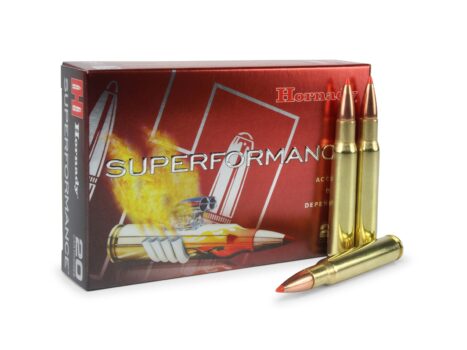
 Ammo Reports Team
| Feature | Detail |
|---|---|
| Primary Use | Big game hunting (deer, elk, black bear) |
| Bullet Type | SST (Super Shock Tip), non-bonded InterLock construction |
| Bullet Weight | 165 grains |
| Case Material | Brass (Long Action cartridge) |
| Primer Type | Boxer (Large Rifle Primer) |
| Packaging | 20 rounds per box |
| Typical Price | $44.99/box — $2.25/round |
| Closest Competitors | Federal Premium Vital-Shok 165 gr Trophy Bonded Tip, Winchester Deer Season XP 150 gr Extreme Point, Remington Core-Lokt 165 gr PSP |
Official Specs
| Spec | Value | Source |
|---|---|---|
| Manufacturer | Hornady | Hornady product data and 2026 catalog |
| Cartridge | 30-06 Springfield | Hornady product data and 2026 catalog |
| Product Line | Superformance | Hornady product data and 2026 catalog |
| Muzzle Velocity (fps) | 2,960 | Hornady product data and 2026 catalog |
| Muzzle Energy (ft-lbs) | 3,210 | Hornady product data and 2026 catalog |
| Bullet Weight | 165 gr | Hornady product data and 2026 catalog |
| Bullet Type | SST (Super Shock Tip), non-bonded InterLock construction | Hornady product data and 2026 catalog |
| BC G1 | 0.447 | Hornady product data and 2026 catalog |
| BC G7 | — | Not found in verified official manufacturer sources |
| Manufacturer SKU | 81153 | Hornady product data and 2026 catalog |
| UPC | — | Not found in verified official manufacturer sources |
| Reloadable | Yes | Brass case, Boxer primer |
| Case Material | Brass | Case construction |
| Primer | Boxer (Large Rifle Primer) | Primer configuration; factory primer model not verified |
| Test Barrel | 24 inches | Hornady product data and 2026 catalog |
Source labels refer to manufacturer publications; unpublished parameters remain unfilled.


Ballistics Table
Official manufacturer data. Hornady product data and 2026 catalog. 200-yard zero.
| Distance (yards) | Velocity (fps) | Energy (ft-lbs) | Trajectory (inches) |
|---|---|---|---|
| 0 | 2960 | 3210 | -1.5 |
| 100 | 2750 | 2770 | 1.6 |
| 200 | 2550 | 2382 | 0.0 |
| 300 | 2358 | 2037 | -6.9 |
| 400 | 2175 | 1733 | -20.1 |
| 500 | 2000 | 1465 | -40.6 |
Calculated reference table – not manufacturer data. 0-700 yards in 100-yard steps. G1 point-mass model; factory muzzle velocity 2960 fps, G1 BC 0.447, 200-yard zero, assumed sight height 1.5 inches, sea level, 59°F, 29.92 inHg, 0% humidity, no wind and level fire. These assumptions are not a claim about factory test conditions. Calculated energy and trajectory are separate estimates; the distance covered does not establish an effective hunting range.
| Distance (yards) | Calculated velocity (fps) | Calculated energy (ft-lbs) | Calculated trajectory (inches) |
|---|---|---|---|
| 0 | 2960 | 3210 | -1.5 |
| 100 | 2746 | 2763 | 1.6 |
| 200 | 2542 | 2368 | 0.0 |
| 300 | 2347 | 2018 | -6.9 |
| 400 | 2161 | 1711 | -20.2 |
| 500 | 1983 | 1441 | -41.0 |
| 600 | 1815 | 1206 | -70.6 |
| 700 | 1656 | 1005 | -110.7 |
The Hornady SST Bullet and Superformance Propellant Technology
The Super Shock Tip bullet deserves explanation beyond its marketing name. The red polymer tip serves two distinct mechanical purposes: it initiates reliable, consistent expansion at a wide range of impact velocities — including the lower velocities encountered at longer ranges — and it improves the bullet’s ballistic coefficient compared to a conventional soft-point design of the same weight. The tip drives rearward into the lead core on impact, triggering the expansion of the jacket, while the InterLock ring — a physical cannelure pressed into the jacket — mechanically locks the core and jacket together. This is not a fully bonded bullet in the chemical sense, but the InterLock system is designed to resist core-jacket separation at high-velocity impact, particularly relevant in the Superformance line where striking velocities are elevated.
The Superformance propellant technology is the other half of the equation. Hornady developed this line using specialized propellant blends that produce higher chamber velocities than conventional powders at equivalent pressure levels. The claimed gain is up to 200 fps over standard factory loads — in this case, a standard 30-06 Springfield 165 gr load typically exits at roughly 2,700–2,800 fps, making the 2,960 fps figure a meaningful real-world improvement. Critically, Hornady states this is achieved without an increase in chamber pressure, recoil, muzzle blast, or temperature sensitivity. That last point matters for hunters in cold-weather conditions where some propellants exhibit velocity loss.
Best Uses
Good fit:
- Whitetail and mule deer hunting at ranges from close timber shots out to approximately 300 yards
- Elk and black bear hunting where the heavier 165 gr weight provides additional retained energy over lighter 150 gr options
- Hunters using rifles with 22″–24″ barrels where the Superformance velocity advantage is fully realized
- Shooters who want a high-BC polymer-tipped bullet without moving to a premium bonded or monolithic design at a higher price point
- All-season use where temperature-stable propellant performance is a practical concern
Not the right tool for:
- Hunters in jurisdictions with lead-free bullet requirements — the SST uses a traditional lead core and does not qualify as non-toxic
- Close-range shots on heavy-boned dangerous game where a fully bonded or solid bullet would be a more appropriate choice
- Rifles with barrels shorter than 20″, where the Superformance velocity advantage diminishes and may not justify the premium over standard loads
- Target shooting or precision long-range competition, where the SST’s hunting-optimized construction is unnecessary and more consistent match bullets exist
- Shooters on a tight per-round budget — at $2.25/round, cheaper 30-06 options are readily available for practice or casual use
Reliability Notes
No structured submissions yet.
Based on manufacturer claims and open-source product information, the following observations are relevant:
- Hornady states that Superformance loads are tested for consistent velocity across a range of temperatures, addressing a known weakness of some fast-burning propellant blends used in high-velocity factory ammunition.
- The SST bullet’s polymer tip is designed to resist deformation during magazine feeding — a practical consideration in bolt-action rifles where cartridges are cycled under field conditions.
- Multiple open-source field reports note that the SST initiates expansion reliably at the reduced impact velocities typical of shots beyond 250 yards, which is a meaningful distinction from some older soft-point designs.
- Hornady publishes this load as optimized for 24″ barrels. Shooters using rifles with shorter barrels should verify actual chronographed velocity before making range assumptions based on published figures.
All notes above come from manufacturer claims or open sources, not structured submission data.
Competitors
| Load | Weight | Bullet | BC G1 | Adv. Velocity | Price/box | Notes |
|---|---|---|---|---|---|---|
| Federal Premium Vital-Shok 165 gr Trophy Bonded Tip | 165 gr | Trophy Bonded Tip (bonded core) | 0.470 | 2,800 fps | ~$52–$58 | Fully bonded; better core retention at high velocity; premium tier |
| Winchester Deer Season XP 150 gr Extreme Point | 150 gr | Polymer-tip, lead core | 0.340 | 2,910 fps | ~$28–$34 | Budget alternative; lighter bullet, lower BC; deer-specific design |
| Remington Core-Lokt 165 gr PSP | 165 gr | Pointed Soft Point (lead core) | ~0.360 | 2,800 fps | ~$28–$36 | Classic budget load; no polymer tip; proven field record; lower BC |
| Nosler Trophy Grade 165 gr AccuBond | 165 gr | AccuBond (bonded polymer tip) | 0.475 | 2,800 fps | ~$55–$65 | Bonded construction; higher BC; premium pricing; superior deep penetration |
| Barnes Vor-TX 168 gr TTSX | 168 gr | Triple-Shock X (lead-free) | 0.430 | 2,700 fps | ~$48–$58 | Lead-free; monolithic copper; required in some jurisdictions; same-bullet alternative |
| Hornady American Whitetail 165 gr InterLock SP | 165 gr | InterLock Soft Point | ~0.370 | 2,800 fps | ~$28–$34 | Same brand, lower tier; budget alternative from Hornady; no polymer tip |
Price Reality
- Typical retail range: $42–$50 per 20-round box; case pricing (typically 10 boxes / 200 rounds) runs approximately $420–$490 when available
- Per-round cost: $2.10–$2.50 depending on retailer and market conditions
- The Hornady American Whitetail 165 gr from the same manufacturer runs $28–$34/box — roughly $0.80–$1.00 less per round for a non-Superformance load
- Federal Vital-Shok Trophy Bonded Tip and Nosler Trophy Grade AccuBond carry similar or higher prices with fully bonded construction — buyers choosing the SST are trading some terminal bonding integrity for a velocity advantage
- Winchester Deer Season XP and Remington Core-Lokt represent the budget tier at $28–$36/box — the Superformance premium is approximately $0.50–$0.80/round over these options
- Fair price benchmark: $44–$48/box is reasonable for current market conditions. Prices above $52/box for this specific load should prompt comparison shopping. Prices below $40 may reflect older stock or promotional pricing and are worth acting on.
Prices change. Check the Where to Buy block for current listings.
Where to Buy
Hornady Superformance 30-06 Springfield 165 Grain SST (Box)
Affiliate links. These do not influence ratings, data, or any editorial content on this page.
FAQ
Does the Superformance line actually deliver the claimed 200 fps velocity increase over standard 30-06 loads?
The 200 fps figure is Hornady’s maximum stated improvement, not a guaranteed average across all comparisons. A standard 165 gr 30-06 Springfield load from most manufacturers runs between 2,700 and 2,800 fps from a 24″ barrel. Hornady’s published 2,960 fps for this Superformance load represents a real gain of 160–260 fps depending on which standard load is used as the baseline. Independent chronograph data from multiple sources generally confirms velocities in the 2,900–2,970 fps range from 24″ barrels, which validates the claim as accurate within normal lot-to-lot variation. From shorter barrels, the absolute velocity is lower, but the relative gain over standard loads is proportionally similar.
How does the SST bullet compare to a fully bonded bullet like the AccuBond or Trophy Bonded Tip for elk hunting?
The SST is not a bonded bullet in the chemical or mechanical fusion sense — its InterLock ring physically resists core-jacket separation but does not guarantee the weight retention of a bonded design at high impact velocities. For elk hunting at typical hunting ranges (under 250 yards), the SST’s higher impact velocity from the Superformance load increases the risk of rapid expansion and reduced penetration depth compared to a bonded bullet like the Nosler AccuBond or Federal Trophy Bonded Tip. At longer ranges where impact velocity has dropped, the SST generally performs with better structural integrity. Hunters targeting large bull elk at close range through heavy shoulder bone may prefer a bonded or monolithic option; for broadside shots at moderate distances, the SST is considered adequate by many experienced hunters.
Is this load legal for hunting in states or areas with lead-free bullet requirements?
This load contains lead and does not meet a nonlead projectile requirement. California requires certified nonlead ammunition when taking wildlife with a firearm statewide, effective July 1, 2019. Verify the exact product against the current CDFW certification list and applicable hunting regulations.
What barrel length is this load optimized for, and does it matter?
The published test barrel is 24 inches. Hornady publishes 2,960 fps muzzle velocity, 3,210 ft-lbs muzzle energy and a 0.447 G1 BC for 81153. Actual velocity can differ with the rifle and conditions; a fixed velocity loss per inch is not a verified specification. Follow the firearm manufacturer’s ammunition requirements.
How does this load compare to the standard Hornady 165 gr SST in the American Whitetail or Custom line?
The bullet is the same 165 gr SST projectile in both cases — the difference is entirely in the propellant charge and resulting velocity. The Superformance load launches the bullet at approximately 2,960 fps versus roughly 2,800 fps for standard Hornady loads using the same bullet. That 160 fps difference translates to a flatter trajectory (approximately 1–2 inches less drop at 300 yards), higher retained energy at all distances, and a slightly higher impact velocity at the target. The tradeoff is cost — the Superformance line typically runs $10–$15 more per box than the American Whitetail equivalent. For hunters shooting at ranges under 200 yards, the practical difference is minimal; for those regularly shooting 250–350 yards, the velocity advantage becomes more meaningful.