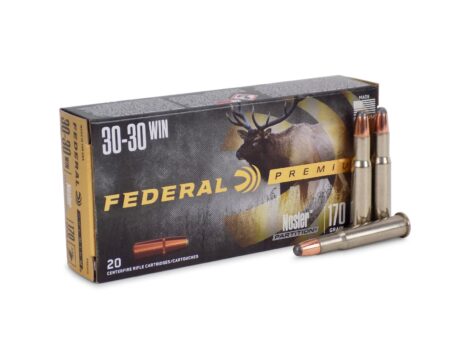
 Ammo Reports Team
| Feature | Detail |
|---|---|
| Primary Use | Deer and medium-to-large game hunting |
| Bullet Type | Nosler Partition — dual lead core, partitioned gilding metal jacket |
| Bullet Weight | 170 grain |
| Case Material | Nickel-plated brass |
| Primer Type | Boxer (factory primer size not verified) |
| Packaging | 20 rounds per box |
| Typical Price | $49.89/box · ~$2.49/round |
| Closest Competitors | Hornady LEVERevolution 30-30 Win 160 gr FTX, Winchester Super-X 30-30 Win 170 gr Power-Point, Remington Core-Lokt 30-30 Win 170 gr SP |
Official Specs
| Spec | Value | Source |
|---|---|---|
| Muzzle Velocity (fps) | 2200 | Federal 2022 catalog, rifle ballistics |
| Muzzle Energy (ft-lbs) | 1827 | Federal 2022 catalog, rifle ballistics |
| Bullet Weight | 170 gr | Federal 2022 catalog, rifle ballistics |
| Bullet Type | Nosler Partition soft point | Federal 2022 catalog, rifle ballistics |
| BC G1 | 0.254 | Federal 2022 catalog, rifle ballistics |
| BC G7 | – | Not found in verified official manufacturer sources |
| Manufacturer SKU | P3030D | Federal 2022 catalog, rifle ballistics |
| UPC | – | Not found in verified official manufacturer sources |
| Reloadable | Yes – brass case | Case/primer construction; exact primer specification unverified |
| Case Material | Nickel-plated brass | Federal 2022 catalog |
| Primer | Boxer; factory primer size not verified | Case/primer construction; exact primer specification unverified |
Verified factory load: Federal P3030D, .30-30 Winchester, 170 gr. Source: Federal 2022 catalog, rifle ballistics. G7 BC and UPC were not found in the verified official sources. This is archived factory data, not confirmation of current production or availability.


Ballistics Table
Manufacturer data and calculated estimates are separated below. All trajectories shown use a 100-yard zero.
Official manufacturer ballistics. Federal 2022 catalog, rifle ballistics. Original published distances through 300 yards; unlisted distances are not interpolated. Test barrel: 24 inches. Sight height: 1.5 inches. Manufacturer catalog atmospheric conditions: 59°F, 29.53 inHg, sea level.
| Yards | Official velocity (fps) | Official energy (ft-lb) | Official trajectory (in) |
|---|---|---|---|
| 0 | 2200 | 1827 | – |
| 100 | 1894 | 1354 | 0 |
| 200 | 1619 | 990 | -8.4 |
| 300 | 1380 | 719 | -30 |
Calculated estimate – not manufacturer data. 0-300 yards, 50-yard increments. G1 point-mass model (py-ballisticcalc); 170 gr, muzzle velocity 2200 fps, G1 BC 0.254, 100-yard zero, sight height 1.5 inches, sea level, 59°F, 29.92 inHg, 0% humidity, no wind. Model atmosphere is stated separately from manufacturer conditions. Actual results vary with firearm, ammunition lot and conditions.
| Yards | Calculated velocity (fps) | Calculated energy (ft-lb) | Calculated trajectory (in) |
|---|---|---|---|
| 0 | 2200 | 1827 | -1.5 |
| 50 | 2041 | 1573 | 0.3 |
| 100 | 1890 | 1348 | -0.0 |
| 150 | 1746 | 1150 | -2.7 |
| 200 | 1610 | 979 | -8.3 |
| 250 | 1484 | 831 | -17.3 |
| 300 | 1369 | 707 | -30.2 |
Key takeaway: The manufacturer table and the 50-yard model serve different purposes and should not be treated as interchangeable measurements. Energy alone does not establish a guaranteed hunting range or terminal performance.
The Nosler Partition Bullet — Why It Matters in This Load
The Nosler Partition is one of the most historically significant hunting bullet designs in American ammunition history. Introduced by John Nosler in 1948, it was the first bullet engineered with a physical copper partition separating the front and rear lead cores. When Federal Premium launched its Premium line, the Nosler Partition was among the first projectiles selected — a pairing that has remained in the catalog for decades.
The design works as follows: the front lead core is enclosed in a tapered jacket that allows controlled mushrooming on impact, while the rear lead core is protected behind the partition wall; the Partition is not a bonded-core design. This means the front half expands reliably even at reduced impact velocities, while the rear half retains mass and drives deep penetration. For a cartridge like the 30-30 Winchester, which operates at moderate velocity compared to modern magnums, this two-stage construction is particularly well-suited — expansion is not dependent on high velocity to initiate.
At 170 grains, this is the a traditional .30-30 hunting bullet weight, further supporting penetration on heavier-bodied deer, black bear, and hogs at woods ranges.
Best Uses
Good fit:
- Whitetail deer hunting at ranges inside 150 yards, particularly in dense timber or brush
- Black bear hunting where shots are expected at close to moderate range
- Wild hog hunting in wooded terrain where a heavier bullet and controlled expansion are preferred
- Hunters using older lever-action rifles chambered in 30-30 Winchester with tubular magazines (flat-nose bullet is tube-magazine safe)
- Situations where reliable terminal performance at reduced impact velocity is required — the Partition design does not need high velocity to expand
Not the right tool for:
- Open-country shots beyond 200 yards, where drop becomes significant and wind drift matters more
- Varmint or small game — 170 grains of expanding bullet is excessive and destructive for small targets
- Hunters seeking lead-free or non-toxic alternatives for areas with lead ammunition restrictions
- Shooters on a budget who need high-volume practice ammunition — this is a premium hunting load priced accordingly
- Use in rifles with tubular magazines loaded with pointed-tip bullets — not applicable here, but worth noting that this load’s flat-nose profile is specifically compatible with tubular magazines
Reliability Notes
No structured submissions yet.
Based on manufacturer claims and open-source product information: Federal describes the Nosler Partition as performing consistently across a wide range of impact velocities, which is relevant for a moderate-velocity cartridge like the 30-30. The partitioned construction is specifically noted to prevent core separation — a failure mode that can occur with standard cup-and-core bullets when impact conditions vary. Federal’s Premium line is loaded to tighter tolerances than their standard American Eagle or Power-Shok lines, which typically translates to more consistent velocity spread across a box. These notes come from manufacturer claims and open sources, not structured test data.
Competitors
| Load | Weight | Bullet | BC G1 | Adv. Velocity | Price/box | Notes |
|---|---|---|---|---|---|---|
| Hornady LEVERevolution 30-30 Win 160 gr FTX | 160 gr | FTX (flex-tip) | 0.330 | 2400 fps | ~$32–$38 | Manufacturer reference: 82730. |
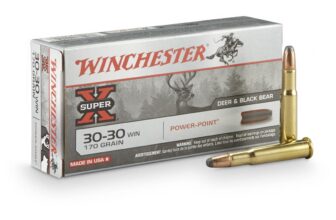
| Winchester Super-X 30-30 Win 170 gr Power-Point | 170 gr | Power-Point SP | 0.241 | 2200 fps | ~$28–$34 | Manufacturer reference: X30303. |
| Remington Core-Lokt 30-30 Win 170 gr SP | 170 gr | Core-Lokt SP | 0.254 | 2200 fps | ~$26–$32 | Manufacturer reference: R30302. |
| Federal Power-Shok 30-30 Win 170 gr SP | 170 gr | Soft Point | 0.254 | 2200 fps | ~$24–$30 | Manufacturer reference: 3030B. |
| Barnes VOR-TX 30-30 Win 150 gr TSX | 150 gr | TSX FN, all-copper | 0.184 | 2335 fps | ~$42–$48 | Manufacturer reference: 21535 / BB30301. |
| Hornady Custom 30-30 Win 170 gr InterLock | 170 gr | InterLock SP | – | – | ~$28–$34 | Exact factory identity/specifications not verified. Original price estimate is not verified. |
Price Reality
- At $49.89 per box (20 rounds), this load sits at the top of the 30-30 price range
- Per-round cost of approximately $2.49 is roughly double the cost of budget 30-30 loads like Remington Core-Lokt or Winchester Super-X
- The Hornady LEVERevolution in 160 gr runs $32–$38 per box — meaningfully cheaper and offers higher advertised velocity, though with a different bullet design
- The Barnes VOR-TX in 150 gr is a close price competitor at $42–$48 and offers lead-free construction, which may justify the premium in restricted areas
- A fair price benchmark for this load is approximately $45–$55 per box given the Nosler Partition component cost; pricing above $55 for a 20-round box should be considered overpriced unless supply is constrained
- Case pricing (typically 10 boxes) is not widely listed for this load; single-box purchase is the standard retail format
Prices change. Check the Where to Buy block for current listings.
Where to Buy
Federal Premium 30-30 Winchester 170 Grain Nosler Partition (Box)
Affiliate links. These do not influence ratings, data, or any editorial content on this page.
FAQ
Why does Federal use the Nosler Partition specifically in this 30-30 load rather than one of their own bullet designs?
The Nosler Partition was the founding bullet of Federal’s Premium line, and the pairing has remained in the catalog because the design’s performance characteristics align well with the 30-30’s velocity envelope. Federal produces its own bonded bullets (Trophy Bonded Bear Claw, Terminal Ascent) but these are generally optimized for higher-velocity cartridges. The Partition’s ability to expand reliably at lower impact velocities — which occur with the 30-30 at moderate ranges — makes it a logical choice for this application. It is also a bullet with decades of documented field performance, which carries weight with the hunting market that relies on the 30-30.
How does this load compare to the Hornady LEVERevolution 160 gr FTX for whitetail deer?
This load’s verified specifications are 170 gr, 2200 fps and G1 BC 0.254. Compare factory tables only when their zero and test conditions are stated. The Ballistics Table separates published manufacturer values from the 50-yard calculated model; it does not establish comparative terminal performance.
Is this load safe to use in older lever-action rifles with tubular magazines?
This review concerns the exact .30-30 Winchester factory load identified in Official Specs. Follow the firearm manual and the ammunition manufacturer’s compatibility instructions for tubular magazines. Bullet-tip material alone does not prove magazine compatibility; this conclusion must not be generalized to other tipped bullets or other calibers.
Does the Nosler Partition offer any advantage over standard soft-point bullets at 30-30 velocities?
At the moderate velocities the 30-30 Winchester produces, standard cup-and-core soft points can occasionally over-expand on impact with light resistance or under-expand at longer ranges where velocity has dropped. The Nosler Partition‘s dual-core construction addresses both failure modes: the front core expands consistently across a wider velocity range, while the rear core remains intact regardless of front-end behavior. For hunters who take shots at varying distances or hunt larger deer and black bear where penetration matters, the Partition’s construction provides a meaningful margin of reliability that standard soft points do not guarantee.
Why is this load priced significantly higher than other 30-30 ammunition?
The Nosler Partition is a premium component bullet that costs substantially more to manufacture than a standard cup-and-core soft point. The partitioned jacket, dual lead cores, and tighter manufacturing tolerances all contribute to the higher per-unit cost. Federal’s Premium line also applies stricter quality control standards than their standard-tier ammunition. For hunters who shoot the 30-30 Winchester for practice or casual plinking, budget loads are entirely appropriate. For a single hunting season where shot count is low and terminal performance matters, the price premium for the Partition is generally considered justified by serious hunters who use this cartridge.