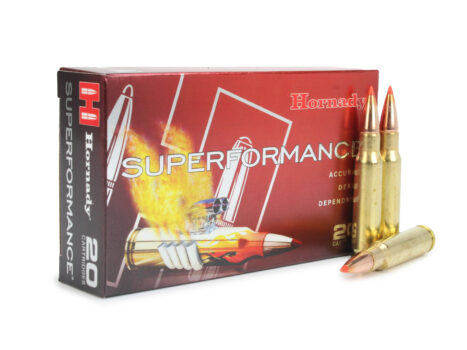
 Ammo Reports Team
| Official Spec | Value |
|---|---|
| Manufacturer | Hornady |
| Cartridge | 308 Winchester |
| Product Line | Superformance |
| Bullet Name / Type | SST – polymer-tipped boat-tail |
| Bullet Weight | 165 gr |
| SKU / Part Number | 80983 |
| UPC | 090255809831 – retailer-listed |
| Rounds per Box | 20 |
| Muzzle Velocity | 2,840 fps |
| Muzzle Energy | 2,955 ft-lbs |
| Ballistic Coefficient G1 | 0.447 |
| Ballistic Coefficient G7 | Not found |
| Case Material | Brass – retailer-listed |
| Primer | Boxer – retailer-listed |
| Reloadable | Yes – retailer-listed |
| Test Barrel Length | 24 in |
| Zero Distance | 200 yd |
| Sight Height | 1.5 in |
| Intended Use | Big game hunting |
| Product Status | Current |
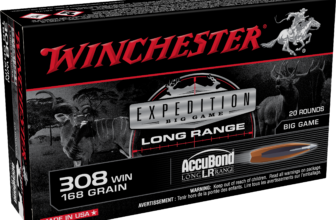
| Closest Competitors | Federal Premium Vital-Shok 165 gr Trophy Bonded Tip, Winchester Expedition Big Game 165 gr AccuBond CT, Remington Core-Lokt Tipped 165 gr .308 Win, Hornady Precision Hunter 178 gr ELD-X .308 Win, Nosler Trophy Grade 165 gr Partition .308 Win, Barnes VOR-TX 168 gr TTSX .308 Win |
Data is based on official manufacturer sources. Found an error? Send us the source link.
Values labeled retailer-listed are retained only where the manufacturer does not publish the identifier or packaging detail.
Ballistics Table
Hornady manufacturer data. No calculated wind values are mixed into this table.
| Yards | Velocity (fps) | Energy (ft-lbs) | Trajectory (in) |
|---|---|---|---|
| 0 | 2,840 | 2,955 | -1.5 |
| 100 | 2,636 | 2,545 | +1.8 |
| 200 | 2,440 | 2,182 | 0 |
| 300 | 2,253 | 1,860 | -7.6 |
| 400 | 2,074 | 1,577 | -22.1 |
| 500 | 1,904 | 1,328 | -44.6 |
The SST Bullet and Superformance Propellant System
The SST (Super Shock Tip) bullet is one of Hornady’s core hunting projectiles. It uses a red polymer tip seated in a lead-core, gilding-metal-jacketed body. The tip serves two functions: it improves the ballistic coefficient by streamlining the nose profile, and it initiates controlled expansion on impact by driving rearward into the lead core. The jacket is tapered and cannelured to produce a controlled mushroom across a wide range of impact velocities — important for a load designed to function from close-range shots at higher retained velocity all the way out to longer ranges where velocity has dropped.
The Superformance designation refers to Hornady’s proprietary propellant blend, which is formulated to produce higher velocities than standard powder charges without exceeding safe pressure limits. The chemistry is optimized for temperature stability, which reduces the velocity variation that can occur between cold-morning and midday shots during a hunt. This is not a standard factory load running standard powder — the velocity advantage is real and documented, and it matters most in the 200–400 yard engagement window typical of open-country deer and elk hunting.
Best Uses
Good fit:
- Whitetail and mule deer hunting at ranges from 50 to 400 yards
- Elk and black bear hunting where shots are expected inside 300 yards
- Open-country hunting where a flatter trajectory compared to standard .308 loads reduces ranging error margin
- Hunters who want a polymer-tipped bullet for reliable feeding in semi-automatic or box-magazine bolt-action rifles
- Situations where the same rifle is used for both medium and larger game and a single load must perform across a range of impact velocities
Not the right tool for:
- Varmint or predator hunting — the 165 gr SST is too heavy and too expensive for high-volume small-game use
- Jurisdictions with lead-free ammunition regulations (California, some national parks) — the SST uses a traditional lead core and does not qualify as a non-toxic projectile
- Extreme long-range precision shooting past 600 yards where a higher G7 BC bullet (e.g., ELD-X or ELD Match) would be more appropriate
- Hunters specifically seeking a bonded bullet for heavy bone and deep penetration on the largest dangerous game — the SST is a cup-and-core design, not a bonded or monometal bullet
Reliability Notes
No structured submissions yet.
From manufacturer claims and open sources: Hornady describes the Superformance line as designed for consistent primer ignition and minimal velocity variation across temperature ranges, which is relevant for hunters in cold-weather conditions. The SST bullet’s polymer tip is reported to resist deformation in magazine stacking, which is a noted failure mode for some soft-point designs. The brass cases are Boxer-primed and described by Hornady as suitable for reloading after firing, though this is a factory ammunition reference only. No feed or extraction failures specific to this load have been identified in open-source reporting. These notes come from manufacturer claims and general open-source discussion, not structured performance submissions.
Competitors
The complete comparison set from the original report is preserved below. Internal links appear only where an exact published Ammo Reports review exists.
| Load | Weight | Bullet | BC G1 | Advertised Velocity | Notes |
|---|---|---|---|---|---|
| Federal Premium Vital-Shok 165 gr Trophy Bonded Tip | 165 gr | Trophy Bonded Tip (bonded) | 0.470 | Not verified | Bonded construction; better deep penetration on heavy game |
| Winchester Expedition Big Game 165 gr AccuBond CT | 165 gr | AccuBond CT (bonded) | 0.475 | Not verified | Bonded core; Nosler bullet; premium tier |
| Remington Core-Lokt Tipped 165 gr .308 Win | 165 gr | Core-Lokt Tipped (cup-and-core, polymer tip) | Not verified | Not verified | Budget alternative; similar design concept, lower velocity |
| Hornady Precision Hunter 178 gr ELD-X .308 Win | 178 gr | ELD-X (expanding, high BC) | 0.552 | Not verified | Same brand; higher BC; better past 400 yd; heavier bullet |
| Nosler Trophy Grade 165 gr Partition .308 Win | 165 gr | Partition (dual-core bonded) | 0.475 | Not verified | Premium; dual-core partition for deep penetration on elk |
| Barnes VOR-TX 168 gr TTSX .308 Win | 168 gr | TTSX (lead-free, monometal) | 0.447 | Not verified | Lead-free; legal in restricted zones; all-copper construction |
Price and Availability
Retail availability changes by seller, location, and lot. Use the retailer links above to check current stock and checkout totals.
Where to Buy
FAQ
Does the SST bullet expand reliably at the lower impact velocities encountered at 400–500 yards?
The SST polymer tip is designed to initiate expansion at impact velocities as low as approximately 1,600 fps, which the Hornady Superformance load at 165 gr retains well past 500 yards under standard conditions. At 500 yards, this load is still moving at roughly 1,971 fps according to calculated trajectory data, leaving a substantial margin above the minimum expansion threshold. For deer-sized game within 400 yards, expansion reliability is not a concern with this bullet. At extreme ranges beyond 500 yards in cold weather or high altitude, confirming retained velocity against the minimum expansion threshold is worth doing before relying on the load.
How does the Superformance 165 gr SST compare to the Hornady Precision Hunter 178 gr ELD-X in .308 Winchester?
These are two different tools within Hornady’s own lineup. The 165 gr SST Superformance offers higher velocity and a flatter trajectory inside 300 yards, making it a better choice for hunters who shoot at mixed distances and want reduced holdover. The 178 gr ELD-X Precision Hunter has a significantly higher BC (0.552 G1 vs. 0.447 G1), which means it resists wind drift better and retains energy more efficiently past 400 yards — but it starts slower. For most whitetail hunters shooting inside 300 yards, the SST Superformance is the more practical choice. For open-country hunters regularly engaging past 400 yards, the ELD-X becomes more competitive.
Is this load legal for hunting in California or other lead-restricted zones?
No. The Hornady SST uses a traditional lead core and does not qualify as a non-toxic or lead-free projectile under California’s AB 711 regulations, which require lead-free ammunition for all hunting statewide. Hunters in California, certain national parks, and other jurisdictions with lead-free requirements should look at alternatives such as the Barnes VOR-TX 168 gr TTSX, which uses an all-copper monometal bullet. Always verify local regulations before purchasing hunting ammunition.
What is the effective hunting range of this load for elk?
For elk-sized game, most experienced hunters and ballisticians recommend a minimum of 1,500 ft-lbs of retained energy and a terminal velocity sufficient for reliable expansion. This load retains over 1,900 ft-lbs at 300 yards and over 1,400 ft-lbs at 500 yards. The energy threshold is met comfortably at practical elk hunting ranges. However, the SST is a cup-and-core design, not a bonded bullet, and penetration depth on heavy-boned elk at close range (under 100 yards) where impact velocity is highest may not match a bonded or partition bullet. For elk inside 200 yards with potential for heavy-shoulder shots, a bonded alternative such as the Federal Trophy Bonded Tip or Nosler Partition is worth considering.
What barrel length is this load optimized for, and does it matter?
Hornady’s published 2,840 fps muzzle velocity is measured from a 24-inch test barrel. Most hunting rifles in .308 Winchester use 20–22 inch barrels, which will typically yield 40–80 fps less than the published figure — roughly 2,760–2,800 fps from a 22-inch barrel. This is a modest reduction that does not meaningfully affect performance inside 400 yards. The Superformance propellant blend is formulated to be efficient across a range of barrel lengths, and the velocity advantage over standard .308 loads remains even in shorter barrels. Hunters using 18-inch tactical-profile barrels may see a slightly larger velocity reduction and should account for that in trajectory calculations.