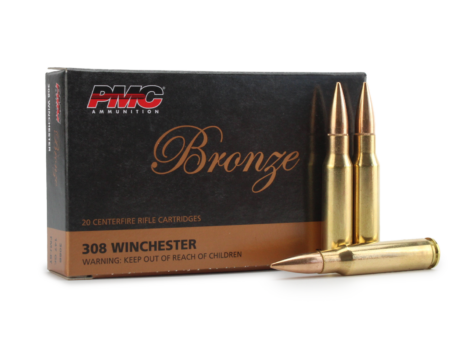
 Ammo Reports Team
| Official Spec | Value |
|---|---|
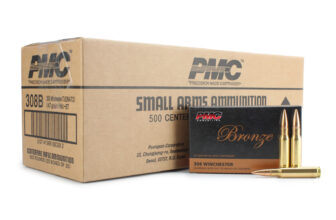
| Manufacturer | PMC |
| Cartridge | 308 Winchester (7.62 NATO) |
| Product Line | Bronze |
| Bullet Name / Type | FMJ-BT |
| Bullet Weight | 147 gr |
| SKU / Part Number | 308B |
| UPC | 741569060288 – retailer-listed |
| Rounds per Box | 20 |
| Muzzle Velocity | 2,780 fps |
| Muzzle Energy | 2,522 ft-lbs |
| Ballistic Coefficient G1 | 0.398 |
| Ballistic Coefficient G7 | Not found |
| Case Material | Brass |
| Primer | Boxer, non-corrosive |
| Reloadable | Yes |
| Test Barrel Length | 24 in |
| Zero Distance | 200 yd |
| Sight Height | 1.5 in |
| Intended Use | Target shooting; training |
| Product Status | Current |
| Closest Competitors | Federal American Eagle 308 Win 150gr FMJ (AE308B), Sellier & Bellot 308 Win 147gr FMJ, Fiocchi 308 Win 150gr FMJ, Winchester USA 308 Win 147gr FMJ (USA308W1), Hornady Black 308 Win 155gr A-MAX/ELD-M, Magtech 308 Win 150gr FMJ |
Data is based on official manufacturer sources. Found an error? Send us the source link.
Values labeled retailer-listed are retained only where the manufacturer does not publish the identifier or packaging detail.
Ballistics Table
PMC manufacturer data. No calculated wind values are mixed into this table.
| Yards | Velocity (fps) | Energy (ft-lbs) | Trajectory (in) |
|---|---|---|---|
| 0 | 2,780 | 2,522 | -1.5 |
| 100 | 2,575 | Not published | +1.88 |
| 200 | 2,380 | Not published | 0 |
| 300 | 2,194 | Not published | -8.03 |
| 400 | 2,018 | Not published | -23.29 |
| 500 | 1,851 | Not published | -47.11 |
Best Uses
Good fit:
- High-volume target shooting and range training where cost-per-round matters
- Semi-automatic and bolt-action 308 Winchester rifles requiring reliable feeding
- Positional shooting practice and drills at 100–300 yards
- Zeroing and load-familiarization work before switching to a hunting or defensive load
- Competitive shooting disciplines that permit FMJ ammunition (e.g., some service rifle formats)
- Recreational plinking and general marksmanship development
Not the right tool for:
- Deer, hog, or any big-game hunting — FMJ bullets do not expand and are illegal for hunting in many U.S. states and countries
- Terminal performance applications requiring reliable energy transfer or controlled expansion
- Long-range precision shooting beyond 400 yards, where standard FMJ construction and non-match quality controls limit practical precision
- Jurisdictions with FMJ restrictions for hunting or self-defense use — verify local laws before purchasing
- Situations requiring published, verified ballistic data for mission-critical applications
Reliability Notes
No structured submissions yet.
Based on manufacturer claims and open-source information: PMC’s Bronze line has a long-standing reputation among budget-conscious shooters for consistent primer ignition and reliable feeding in semi-automatic platforms, including AR-10-pattern rifles and M1A variants. The brass case is Boxer-primed, which supports reuse by handloaders, though this page covers factory loads only. PMC manufactures ammunition at its own facility in South Korea and maintains in-house production of components including brass and projectiles, which the company cites as a quality-consistency advantage. Open-source user reports suggest that case dimensions are generally within SAAMI specification and that the load functions reliably in both tight-chamber bolt guns and gas-operated semi-automatics. No structured failure-rate or lot-consistency data is available. All notes above reflect manufacturer claims or aggregated open-source observations, not structured AmmoReports submissions.
Competitors
The complete comparison set from the original report is preserved below. Internal links appear only where an exact published Ammo Reports review exists.
| Load | Weight | Bullet | BC G1 | Advertised Velocity | Notes |
|---|---|---|---|---|---|
| Federal American Eagle 308 Win 150gr FMJ (AE308B) | 150 gr | FMJ-BT | Not verified | Not verified | Slightly heavier; published velocity; widely available |
| Sellier & Bellot 308 Win 147gr FMJ | 147 gr | FMJ | Not verified | Not verified | Same bullet weight as PMC; published specs; European manufacture |
| Fiocchi 308 Win 150gr FMJ | 150 gr | FMJ | – | Not verified | Italian manufacture; slightly heavier bullet |
| Winchester USA 308 Win 147gr FMJ (USA308W1) | 147 gr | FMJ | – | Not verified | Higher published velocity; domestic manufacture; premium budget tier |
| Hornady Black 308 Win 155gr A-MAX/ELD-M | 155 gr | ELD-M | Not verified | Not verified | Premium alternative; significantly better BC; not FMJ; for precision use |
| Magtech 308 Win 150gr FMJ | 150 gr | FMJ | – | Not verified | Budget alternative; Brazilian manufacture; comparable price point |
Price and Availability
Retail availability changes by seller, location, and lot. Use the retailer links above to check current stock and checkout totals.
Where to Buy
Confirm the exact SKU and package quantity before ordering.
FAQ
Does the PMC Bronze 147gr FMJ expand on impact, and can it be used for deer hunting?
The PMC Bronze FMJ uses a lead-core, full-metal-jacket construction specifically designed to resist deformation — it does not expand on impact. This makes it unsuitable for ethical deer hunting, as the lack of expansion limits energy transfer and reliable terminal performance. Beyond the ethical concern, FMJ ammunition is prohibited for hunting in many U.S. states and in most of the European Union. Hunters should select an appropriate soft-point or polymer-tipped expanding bullet for any big-game application.
Why doesn’t PMC publish muzzle velocity for this load?
PMC does not publicly list muzzle velocity or muzzle energy for all loads in the Bronze line on their official website, which is an acknowledged gap in their product documentation compared to competitors like Federal and Hornady. The estimated velocity used in the ballistics table above (~2,700 fps from a 24" barrel) is based on industry reference data for 147gr FMJ .308 loads and is consistent with what independent chronograph users have reported in open forums. Shooters who require verified ballistic data for a specific application should consider Sellier & Bellot’s 147gr FMJ, which publishes a confirmed muzzle velocity.
How does the 147gr bullet weight compare to more common 150gr and 168gr .308 loads?
The 147 grain projectile is slightly lighter than the more common 150gr FMJ loads, which means it will typically exit the muzzle at a marginally higher velocity for a given powder charge. In practical terms at 100–300 yards, the difference between 147gr and 150gr loads is negligible for target shooting. The 168gr match bullet — common in precision loads — offers a significantly higher ballistic coefficient and is better suited for long-range work beyond 400 yards, but at considerably higher cost per round.
Is the brass in PMC Bronze 308 reloadable?
Yes. PMC Bronze uses Boxer-primed brass cases, which are compatible with standard reloading dies and decapping tools. The brass is generally regarded in the reloading community as serviceable for multiple firings, though this page covers factory ammunition only and does not provide reloading guidance. Shooters who collect brass for reloading should inspect cases after firing for any signs of stretching or primer pocket loosening, as with any brass regardless of manufacturer.
How does PMC Bronze compare to Sellier & Bellot 147gr FMJ — are they essentially the same load?
Both loads use a 147 grain FMJ projectile in .308 Winchester with Boxer-primed brass, and they occupy the same price tier. The key practical difference is that Sellier & Bellot publishes a muzzle velocity (~2,723 fps), which gives shooters a verified starting point for ballistic calculations, while PMC does not. Both are manufactured to SAAMI specifications and are reported to function reliably in a wide range of platforms. If published data matters for your application, S&B has a documentation advantage; if availability or price tips slightly in PMC’s favor at your source, the functional difference at typical training distances is minimal.