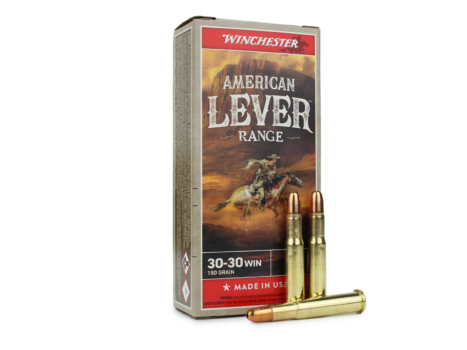
 Ammo Reports Team
| Feature | Detail |
|---|---|
| Primary Use | Lever-action rifle target shooting and plinking |
| Bullet Type | Jacketed Hollow Point (JHP) |
| Bullet Weight | 150 gr |
| Case Material | Brass |
| Primer Type | Boxer (factory primer size not verified) |
| Packaging | 20 rounds per box |
| Typical Price | $27.99/box · $1.40/round |
| Closest Competitors | Hornady LEVERevolution 30-30 Win 160 gr FTX, Federal Power-Shok 30-30 Win 150 gr JSP, Remington Core-Lokt 30-30 Win 150 gr SP |
Official Specs
| Spec | Value | Source |
|---|---|---|
| Muzzle Velocity (fps) | 2390 | Winchester product specifications |
| Muzzle Energy (ft-lbs) | 1902 | Winchester product specifications |
| Bullet Weight | 150 gr | Winchester product specifications |
| Bullet Type | American Lever Range Jacketed Hollow Point / Open Tip | Winchester product specifications |
| BC G1 | 0.218 | Winchester product specifications |
| BC G7 | – | Not found in verified official manufacturer sources |
| Manufacturer SKU | W3030AL | Winchester product specifications |
| UPC | – | Not found in verified official manufacturer sources |
| Reloadable | Yes – brass case | Case/primer construction; exact primer specification unverified |
| Case Material | Brass | Case/primer construction; exact primer specification unverified |
| Primer | Boxer; factory primer size not verified | Case/primer construction; exact primer specification unverified |
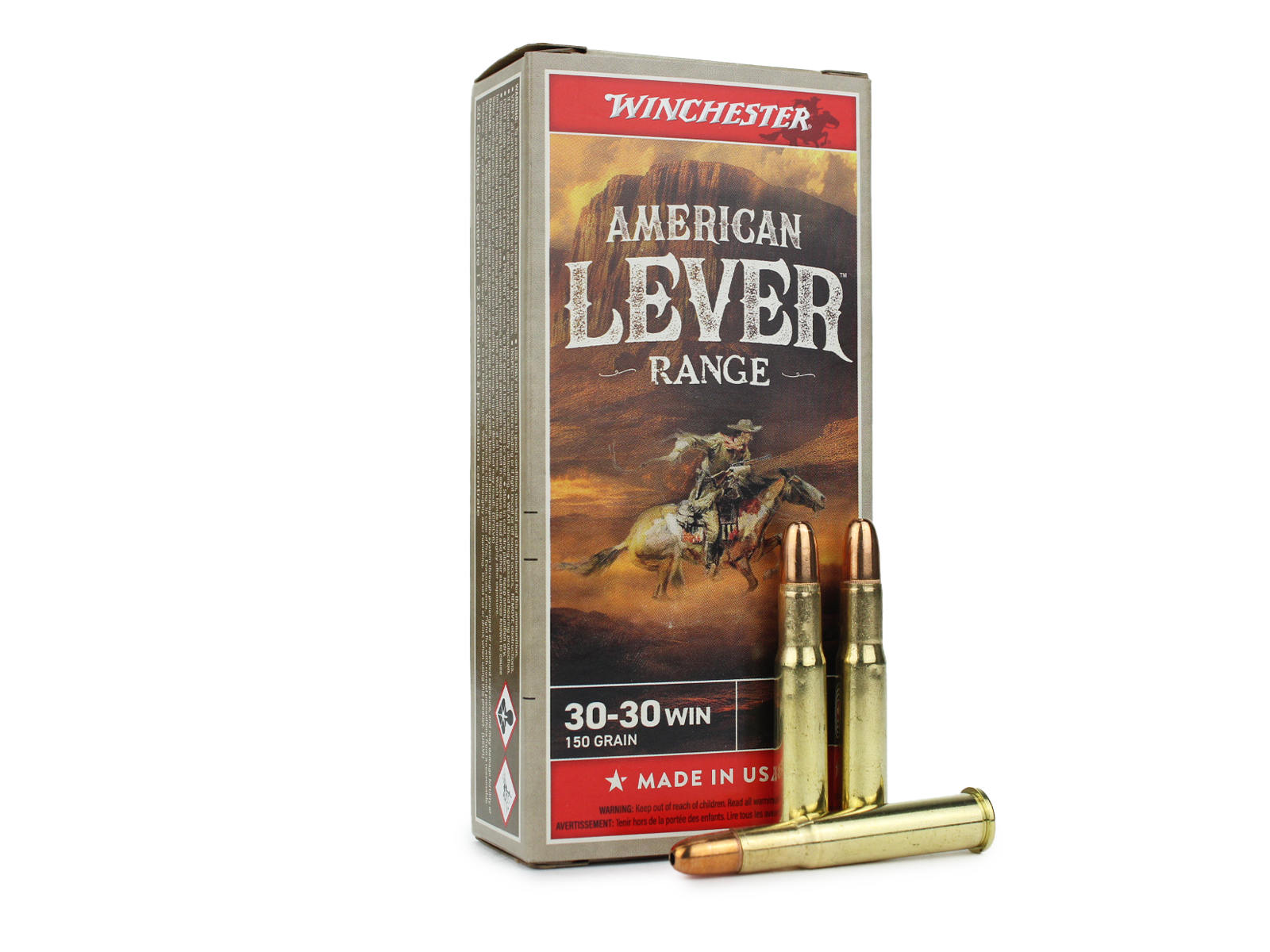
Verified factory load: Winchester W3030AL, .30-30 Winchester, 150 gr. Source: Winchester product specifications. G7 BC and UPC were not found in the verified official sources. The current product list calls this bullet Jacketed Hollow Point; the January 2026 launch release calls it Open Tip. Both identify W3030AL as range ammunition.

Ballistics Table
Manufacturer data and calculated estimates are separated below. All trajectories shown use a 100-yard zero.
A complete official downrange table for this exact SKU was not found in the verified manufacturer sources. The muzzle specifications and BC are manufacturer-published; the following distances are calculated.
Calculated estimate – not manufacturer data. 0-300 yards, 50-yard increments. G1 point-mass model (py-ballisticcalc); 150 gr, muzzle velocity 2390 fps, G1 BC 0.218, 100-yard zero, sight height 1.5 inches, sea level, 59°F, 29.92 inHg, 0% humidity, no wind. Sight height is an explicitly assumed model input. Actual results vary with firearm, ammunition lot and conditions.
| Yards | Calculated velocity (fps) | Calculated energy (ft-lb) | Calculated trajectory (in) |
|---|---|---|---|
| 0 | 2390 | 1902 | -1.5 |
| 50 | 2197 | 1608 | 0.2 |
| 100 | 2013 | 1350 | -0.0 |
| 150 | 1839 | 1126 | -2.3 |
| 200 | 1675 | 935 | -7.2 |
| 250 | 1524 | 773 | -15.2 |
| 300 | 1386 | 640 | -26.9 |
Key takeaway: The manufacturer table and the 50-yard model serve different purposes and should not be treated as interchangeable measurements. Energy alone does not establish a guaranteed hunting range or terminal performance.
Why This Load Exists
The Winchester American Lever Range line was developed to address a specific problem that lever-action shooters have faced for decades: the tubular magazine. In a tubular magazine, cartridges stack nose-to-primer, meaning a pointed (spitzer) bullet tip rests directly against the primer of the round in front of it. Under recoil, this contact can cause a chain-fire — a dangerous and potentially catastrophic event. For generations, this forced 30-30 Winchester shooters to use flat-nosed or round-nosed bullets, which carry inferior ballistic coefficients compared to pointed projectiles.
Winchester describes American Lever Range as ammunition developed for reliable feeding, cycling and consistent range performance in lever-action rifles. The product list identifies W3030AL as a 150 gr Jacketed Hollow Point; the launch release uses Open Tip. Neither description establishes hunting expansion or penetration for this exact factory load.
Best Uses
Good fit:
- Range practice and function testing in lever-action rifles chambered in 30-30 Winchester
- Lever-action target practice and training; manufacturer hunting performance is not verified for W3030AL.
- Hog shooting at moderate ranges where terminal expansion from a JHP is desirable
- Shooters seeking a tubular-magazine-safe load that maintains a reasonably aerodynamic profile
- Training with a load that approximates hunting-weight bullet performance without premium pricing
Not the right tool for:
- Long-range shooting beyond 200 yards, where the JHP’s moderate BC produces significant drop and wind drift
- Varmint or predator hunting where rapid fragmentation or minimal meat damage is a priority — a JHP at this weight is engineered for larger game
- Jurisdictions or hunting areas with restrictions on expanding bullets or specific bullet construction requirements
- Bolt-action or single-shot rifles where the tubular-magazine-safe design offers no benefit and other bullet profiles may outperform it ballistically
- Elk or other large, heavy-boned North American game where deeper penetration from a bonded or partition-style bullet is more appropriate
Reliability Notes
No structured submissions yet.
Based on manufacturer claims and open-source product descriptions, the American Lever Range line is built around modern propellant formulations that Winchester states burn cleaner than traditional powders used in legacy 30-30 loads. This is a manufacturer claim, not independently verified structured data. The brass case and boxer primer construction are consistent with Winchester’s standard production quality for this price tier, and the design is intended for reliable cycling in lever-action platforms including the Winchester Model 94, Marlin 336, and similar rifles. No functional or safety concerns have been identified in publicly available sources at the time of publication. The JHP bullet design is specifically noted by Winchester as engineered for tubular magazine compatibility, addressing a known safety consideration inherent to the platform.
Competitors
| Load | Weight | Bullet | BC G1 | Adv. Velocity | Price/box | Notes |
|---|---|---|---|---|---|---|
| Hornady LEVERevolution 30-30 Win 160 gr FTX | 160 gr | FTX (polymer-tipped) | 0.330 | 2400 fps | ~$32–$36 | Manufacturer reference: 82730. |
| Federal Power-Shok 30-30 Win 150 gr JSP | 150 gr | Jacketed Soft Point | 0.218 | 2390 fps | ~$24–$28 | Manufacturer reference: 3030A. |
| Remington Core-Lokt 30-30 Win 150 gr SP | 150 gr | Core-Lokt Soft Point | 0.193 | 2390 fps | ~$26–$30 | Manufacturer reference: R30301. |
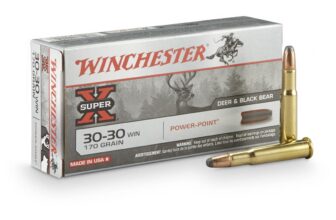
| Winchester Super-X 30-30 Win 150 gr Power-Point | 150 gr | Power-Point SP | 0.218 | 2390 fps | ~$26–$30 | Manufacturer reference: X30306. |
| Browning BXR 30-30 Win 155 gr RNCSX | 155 gr | Matrix Tip | – | – | ~$30–$34 | Exact factory identity/specifications not verified. Original price estimate is not verified. |
| Fiocchi 30-30 Win 150 gr FSP | 150 gr | Flat Soft Point | – | – | ~$22–$26 | Exact factory identity/specifications not verified. Original price estimate is not verified. |
Price Reality
- Typical retail price: $27.99 per box of 20 rounds
- Per-round cost: approximately $1.40/round
- At current pricing, a case of 10 boxes (200 rounds) would run approximately $279.90 before shipping, though case pricing may vary by retailer
- Federal Power-Shok 150 gr JSP and Fiocchi 150 gr FSP typically come in $2–$6 cheaper per box, making them the go-to budget alternatives at the same bullet weight and velocity
- Hornady LEVERevolution 160 gr FTX commands a $4–$8 premium per box and offers a measurably superior ballistic coefficient — worth the extra cost for hunters prioritizing downrange performance
- Remington Core-Lokt 150 gr SP and Winchester Super-X Power-Point trade within $1–$2 of this load and represent direct price competition at the same weight class
- At $1.40/round, this load sits in the mid-tier for 30-30 Winchester factory ammunition — not budget, not premium. Paying more than $33–$34 per box for this specific load would be above fair market value based on current trends
Prices change. Check the Where to Buy block for current listings.
Where to Buy
Winchester American Lever Range 30-30 Win 150 Gr JHP (Box)
Affiliate links. These do not influence ratings, data, or any editorial content on this page.
FAQ
Is the Winchester American Lever Range JHP safe to use in a tubular magazine lever-action rifle?
This review concerns the exact .30-30 Winchester factory load identified in Official Specs. Follow the firearm manual and the ammunition manufacturer’s compatibility instructions for tubular magazines. Bullet-tip material alone does not prove magazine compatibility; this conclusion must not be generalized to other tipped bullets or other calibers.
How does this load compare to Hornady LEVERevolution for deer hunting?
Winchester positions American Lever Range W3030AL as range ammunition. Verified manufacturer sources do not establish hunting expansion or penetration for this exact load; its muzzle energy and hollow-point/open-tip label alone do not establish suitability for deer or hogs.
What barrel length was used to derive the stated 2,390 fps muzzle velocity?
A test-barrel length for W3030AL was not found in the verified product specifications. A length used for another Winchester load should not be assigned to this SKU.
Can this ammunition be used for hog hunting?
Winchester positions American Lever Range W3030AL as range ammunition. Verified manufacturer sources do not establish hunting expansion or penetration for this exact load; its muzzle energy and hollow-point/open-tip label alone do not establish suitability for deer or hogs.
Is this load appropriate for jurisdictions that require non-lead ammunition?
No. The Winchester American Lever Range JHP uses a lead-core bullet with a copper jacket — standard construction for this price tier. It is not a lead-free load and does not comply with regulations in areas that mandate non-toxic or all-copper ammunition, such as California’s statewide non-lead hunting requirement. Shooters hunting in those jurisdictions should look at all-copper options such as the Barnes TSX or similar lead-free 30-30 loads. For standard hunting seasons in areas without lead restrictions, this load presents no regulatory concern.