 Ammo Reports Team
| Feature | Detail |
|---|---|
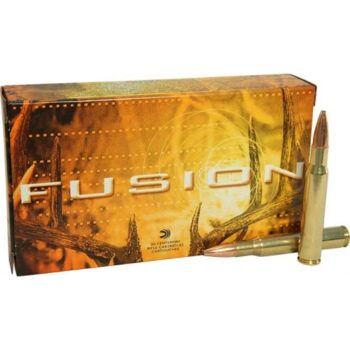
| Primary Use | Deer hunting |
| Bullet Type | Fusion Soft Point, bonded |
| Bullet Weight | 165 grain |
| Case Material | Brass (Long Action cartridge) |
| Primer Type | Boxer (Large Rifle Primer) |
| Packaging | 20 rounds per box |
| Typical Price | $40.99/box — $2.05/round |
| Closest Competitors | Hornady American Whitetail 30-06 165 gr BTSP, Winchester Power-Point 30-06 165 gr PSP, Remington Core-Lokt 30-06 165 gr PSP |
Official Specs
| Spec | Value | Source |
|---|---|---|
| Manufacturer | Federal | Federal product data |
| Cartridge | 30-06 Springfield | Federal product data |
| Product Line | Fusion | Federal product data |
| Muzzle Velocity (fps) | 2,790 | Federal product data |
| Muzzle Energy (ft-lbs) | 2,852 | Federal product data |
| Bullet Weight | 165 gr | Federal product data |
| Bullet Type | Fusion Soft Point, bonded | Federal product data |
| BC G1 | 0.454 | Federal product data |
| BC G7 | — | Not found in verified official manufacturer sources |
| Manufacturer SKU | F3006FS2 | Federal product data |
| UPC | 029465097981 | Federal product data |
| Reloadable | Yes | Brass case, Boxer primer |
| Case Material | Brass | Case construction |
| Primer | Boxer (Large Rifle Primer) | Primer configuration; factory primer model not verified |
Source labels refer to manufacturer publications; unpublished parameters remain unfilled.

Ballistics Table
Official manufacturer data. Federal product data. 100-yard zero.
| Distance (yards) | Velocity (fps) | Energy (ft-lbs) | Trajectory (inches) |
|---|---|---|---|
| 0 | 2790 | 2852 | — |
| 100 | 2590 | 2458 | 0 |
| 200 | 2399 | 2109 | -3.7 |
| 300 | 2217 | 1800 | -13.4 |
| 400 | 2042 | 1527 | — |
| 500 | 1875 | 1287 | — |
Factory trajectory shown is Federal's Average Range table: 100-yard zero and 1.5-inch sight height. Its separate Long Range table is not combined with this trajectory.
Calculated reference table – not manufacturer data. 0-700 yards in 100-yard steps. G1 point-mass model; factory muzzle velocity 2790 fps, G1 BC 0.454, 100-yard zero, assumed sight height 1.5 inches, sea level, 59°F, 29.92 inHg, 0% humidity, no wind and level fire. These assumptions are not a claim about factory test conditions. Calculated energy and trajectory are separate estimates; the distance covered does not establish an effective hunting range.
| Distance (yards) | Calculated velocity (fps) | Calculated energy (ft-lbs) | Calculated trajectory (inches) |
|---|---|---|---|
| 0 | 2790 | 2852 | -1.5 |
| 100 | 2587 | 2452 | 0.0 |
| 200 | 2393 | 2098 | -3.7 |
| 300 | 2208 | 1786 | -13.5 |
| 400 | 2030 | 1510 | -30.4 |
| 500 | 1862 | 1270 | -55.8 |
| 600 | 1703 | 1062 | -91.3 |
| 700 | 1555 | 886 | -138.7 |
The Federal Fusion Bonding Process
The Fusion bullet is distinguished by its manufacturing method rather than a conventional cup-and-core or mechanically bonded construction. Federal uses an electro-chemical process to molecularly bond the jacket to the lead core, beginning from the inside out. This differs from standard bonded designs where the jacket is chemically or mechanically attached after forming. The result is a bullet that resists core-jacket separation during penetration, which is the primary failure mode of unbonded projectiles at high impact velocities or when striking heavy bone.
Federal identifies this factory load as Fusion Soft Point. The SBT wording in the article title is not the verified manufacturer bullet designation. The skived tip — a pre-cut notch at the bullet’s nose — is designed to initiate consistent expansion at a range of impact velocities, including lower-velocity impacts at extended distances. Federal’s published claims for the Fusion line include industry-leading expansion diameter and weight retention figures, though independent third-party gel testing results vary by range and velocity at impact. This load was specifically engineered around deer-sized game, and the construction reflects that focused design intent rather than a general-purpose approach.
Best Uses
Good fit:
- Whitetail deer hunting at ranges from close timber shots out to 300+ yards
- Mule deer and pronghorn in open country where a flat-shooting 30-06 is appropriate
- Hunters who prioritize bullet weight retention and controlled expansion over raw velocity
- Situations where a bonded bullet is preferred — angled shots, shoulder-heavy deer, dense cover where bone contact is likely
- Hunters seeking a purpose-built deer round at a mid-tier price point without stepping into premium territory
Not the right tool for:
- Elk, moose, or large bear — the 165 gr Fusion Soft Point in 30-06 can work on elk at close range, but heavier bullets and more robust constructions are generally preferred for larger North American game
- Varmint or predator hunting — the expansion profile and bullet cost make this a poor fit for high-volume or small-target use
- Long-range precision shooting — without a published BC, dialing precise corrections beyond 400 yards requires field-verified data
- Jurisdictions with lead-free ammunition requirements (California deer zones, certain federal lands) — this is a lead-core bullet
Reliability Notes
No structured submissions yet.
Based on manufacturer claims and open-source product information: Federal states the Fusion line delivers consistent expansion across a wide velocity range, which is relevant for 30-06 loads that may impact at varying velocities depending on shot distance. The bonded construction is described as producing high weight retention — Federal has historically cited figures above 95% in controlled testing for the Fusion line, though specific published data for this exact 165 gr load was not located at time of writing. Brass cases and Boxer primers make this load compatible with standard bolt-action and semi-automatic 30-06 platforms. No feeding or extraction issues specific to this load have been identified in open sources. All notes here come from manufacturer claims or publicly available product information, not structured user data.
Competitors
| Load | Weight | Bullet | BC G1 | Adv. Velocity | Price/box | Notes |
|---|---|---|---|---|---|---|
| Hornady American Whitetail 30-06 165 gr BTSP | 165 gr | InterLock BTSP | ~0.447 | 2,800 fps | ~$32–$36 | Budget alternative; unbonded but proven cup-and-core design |
| Remington Core-Lokt 30-06 165 gr PSP | 165 gr | Core-Lokt PSP | ~0.392 | 2,800 fps | ~$28–$34 | Classic budget option; unbonded, flat-base, lower BC |
| Winchester Power-Point 30-06 165 gr PSP | 165 gr | Power-Point PSP | ~0.383 | 2,800 fps | ~$30–$36 | Budget; cup-and-core, known for rapid expansion |
| Federal Trophy Bonded Tip 30-06 165 gr | 165 gr | Trophy Bonded Tip | ~0.490 | 2,800 fps | ~$52–$58 | Premium alternative; same manufacturer, higher BC, polymer tip |
| Nosler Trophy Grade 30-06 165 gr AccuBond | 165 gr | AccuBond (bonded) | ~0.475 | 2,800 fps | ~$54–$62 | Premium bonded; widely trusted for larger deer and elk |
| Barnes VOR-TX 30-06 168 gr TTSX | 168 gr | TTSX (lead-free) | ~0.435 | 2,750 fps | ~$52–$60 | Lead-free option; required in California; all-copper construction |
Price Reality
- Typical retail range: $38–$44 per 20-round box depending on retailer and region; case pricing (typically 10 boxes/200 rounds) may reduce per-box cost to approximately $36–$40 when available
- Per-round cost: approximately $1.95–$2.20 at normal retail pricing
- The Hornady American Whitetail 165 gr and Remington Core-Lokt 165 gr both come in at $8–$12 less per box, making them the clear budget alternatives — the premium paid for Fusion reflects the bonded bullet construction
- Federal Trophy Bonded Tip and Nosler Trophy Grade loads cost $10–$20 more per box, placing Fusion squarely in the mid-tier segment
- A fair price benchmark: anything above $46/box for this load should be considered above market unless supply is constrained; below $38 represents a strong buy
Prices change. Check the Where to Buy block for current listings.
Where to Buy
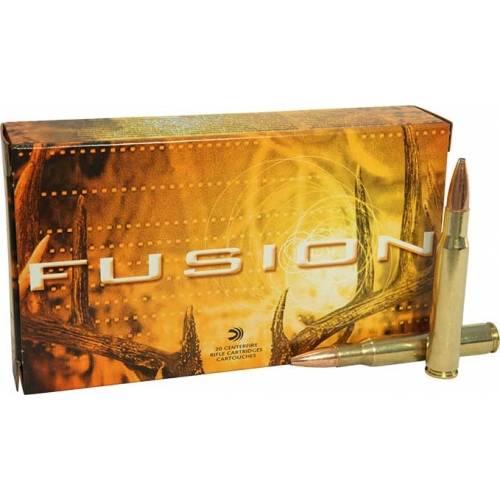
Federal Fusion 30-06 Springfield 165 Grain SBT (Box)
Affiliate links. These do not influence ratings, data, or any editorial content on this page.
FAQ
Does the Federal Fusion 165 gr SBT use the same bonding process as Federal’s premium Trophy Bonded line?
Both the Fusion and Trophy Bonded lines use bonded bullet construction, but they are distinct products with different manufacturing approaches and performance profiles. The Fusion uses an electro-chemical bonding process applied during jacket formation, while the Trophy Bonded line uses a separate bonding method with a different jacket profile and tip design. The Trophy Bonded Tip includes a polymer tip for improved BC and initiating expansion, which the Fusion SBT does not. The Fusion line is positioned specifically for deer-sized game at a lower price point, while Trophy Bonded loads are designed for a broader range of game including larger animals.
How does the 165 gr Fusion SBT compare to the 150 gr Fusion load for whitetail deer?
Federal rates the separate 150 gr Fusion load F3006FS1 at 2,900 fps with G1 BC 0.410. This 165 gr F3006FS2 is rated at 2,790 fps with G1 BC 0.454. Both use bonded Fusion Soft Point bullets. Initial velocity alone does not establish which has less drop or wind drift at every distance.
Is the Federal Fusion 30-06 165 gr SBT legal for deer hunting in California?
This load contains lead and does not meet a nonlead projectile requirement. California requires certified nonlead ammunition when taking wildlife with a firearm statewide, effective July 1, 2019. Verify the exact product against the current CDFW certification list and applicable hunting regulations.
What is the effective range of this load for deer hunting?
Federal publishes 2,790 fps muzzle velocity, 2,852 ft-lbs muzzle energy and a 0.454 G1 BC for F3006FS2. The factory table and separate calculated reference show retained velocity and energy, but neither alone establishes an effective hunting range. Bullet performance, conditions and demonstrated accuracy must all be considered.
Why doesn’t Federal publish muzzle velocity for this specific Fusion load?
Federal publishes velocity data for many of their Fusion loads, but data availability varies by SKU and is not always reflected consistently across retail listings and the manufacturer’s website. The absence of a published velocity for this specific 165 gr Fusion Soft Point configuration does not indicate a product deficiency — it is a data-availability gap common to mid-tier factory ammunition lines. Buyers who need confirmed velocity figures for precision ballistic calculations should chronograph the load from their specific barrel, as muzzle velocity varies meaningfully with barrel length, temperature, and lot variation regardless of published specs. A 24-inch test barrel will typically produce higher velocities than a 22-inch hunting rifle barrel.