 Ammo Reports Team
| Feature | Detail |
|---|---|
| Primary Use | Medium and big game hunting (deer, black bear, feral hog) |
| Bullet Type | Jacketed Soft Point (JSP) |
| Bullet Weight | 150 gr |
| Case Material | Brass |
| Primer Type | Boxer (factory primer size not verified) |
| Packaging | 20 rounds per box |
| Typical Price | $36.49/box — $1.82/round |
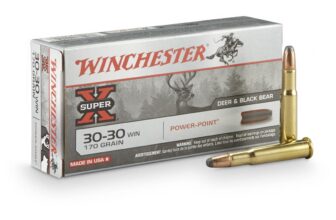
| Closest Competitors | Winchester Super-X 30-30 Win 150 gr Power-Point, Remington Core-Lokt 30-30 Win 150 gr SP, Hornady LEVERevolution 30-30 Win 160 gr FTX |
Official Specs
| Spec | Value | Source |
|---|---|---|
| Muzzle Velocity (fps) | 2390 | Federal product specifications |
| Muzzle Energy (ft-lbs) | 1902 | Federal product specifications |
| Bullet Weight | 150 gr | Federal product specifications |
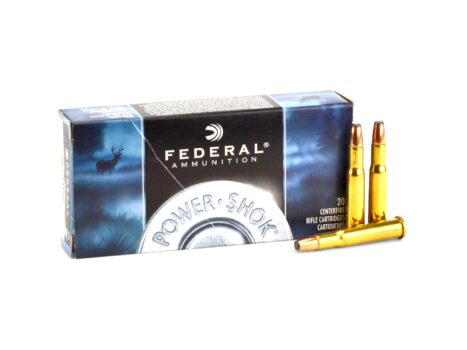
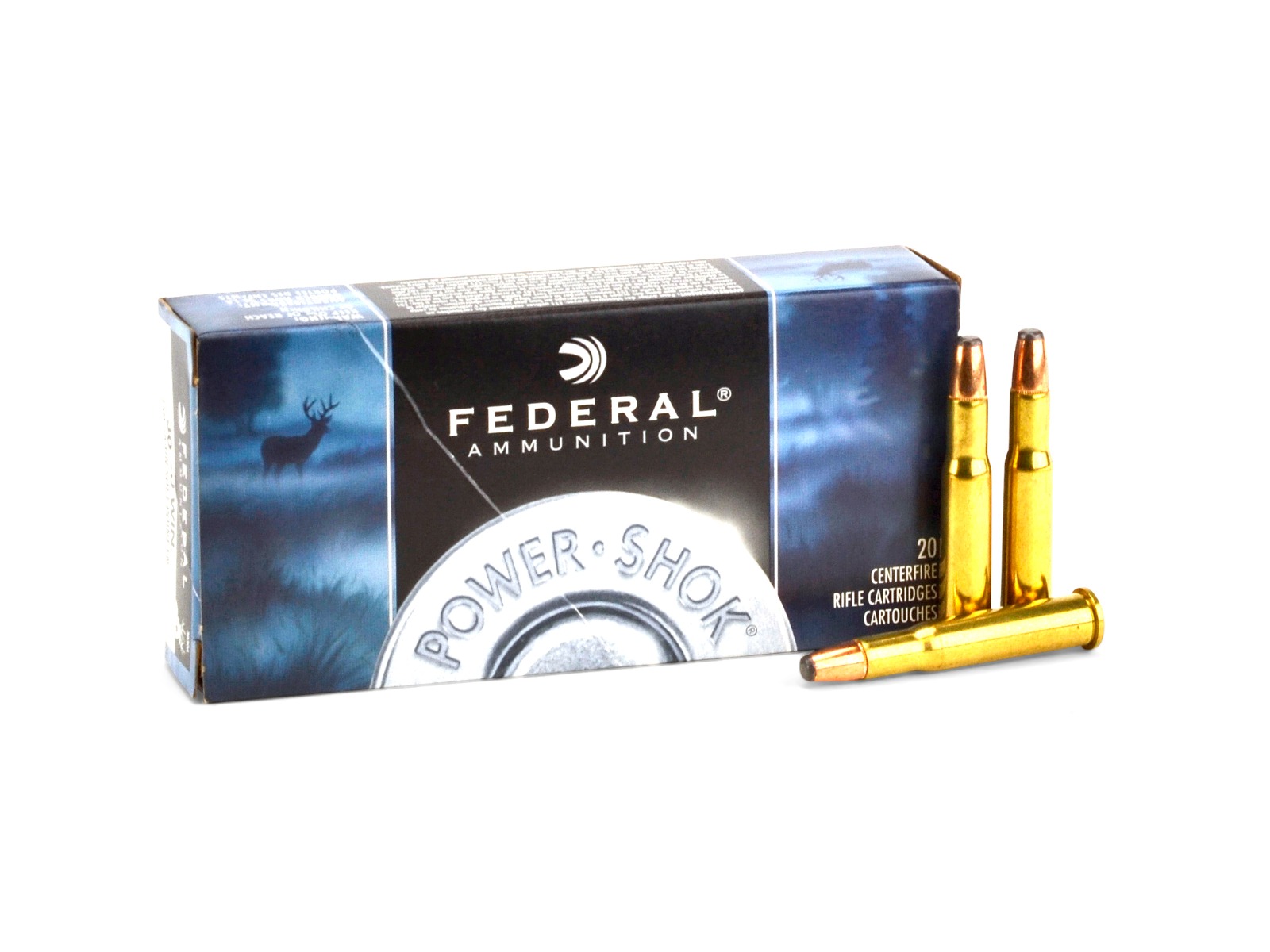
| Bullet Type | Power-Shok Jacketed Soft Point | Federal product specifications |
| BC G1 | 0.218 | Federal product specifications |
| BC G7 | – | Not found in verified official manufacturer sources |
| Manufacturer SKU | 3030A | Federal product specifications |
| UPC | 029465084486 | Federal product structured data |
| Reloadable | Yes – brass case | Case/primer construction; exact primer specification unverified |
| Case Material | Brass | Case/primer construction; exact primer specification unverified |
| Primer | Boxer; factory primer size not verified | Case/primer construction; exact primer specification unverified |
Verified factory load: Federal 3030A, .30-30 Winchester, 150 gr. Source: Federal product specifications. G7 BC was not found in the verified official sources.

Ballistics Table
Manufacturer data and calculated estimates are separated below. All trajectories shown use a 100-yard zero.
Official manufacturer ballistics. Federal product specifications. Original published distances through 300 yards; unlisted distances are not interpolated. Test barrel: 24 inches. Sight height: 1.5 inches. Manufacturer catalog atmospheric conditions: 59°F, 29.53 inHg, sea level.
| Yards | Official velocity (fps) | Official energy (ft-lb) | Official trajectory (in) |
|---|---|---|---|
| 0 | 2390 | 1902 | – |
| 100 | 2019 | 1358 | 0 |
| 200 | 1686 | 947 | -7.2 |
| 300 | 1399 | 652 | -26.7 |
Calculated estimate – not manufacturer data. 0-300 yards, 50-yard increments. G1 point-mass model (py-ballisticcalc); 150 gr, muzzle velocity 2390 fps, G1 BC 0.218, 100-yard zero, sight height 1.5 inches, sea level, 59°F, 29.92 inHg, 0% humidity, no wind. Model atmosphere is stated separately from manufacturer conditions. Actual results vary with firearm, ammunition lot and conditions.
| Yards | Calculated velocity (fps) | Calculated energy (ft-lb) | Calculated trajectory (in) |
|---|---|---|---|
| 0 | 2390 | 1902 | -1.5 |
| 50 | 2197 | 1608 | 0.2 |
| 100 | 2013 | 1350 | -0.0 |
| 150 | 1839 | 1126 | -2.3 |
| 200 | 1675 | 935 | -7.2 |
| 250 | 1524 | 773 | -15.2 |
| 300 | 1386 | 640 | -26.9 |
Key takeaway: The manufacturer table and the 50-yard model serve different purposes and should not be treated as interchangeable measurements. Energy alone does not establish a guaranteed hunting range or terminal performance.
The Federal Power-Shok Line and the 30-30’s Place in It
The Federal Power-Shok series occupies the entry-level tier of Federal’s rifle ammunition lineup, designed to deliver functional hunting performance at an accessible price point rather than to push terminal or ballistic technology forward. The 30-30 Winchester cartridge itself carries one of the longest deer-hunting track records of any American centerfire round, introduced in 1895 and still chambered in millions of lever-action rifles today. The pairing of a 150-grain jacketed soft point with this cartridge is not accidental — it represents the most historically proven bullet weight for the caliber, balancing sectional density, velocity, and expansion characteristics within the modest pressure limits of the cartridge. Federal’s choice to use a traditional JSP rather than a polymer-tipped design keeps this load compatible with tubular magazines without any risk of primer ignition from bullet-tip contact — a practical engineering constraint that shapes the entire category.
Best Uses
Good fit:
- Whitetail deer hunting inside 150 yards, particularly in wooded or brushy terrain where shots are typically short
- Black bear hunting at close to moderate range where the jacketed soft point construction provides controlled expansion
- Feral hog management in environments where lever-action rifles are preferred for their handling characteristics
- Hunters seeking a budget-accessible load for practice or as a backup to a premium hunting round in the same caliber
- Shooters with older lever-action rifles chambered in 30-30 where tubular magazine compatibility is required
Not the right tool for:
- Open-country or prairie hunting where shots regularly exceed 200 yards — trajectory drop becomes a significant field liability
- Hunters in states or jurisdictions requiring lead-free ammunition in designated zones — this load uses a traditional lead-core bullet
- Situations demanding deep penetration on heavy-boned large game like elk or moose, where heavier or bonded bullets are more appropriate
- Competitive shooting or precision applications where published BC and velocity data are required for accurate external ballistics calculations
Reliability Notes
No structured submissions yet.
Based on manufacturer claims and open-source user feedback, the Federal Power-Shok line is described as offering consistent primer ignition and reliable feeding in lever-action platforms. The brass case construction is noted to be reloadable for those who retain brass, though this is a factory-load reference page and reloading specifics are outside scope. Some open-source accounts note that Power-Shok JSP bullets perform adequately on deer-sized game at typical 30-30 ranges but may not expand as reliably at reduced velocities beyond 200 yards compared to premium bonded or polymer-tipped designs. These observations come from open sources and manufacturer product positioning, not structured chronograph or terminal performance data collected by this database.
Competitors
| Load | Weight | Bullet | BC G1 | Adv. Velocity | Price/box | Notes |
|---|---|---|---|---|---|---|
| Winchester Super-X Power-Point 30-30 Win | 150 gr | Power-Point SP | 0.218 | 2390 fps | ~$32–$36 | Manufacturer reference: X30306. |
| Remington Core-Lokt 30-30 Win | 150 gr | Core-Lokt SP | 0.193 | 2390 fps | ~$30–$35 | Manufacturer reference: R30301. |
| Hornady LEVERevolution 30-30 Win | 160 gr | FTX (polymer tip) | 0.330 | 2400 fps | ~$38–$45 | Manufacturer reference: 82730. |
| Federal Power-Shok 30-30 Win 170 gr | 170 gr | Round Nose SP | 0.254 | 2200 fps | ~$34–$38 | Manufacturer reference: 3030B. |
| Browning BXR 30-30 Win | 155 gr | Rapid Expansion Matrix Tip | – | – | ~$38–$44 | Exact factory identity/specifications not verified. Original price estimate is not verified. |
| HSM Trophy Gold 30-30 Win | 150 gr | Nosler Ballistic Tip | – | – | ~$45–$55 | Exact factory identity/specifications not verified. Original price estimate is not verified. |
Price Reality
- Typical retail range: $33–$40 per 20-round box depending on retailer and market conditions; case pricing (typically 10 boxes/200 rounds) when available runs approximately $320–$380
- Per-round cost: At $36.49 list price, this load runs approximately $1.82 per round
- Versus Winchester Super-X 30-30 150 gr: Winchester’s comparable load typically retails $2–$5 less per box, making it the more aggressive budget option with similar ballistic performance
- Versus Hornady LEVERevolution 160 gr FTX: Hornady’s premium load commands a $5–$10 premium per box and delivers measurably better downrange performance due to its higher BC polymer-tipped bullet
- Versus Remington Core-Lokt 30-30 150 gr: Core-Lokt typically runs $1–$4 less per box and offers a bonded-core construction that some hunters consider an advantage for terminal performance
- Fair price benchmark: At or below $36 per box this load represents fair market value for a standard JSP hunting round in this caliber. Pricing above $40 per box for this specific load warrants comparison shopping — equivalent or superior options are typically available at that price point
Prices change. Check the Where to Buy block for current listings.
Where to Buy
Federal 30-30 Winchester 150 Grain SP (Box)
Affiliate links. These do not influence ratings, data, or any editorial content on this page.
FAQ
Does the 150-grain JSP bullet in this load work with tubular magazines?
This review concerns the exact .30-30 Winchester factory load identified in Official Specs. Follow the firearm manual and the ammunition manufacturer’s compatibility instructions for tubular magazines. Bullet-tip material alone does not prove magazine compatibility; this conclusion must not be generalized to other tipped bullets or other calibers.
How does this load compare to Hornady LEVERevolution in practical hunting situations?
This load’s verified specifications are 150 gr, 2390 fps and G1 BC 0.218. Compare factory tables only when their zero and test conditions are stated. The Ballistics Table separates published manufacturer values from the 50-yard calculated model; it does not establish comparative terminal performance.
Is this load appropriate for black bear hunting?
The 150-grain jacketed soft point at 30-30 velocities is considered adequate for black bear at close range by many experienced hunters, particularly for animals in the 150–250 lb range. The JSP construction provides controlled expansion that transfers energy effectively into soft tissue. For larger black bear or shots at the outer edge of the cartridge’s practical range, a heavier bullet (such as the 170-grain option in the same line) or a bonded bullet design may offer more reliable penetration through heavy muscle and bone. Shot placement remains the dominant factor at these ranges regardless of bullet choice.
What official velocity and ballistic coefficient does the manufacturer publish for this load?
Federal publishes 2390 fps and a G1 BC of 0.218 for 3030A. The earlier statement that these specifications were unpublished was incorrect.
Can this load be used for deer hunting in jurisdictions with lead-free requirements?
No — this Federal Power-Shok load uses a traditional lead-core jacketed bullet and is not compliant with lead-free ammunition regulations in force in California or in specific wildlife management units in other states that prohibit lead projectiles. Hunters in those areas should look to Federal’s Trophy Copper line or other manufacturers’ lead-free offerings specifically designed for compliance with those regulations. Always verify current regulations in your specific hunting unit before selecting ammunition, as lead-free requirements vary by state, zone, and game species.