 Ammo Reports Team
| Feature | Detail |
|---|---|
| Primary Use | Deer hunting at short to moderate range |
| Bullet Type | Fusion Soft Point — electrochemically bonded lead core to copper jacket |
| Bullet Weight | 170 grain |
| Case Material | Brass |
| Primer Type | Boxer (factory primer size not verified) |
| Packaging | 20 rounds per box |
| Typical Price | $35.99/box — $1.80/round |
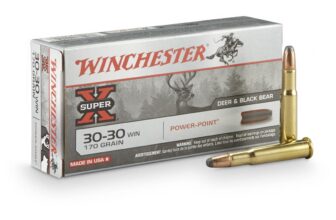
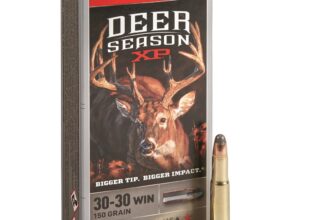
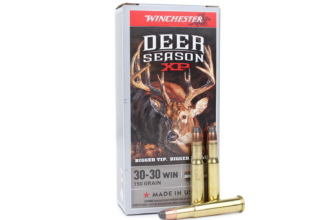
| Closest Competitors | Winchester Deer Season XP 30-30 Win 150 gr Extreme Point, Hornady LEVERevolution 30-30 Win 160 gr FTX, Remington Core-Lokt 30-30 Win 170 gr SP |
Official Specs
| Spec | Value | Source |
|---|---|---|
| Muzzle Velocity (fps) | 2200 | Federal product specifications |
| Muzzle Energy (ft-lbs) | 1827 | Federal product specifications |
| Bullet Weight | 170 gr | Federal product specifications |
| Bullet Type | Fusion Soft Point (bonded) | Federal product specifications |
| BC G1 | 0.313 | Federal product specifications |
| BC G7 | – | Not found in verified official manufacturer sources |
| Manufacturer SKU | F3030FS2 | Federal product specifications |
| UPC | 029465097936 | Federal product structured data |
| Reloadable | Yes – brass case | Case/primer construction; exact primer specification unverified |
| Case Material | Brass | Case/primer construction; exact primer specification unverified |
| Primer | Boxer; factory primer size not verified | Case/primer construction; exact primer specification unverified |
Verified factory load: Federal F3030FS2, .30-30 Winchester, 170 gr. Source: Federal product specifications. G7 BC was not found in the verified official sources.

Ballistics Table
Manufacturer data and calculated estimates are separated below. All trajectories shown use a 100-yard zero.
Official manufacturer ballistics. Federal product specifications. Original published distances through 300 yards; unlisted distances are not interpolated. Test barrel: 24 inches. Sight height: 1.5 inches. Manufacturer catalog atmospheric conditions: 59°F, 29.53 inHg, sea level.
| Yards | Official velocity (fps) | Official energy (ft-lb) | Official trajectory (in) |
|---|---|---|---|
| 0 | 2200 | 1827 | – |
| 100 | 1950 | 1435 | 0 |
| 200 | 1719 | 1115 | -7.7 |
| 300 | 1510 | 860 | -27.2 |
Calculated estimate – not manufacturer data. 0-300 yards, 50-yard increments. G1 point-mass model (py-ballisticcalc); 170 gr, muzzle velocity 2200 fps, G1 BC 0.313, 100-yard zero, sight height 1.5 inches, sea level, 59°F, 29.92 inHg, 0% humidity, no wind. Model atmosphere is stated separately from manufacturer conditions. Actual results vary with firearm, ammunition lot and conditions.
| Yards | Calculated velocity (fps) | Calculated energy (ft-lb) | Calculated trajectory (in) |
|---|---|---|---|
| 0 | 2200 | 1827 | -1.5 |
| 50 | 2071 | 1619 | 0.3 |
| 100 | 1946 | 1430 | -0.0 |
| 150 | 1826 | 1259 | -2.6 |
| 200 | 1712 | 1106 | -7.7 |
| 250 | 1603 | 969 | -15.9 |
| 300 | 1500 | 849 | -27.4 |
Key takeaway: The manufacturer table and the 50-yard model serve different purposes and should not be treated as interchangeable measurements. Energy alone does not establish a guaranteed hunting range or terminal performance.
The Fusion Bullet Construction
The Fusion bullet is not a conventional cup-and-core projectile. Federal developed the Fusion line around an electrochemical bonding process that molecularly fuses the copper jacket to the lead core — a construction method that distinguishes it from standard soft point bullets where the jacket is mechanically swaged onto the core. The practical result is a bullet that resists core-jacket separation on impact, allowing more of the bullet’s mass to remain intact as it expands and penetrates tissue.
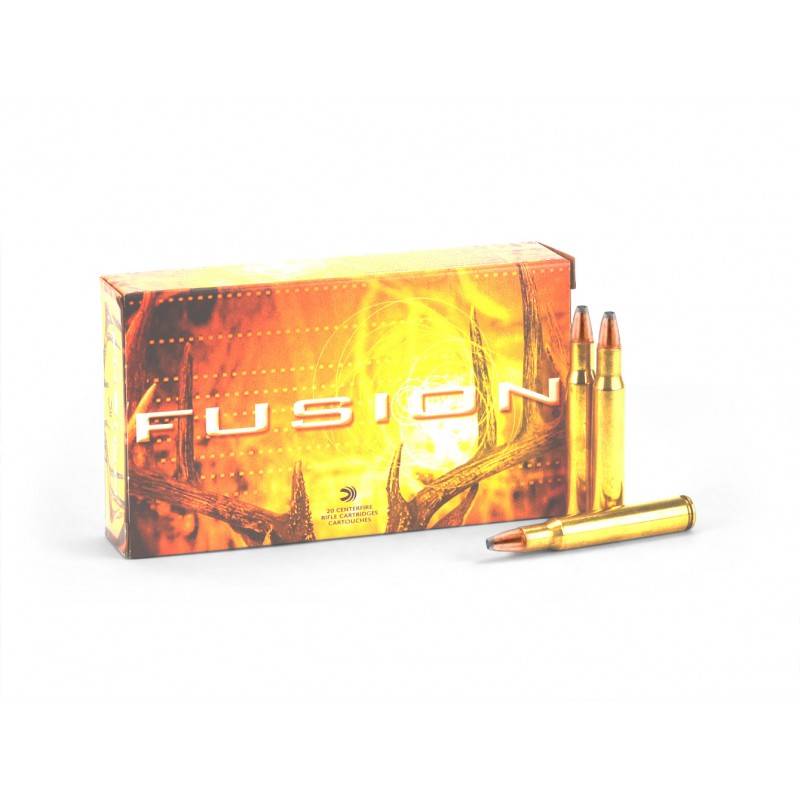
Federal identifies this rifle load as F3030FS2, 170 gr Fusion Soft Point, with a molecularly bonded jacket and pressure-formed core. The official product specifications do not identify the base as boat-tail, so SBT should not be treated as verified construction data.
F3030FS2 is a .30-30 Winchester rifle load. Generic descriptions of Fusion handgun ammunition do not establish specifications for this product.
Best Uses
Good fit:
- Whitetail deer hunting in wooded or brushy environments where shots are typically inside 150 yards
- Lever-action rifle platforms chambered in 30-30 Winchester, including the Marlin 336 and Winchester Model 94
- Hunters who prioritize bullet integrity and controlled expansion over flat trajectory
- Situations where a heavier 170 gr projectile is preferred over lighter 150 gr options for additional momentum through brush
- Hunters in states or regions where traditional lead-core soft point bullets remain fully legal for deer
Not the right tool for:
- Open-country or long-range deer hunting where shots beyond 200 yards are expected
- Elk, moose, or large dangerous game where deeper penetration from heavier, purpose-built cartridges is warranted
- Varmint or predator applications where bullet weight and construction are mismatched to the target
- Hunters in jurisdictions with lead-free ammunition requirements — this is a lead-core load
- Competitive or precision shooting applications where published BC and velocity data are required for ballistic solver inputs
Reliability Notes
No structured submissions yet.
Based on manufacturer claims and open-source product information, the Fusion bonding process is designed to prevent core-jacket separation, which is a documented failure mode in standard cup-and-core soft points at high-impact velocities or when contacting heavy bone. Federal positions the Fusion line as optimized for deer-class game, and the 170 gr weight in 30-30 Winchester is consistent with the cartridge’s long-established reputation for adequate penetration on whitetail at close range. The brass case and Boxer primer construction make this load reloadable, which is relevant for cost-conscious shooters — though reloading data is outside the scope of this reference. No recall notices, safety alerts, or documented lot-specific issues have been identified for this load at the time of publication. Community-submitted field data will be incorporated as submissions are received.
Competitors
| Load | Weight | Bullet | BC G1 | Muzzle Velocity | Price/box | Notes |
|---|---|---|---|---|---|---|
| Hornady LEVERevolution 30-30 Win 160 gr FTX | 160 gr | FTX (Flex Tip) | 0.330 | 2400 fps | ~$32–$38 | Manufacturer reference: 82730. |
| Winchester Deer Season XP 30-30 Win 150 gr Extreme Point | 150 gr | Extreme Point (polymer tip) | 0.215 | 2320 fps | ~$28–$34 | Manufacturer reference: X3030DS (2026 catalog; online velocity differs). |
| Remington Core-Lokt 30-30 Win 170 gr SP | 170 gr | Core-Lokt Soft Point | 0.254 | 2200 fps | ~$26–$32 | Manufacturer reference: R30302. |
| Federal Power-Shok 30-30 Win 170 gr SP | 170 gr | Jacketed Soft Point | 0.254 | 2200 fps | ~$24–$30 | Manufacturer reference: 3030B. |
| Barnes VOR-TX 30-30 Win 150 gr TSX FN | 150 gr | TSX FN, all-copper | 0.184 | 2335 fps | ~$45–$55 | Manufacturer reference: 21535 / BB30301. |
| Nosler Ballistic Tip 30-30 Win 150 gr | 150 gr | Ballistic Tip | 0.232 | 2390 fps | ~$38–$45 | Manufacturer reference: 40065. |
Price Reality
- Typical retail range: $33–$40 per 20-round box depending on retailer and availability
- Per-round cost: approximately $1.65–$2.00 per round at typical pricing; $1.80/round at the $35.99 reference price
- Versus Remington Core-Lokt 170 gr: Core-Lokt typically runs $26–$32/box — the Fusion commands a $5–$10 premium for the bonded bullet construction
- Versus Hornady LEVERevolution 160 gr FTX: LEVERevolution is priced comparably at $32–$38/box and offers a higher BC with the FTX tip — a meaningful consideration if trajectory matters
- Versus Barnes VOR-TX 150 gr TSX: Barnes runs $45–$55/box, making the Fusion a mid-tier option between budget soft points and premium lead-free loads
- Fair price benchmark: At $35.99/box, this load is reasonably positioned for a bonded-core deer hunting cartridge. Prices above $42/box for a standard 20-round box should be considered above market unless supply is constrained
Prices change. Check the Where to Buy block for current listings.
Where to Buy
Federal Fusion 30-30 Winchester 170 Grain SBT (Box)
Affiliate links. These do not influence ratings, data, or any editorial content on this page.
FAQ
Does the Fusion bonding process make a meaningful difference for 30-30 deer hunting compared to a standard soft point?
This load’s verified specifications are 170 gr, 2200 fps and G1 BC 0.313. Compare factory tables only when their zero and test conditions are stated. The Ballistics Table separates published manufacturer values from the 50-yard calculated model; it does not establish comparative terminal performance.
How does the Federal Fusion 170 gr SBT compare to the Hornady LEVERevolution 160 gr FTX for deer hunting?
This load’s verified specifications are 170 gr, 2200 fps and G1 BC 0.313. Compare factory tables only when their zero and test conditions are stated. The Ballistics Table separates published manufacturer values from the 50-yard calculated model; it does not establish comparative terminal performance.
Is the Federal Fusion 30-30 170 gr SBT legal for deer hunting in lead-restricted areas?
No. This is a lead-core projectile with a copper jacket — it does not qualify as lead-free ammunition under regulations that require non-toxic or all-copper bullets. Hunters in California or other jurisdictions with lead-free requirements for deer hunting on public land should consider the Barnes VOR-TX 30-30 Win 150 gr TSX FN or other certified non-toxic alternatives. Always verify current state and land-management regulations before selecting ammunition, as rules vary by zone and season.
Why does the product description reference handgun ammunition if this is a rifle load?
F3030FS2 is a .30-30 Winchester rifle load. The official description identifies a 170 gr Fusion Soft Point; handgun product descriptions are not evidence for its construction or performance.
What barrel length does Federal assume for 30-30 velocity specifications, and does it matter for lever-action rifles?
The cited manufacturer ballistic data uses a 24-inch test barrel. Its published velocity for this load is 2200 fps. A shorter barrel can change velocity, but no fixed loss per inch is verified for every rifle or ammunition lot.