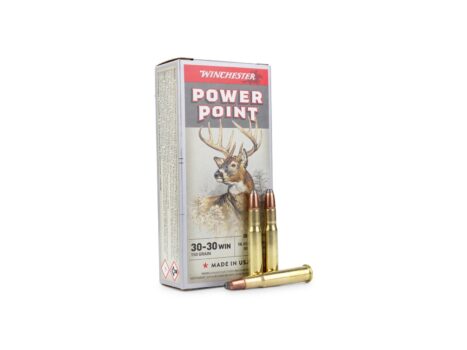
 Ammo Reports Team
| Feature | Detail |
|---|---|
| Primary Use | Deer hunting, medium-sized game |
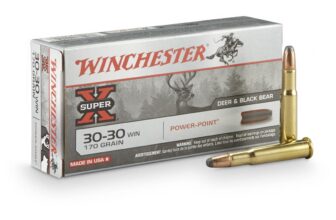
| Bullet Type | Jacketed Soft Point with notched jacket (Power-Point) |
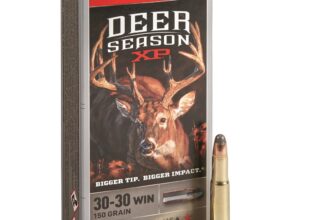
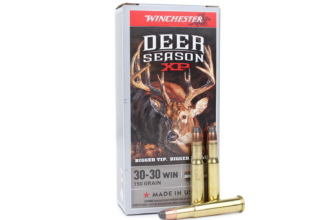
| Bullet Weight | 150 gr |
| Case Material | Brass |
| Primer Type | Boxer (factory primer size not verified) |
| Packaging | 20 rounds per box |
| Typical Price | $33.99/box — $1.70/round |
| Closest Competitors | Federal Power-Shok 30-30 Win 150 gr SP, Remington Core-Lokt 30-30 Win 150 gr SP, Hornady LEVERevolution 30-30 Win 160 gr FTX |
Official Specs
| Spec | Value | Source |
|---|---|---|
| Muzzle Velocity (fps) | 2390 | Winchester 2026 catalog, p. 31 |
| Muzzle Energy (ft-lbs) | 1902 | Winchester 2026 catalog, p. 31 |
| Bullet Weight | 150 gr | Winchester 2026 catalog, p. 31 |
| Bullet Type | Power-Point soft point | Winchester 2026 catalog, p. 31 |
| BC G1 | 0.218 | Winchester 2026 catalog, p. 31 |
| BC G7 | – | Not found in verified official manufacturer sources |
| Manufacturer SKU | X30306 | Winchester 2026 catalog, p. 31 |
| UPC | – | Not found in verified official manufacturer sources |
| Reloadable | Yes – brass case | Case/primer construction; exact primer specification unverified |
| Case Material | Brass | Case/primer construction; exact primer specification unverified |
| Primer | Boxer; factory primer size not verified | Case/primer construction; exact primer specification unverified |
Verified factory load: Winchester X30306, .30-30 Winchester, 150 gr. Source: Winchester 2026 catalog, p. 31. G7 BC and UPC were not found in the verified official sources.


Ballistics Table
Manufacturer data and calculated estimates are separated below. All trajectories shown use a 100-yard zero.
Official manufacturer ballistics. Winchester 2026 catalog, p. 31. Original published distances through 300 yards; unlisted distances are not interpolated. Test barrel: 24 inches. Sight height is not specified in the cited Winchester table.
| Yards | Official velocity (fps) | Official energy (ft-lb) | Official trajectory (in) |
|---|---|---|---|
| 0 | 2390 | 1902 | – |
| 100 | 2019 | 1357 | 0 |
| 200 | 1685 | 945 | -7.7 |
| 300 | 1398 | 651 | -27.9 |
Calculated estimate – not manufacturer data. 0-300 yards, 50-yard increments. G1 point-mass model (py-ballisticcalc); 150 gr, muzzle velocity 2390 fps, G1 BC 0.218, 100-yard zero, sight height 1.5 inches, sea level, 59°F, 29.92 inHg, 0% humidity, no wind. Sight height is an explicitly assumed model input. Actual results vary with firearm, ammunition lot and conditions.
| Yards | Calculated velocity (fps) | Calculated energy (ft-lb) | Calculated trajectory (in) |
|---|---|---|---|
| 0 | 2390 | 1902 | -1.5 |
| 50 | 2197 | 1608 | 0.2 |
| 100 | 2013 | 1350 | -0.0 |
| 150 | 1839 | 1126 | -2.3 |
| 200 | 1675 | 935 | -7.2 |
| 250 | 1524 | 773 | -15.2 |
| 300 | 1386 | 640 | -26.9 |
Key takeaway: The manufacturer table and the 50-yard model serve different purposes and should not be treated as interchangeable measurements. Energy alone does not establish a guaranteed hunting range or terminal performance.
The Power-Point Bullet Design
The Power-Point is one of the longest-running hunting bullet designs in Winchester’s catalog, and its continued production reflects genuine field performance rather than brand inertia. The defining feature is a series of notches cut into the jacket near the nose, which control the initiation and progression of expansion on impact. This design encourages the jacket to peel back in a consistent pattern, producing a wide, mushroomed profile intended to maximize energy transfer to the target rather than passing through with minimal tissue disruption.
Unlike bonded or partition-style bullets, the Power-Point is a conventional cup-and-core construction. The lead core is not chemically or mechanically bonded to the jacket, which means core-jacket separation is possible at high impact velocities — though at 30-30 Winchester velocity levels, this is rarely a practical concern. The bullet was engineered for the moderate velocity range that lever-action cartridges occupy, and the expansion characteristics reflect that design intent.
The flat or round-nose profile of the 150 gr JSP is also a deliberate safety feature for tubular magazines. Pointed bullets seated nose-to-primer in a tube magazine create a primer-strike risk under recoil, which is why the 30-30 family has historically used blunt-nosed projectiles. This geometry does reduce the ballistic coefficient compared to spitzer bullets of similar weight, which is one reason drop becomes significant past 200 yards.
Best Uses
Good fit:
- Hunting whitetail deer in wooded or brushy terrain at ranges under 150 yards
- Stand hunting or still hunting where shots are typically inside 100 yards
- Lever-action rifles with tubular magazines — this bullet profile is specifically compatible
- Hunters seeking a time-tested, widely available load without premium pricing
- Situations where JSP construction is preferred over bonded or polymer-tipped bullets for moderate-velocity performance
- States or regions where lead projectiles remain legal and no lead-free requirement applies
Not the right tool for:
- Open-country shots beyond 200 yards, where trajectory and energy loss become limiting factors
- Elk, moose, or large bear — retained energy and bullet construction are better matched to deer-class animals
- Jurisdictions with lead-free ammunition requirements for hunting (California condor zones, certain national parks)
- Rifles chambered for other cartridges — confirm your chamber before purchase; 30-30 Winchester and 30-30 Ackley Improved are not interchangeable
- Hunters who require a published, verified ballistic coefficient for precise long-range drop compensation
Reliability Notes
No structured submissions yet.
Based on manufacturer claims and open-source information: Winchester describes the Power-Point design as delivering controlled expansion across a range of impact conditions, with the notched jacket intended to initiate expansion reliably even at the lower end of the velocity range encountered at field distances. The brass case and Boxer primer construction make this load compatible with standard bolt-action and lever-action feeding systems, and the reloadable case is a practical benefit for shooters who recover brass.
Open-source field reports from hunting forums and published reviews consistently note that 30-30 Power-Point loads have produced clean kills on whitetail deer at distances under 150 yards when shots are placed in the vital zone. No recurring reports of failure to expand, excessive fragmentation, or feeding issues in common lever-action platforms (Marlin 336, Winchester Model 94) were identified at time of publication. All notes here come from manufacturer claims or open sources — not structured performance data.
Competitors
| Load | Weight | Bullet | BC G1 | Adv. Velocity | Price/box | Notes |
|---|---|---|---|---|---|---|
| Federal Power-Shok 30-30 Win 150 gr SP | 150 gr | Jacketed Soft Point | 0.218 | 2390 fps | ~$28–$32 | Manufacturer reference: 3030A. |
| Remington Core-Lokt 30-30 Win 150 gr SP | 150 gr | Core-Lokt Soft Point | 0.193 | 2390 fps | ~$28–$33 | Manufacturer reference: R30301. |
| Hornady LEVERevolution 30-30 Win 160 gr FTX | 160 gr | FTX Flex Tip | 0.330 | 2400 fps | ~$34–$40 | Manufacturer reference: 82730. |
| Winchester Super-X 30-30 Win 170 gr JSP | 170 gr | Power-Point JSP | 0.241 | 2200 fps | ~$33–$36 | Manufacturer reference: X30303. |
| Remington HTP 30-30 Win 150 gr SP | 150 gr | Soft Point | – | – | ~$30–$34 | Exact factory identity/specifications not verified. Original price estimate is not verified. |
| Barnes VOR-TX 30-30 Win 150 gr RRSP | 150 gr | Round Nose Solid Copper | – | – | ~$42–$48 | Exact factory identity/specifications not verified. Original price estimate is not verified. |
Verified competitor specifications use exact manufacturer product references. A dash identifies an unresolved factory specification or product identity; similar bullets and other weights were not substituted. Existing price estimates were not refreshed.
Price Reality
- Typical retail range: $30–$36 per 20-round box depending on retailer and market conditions
- Per-round cost: approximately $1.50–$1.80 at typical retail
- Case pricing: not commonly sold in bulk cases by major retailers for this load; individual box pricing dominates
- vs. Federal Power-Shok 30-30 150 gr: generally $3–$6 less per box — the Federal load represents the clearest budget alternative at comparable ballistics
- vs. Remington Core-Lokt 30-30 150 gr: pricing is roughly equivalent; Core-Lokt offers bonded-style construction at a similar price point
- vs. Hornady LEVERevolution 160 gr FTX: LEVERevolution typically runs $5–$10 more per box and offers a meaningfully higher BC and flatter trajectory for hunters who shoot past 150 yards
- Fair price benchmark: $33–$36 per box is within normal range for this load. Prices above $38 for a standard 20-round box of non-premium 30-30 ammunition should be considered elevated unless driven by documented supply constraints.
Prices change. Check the Where to Buy block for current listings.
Where to Buy
Winchester Super-X 30-30 Win 150 Gr JSP (Box)
Affiliate links. These do not influence ratings, data, or any editorial content on this page.
FAQ
Does the notched jacket on the Power-Point bullet actually improve expansion compared to a plain JSP?
This load’s verified specifications are 150 gr, 2390 fps and G1 BC 0.218. Compare factory tables only when their zero and test conditions are stated. The Ballistics Table separates published manufacturer values from the 50-yard calculated model; it does not establish comparative terminal performance.
How does this load compare to the Hornady LEVERevolution 160 gr FTX for deer hunting?
This load’s verified specifications are 150 gr, 2390 fps and G1 BC 0.218. Compare factory tables only when their zero and test conditions are stated. The Ballistics Table separates published manufacturer values from the 50-yard calculated model; it does not establish comparative terminal performance.
Is this ammunition safe to use in a Marlin 336 or Winchester Model 94 with a tubular magazine?
This review concerns the exact .30-30 Winchester factory load identified in Official Specs. Follow the firearm manual and the ammunition manufacturer’s compatibility instructions for tubular magazines. Bullet-tip material alone does not prove magazine compatibility; this conclusion must not be generalized to other tipped bullets or other calibers.
Can this load be used for game larger than whitetail deer, such as black bear or feral hogs?
The Power-Point at 150 gr is a capable load for feral hogs of typical size, where shot placement and moderate penetration are usually sufficient. For black bear, the answer depends on context: a 150–200 lb black bear taken at close range with a well-placed shot through the vitals is within the reasonable capability of this load, but it is not the preferred choice for larger bears or situations where deep penetration through heavy bone is required. The cup-and-core construction without bonding means the bullet may not hold together as reliably as bonded options (such as the Federal Trophy Bonded or Barnes RRSP) under high-resistance impacts. Hunters pursuing large or potentially dangerous game are generally better served by heavier, bonded, or solid-copper options in 30-30 if they choose to use this cartridge at all.
What official velocity and ballistic coefficient does the manufacturer publish for this load?
Winchester publishes 2390 fps and a G1 BC of 0.218 for X30306. The earlier statement that these specifications were unpublished was incorrect.