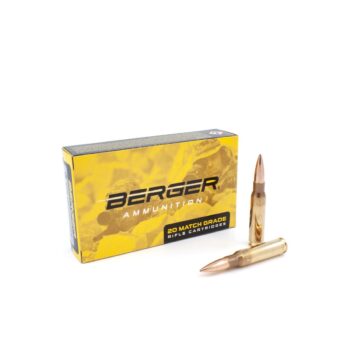
 Ammo Reports Team
| Official Spec | Value |
|---|---|
| Manufacturer | Berger |
| Cartridge | 308 Winchester |
| Product Line | OTM Tactical |
| Bullet Name / Type | Berger OTM Tactical |
| Bullet Weight | 175 gr |
| SKU / Part Number | 60010 |
| UPC | 679459600101 – retailer-listed |
| Rounds per Box | 20 |
| Muzzle Velocity | 2,668 fps |
| Muzzle Energy | 2,766 ft-lbs |
| Ballistic Coefficient G1 | 0.512 |
| Ballistic Coefficient G7 | 0.263 |
| Case Material | Premium 308 brass |
| Primer | Match-grade primer |
| Reloadable | Not found |
| Test Barrel Length | 26 in |
| Zero Distance | 200 yd |
| Sight Height | Not found |
| Intended Use | Target shooting; tactical; competition |
| Product Status | Current |
| Closest Competitors | Federal Gold Medal Match .308 Win, Hornady Match .308 Win, Black Hills Gold .308 Win, Lapua Scenar-L .308 Win, Nosler Match Grade .308 Win, Sig Sauer Elite Match .308 Win |
Data is based on official manufacturer sources. Found an error? Send us the source link.
Values labeled retailer-listed are retained only where the manufacturer does not publish the identifier or packaging detail.
Ballistics Table
Berger manufacturer data. No calculated wind values are mixed into this table.
| Yards | Velocity (fps) | Energy (ft-lbs) | Trajectory (in) |
|---|---|---|---|
| 0 | 2,668 | 2,766 | Not published |
| 100 | 2,496 | 2,422 | +2.04 |
| 200 | 2,331 | 2,112 | 0 |
| 300 | 2,173 | 1,835 | -8.46 |
| 400 | 2,020 | 1,586 | -24.29 |
The Berger OTM Bullet and Why It Exists in Factory Form
Berger Bullets built its reputation supplying match-grade component bullets to competitive shooters and precision military programs before entering the factory-loaded ammunition market. The 175 grain OTM was specifically engineered to function reliably in magazine-fed semi-automatic platforms — most notably the M110 and SR-25 family — without the feeding reliability concerns that can affect some very-low-drag VLD designs whose aggressive ogive geometry can catch on feed ramps.
The Open Tip Match construction is a manufacturing method, not a terminal-performance designation. The small open tip results from the jacket being drawn from the base, producing a more consistent core-to-jacket concentricity than a traditional cup-and-core lead-tip bullet. This concentricity is what drives the tight group sizes that define match-grade performance. The OTM is not a hollow-point hunting bullet and is not designed for controlled expansion on game.
Berger’s decision to produce factory-loaded ammunition using this projectile responds to a real-world need: not every precision shooter hand-loads, and law enforcement or military procurement channels require factory-packaged, lot-numbered ammunition for chain-of-custody and accountability purposes.
Best Uses
Good fit:
- Precision rifle competition (PRS, NRL, F-Class) requiring sub-MOA performance from bolt-action or semi-automatic platforms
- Law enforcement precision rifle qualification and training where factory-loaded, lot-traceable ammunition is required
- Military marksmanship training and evaluation programs
- Long-range target shooting from 100 to 600 yards on standard centerfire ranges
- Barrel break-in and load development baseline for 308 Winchester precision rifles
- Shooters who want to replicate the terminal and ballistic profile of a hand-loaded 175 gr OTM without investing in reloading equipment
Not the right tool for:
- Deer, elk, or any big-game hunting — the OTM bullet is not designed for controlled expansion and is not appropriate for ethical harvest of game animals
- High-volume practice or training where cost per round is a primary constraint; this is a precision-use load
- Short-barrel rifles (16″ or under) where muzzle velocity will fall below Berger’s 2,668 fps figure from a 26-inch test barrel
- Jurisdictions that restrict or prohibit open-tip or hollow-point projectiles for civilian use — verify local regulations before purchase
- Suppressed hosts where subsonic performance is the goal — this is a full-velocity load
Reliability Notes
No structured submissions yet.
Based on manufacturer claims and open-source information: Berger positions this load as manufactured to match-grade quality control standards, with emphasis on consistent powder charges and primer seating to minimize velocity standard deviation across a box. The 175 gr OTM bullet is described as optimized for magazine-length cartridge overall length (COAL) to ensure reliable cycling in standard AICS-pattern magazines and AR-10 / SR-25 platforms. No feed or extraction issues specific to this load have been identified in available open sources. These notes reflect manufacturer claims and publicly available information, not structured AmmoReports data.
Competitors
The complete comparison set from the original report is preserved below. Internal links appear only where an exact published Ammo Reports review exists.
| Load | Weight | Bullet | BC G1 | Advertised Velocity | Notes |
|---|---|---|---|---|---|
| Federal Gold Medal Match .308 Win | 175 gr | Sierra MatchKing BTHP | 0.505 | Not verified | Industry-standard reference load; widely available; budget-relative alternative |
| Hornady Match .308 Win | 168 gr | ELD-M | 0.523 | Not verified | Lower weight; slightly higher advertised velocity; 168 gr is the traditional short-range match standard |
| Black Hills Gold .308 Win | 175 gr | Sierra MatchKing | 0.505 | Not verified | Uses same 175 gr SMK projectile class; favored in military precision programs |
| Lapua Scenar-L .308 Win | 175 gr | Scenar-L OT | 0.510 | Not verified | Premium European alternative; exceptional lot-to-lot consistency; premium price |
| Nosler Match Grade .308 Win | 175 gr | Custom Competition BTHP | 0.500 | Not verified | Comparable weight and design; uses Nosler’s in-house match bullet |
| Sig Sauer Elite Match .308 Win | 175 gr | OTM | 0.505 | Not verified | Budget-relative option in the 175 gr OTM class; less established match track record |
Price and Availability
Retail availability changes by seller, location, and lot. Use the retailer links above to check current stock and checkout totals.
Where to Buy
Confirm the exact SKU and package quantity before ordering.
FAQ
Is the Berger 175 gr OTM the same bullet used in U.S. military sniper ammunition?
The M118LR cartridge — the U.S. military’s standard long-range sniper round — uses a 175 grain Sierra MatchKing OTM, not the Berger OTM. The two bullets occupy the same weight class and general design category, and both are used extensively in precision military and law enforcement applications. Berger’s 175 gr OTM has its own independent track record in competitive shooting and law enforcement precision programs. Calling the Berger bullet a "military" projectile is accurate in a general context but should not be taken to mean it is the specific projectile in current U.S. military service loads.
How does the 175 gr OTM compare to the 168 gr ELD-M for long-range .308 Winchester shooting?
The 168 gr ELD-M from Hornady is an excellent bullet that retains supersonic flight reliably to around 800 yards under standard conditions. The 175 gr OTM has a slight sectional density advantage that generally translates to marginally better wind deflection performance at distances beyond 500 yards. In practical terms, for most shooters engaging targets inside 600 yards, the difference is small and will be masked by other variables. The 175 gr load becomes the clear choice when shooting at distances approaching the transonic threshold, where its higher sectional density provides a more stable deceleration profile.
Can this ammunition be used for deer hunting?
No. The Open Tip Match bullet is designed for accuracy, not terminal expansion on game. It does not reliably expand or transfer energy in the controlled manner required for ethical, humane harvest of deer or other big-game animals. Shooters seeking a .308 Winchester load for hunting should look at purpose-built hunting projectiles such as bonded soft-points, polymer-tipped hunting bullets, or controlled-expansion designs. Using OTM ammunition for hunting is also prohibited or restricted in some jurisdictions.
Why doesn’t Berger publish a muzzle velocity for this factory load?
This is a known gap in Berger’s factory ammunition data presentation. Berger has historically focused on component bullet specifications — where BC, sectional density, and dimensional data are well-documented — rather than extensive factory-load ballistic sheets. The absence of a published muzzle velocity does not indicate a quality issue; it reflects a product data gap that is common among manufacturers who entered the factory ammunition market after establishing themselves in the component bullet space. Shooters requiring a confirmed velocity figure should chronograph the load from their specific barrel length, as results will vary meaningfully between a 24-inch bolt-action barrel and a 16-inch semi-automatic carbine.
Is this load appropriate for suppressed .308 Winchester rifles?
Yes, with the understanding that this is a full-velocity supersonic load, not a subsonic or reduced-velocity offering. It will function correctly through a suppressor and will benefit from the suppressor’s noise and muzzle blast reduction. However, the bullet will remain supersonic throughout its flight path, meaning the supersonic crack of the projectile will still be audible downrange regardless of suppressor use. Shooters seeking hearing-safe performance at the shooter’s position will find this load effective in that regard; shooters seeking quiet terminal impact at the target will need a purpose-built subsonic load.