
People ask me “what’s the best .300 Blackout load” the same way they used to ask me which .30-06 bullet is the best one. Wrong question, same as before. There is no single best .300 Blackout load, because .300 Blackout was never built to do one job. It was built around two separate operating ideas wearing the same headstamp: light, fast projectiles that take advantage of a short, compact barrel, and heavy, slow projectiles built to stay under the sound barrier for lawful suppressed use. A 110-grain load and a 220-grain subsonic load can sit in the same box on the shelf and still answer two completely different questions.
So let’s ask the right question instead: for what job, at what weight, and for what it actually costs to test it properly. Choose the job first. Then choose the bullet construction that fits the job. Then confirm the result in your own rifle, because a published number is comparison data, not a promise – which is exactly why our about page exists, to explain who’s checking these numbers and how. A sound suppressor is worth mentioning up front too, since it comes up in three of the five categories below: it reduces muzzle report, it does not make a firearm hearing-safe, and owning and using one stays subject to whatever federal, state, and local law currently governs it – that part is on you to verify, not on a spec sheet to settle.
At a glance
| Load category | Current example | Published figure | Best use case to investigate |
|---|---|---|---|
| Light supersonic varmint/range category | Hornady BLACK 110 gr V-MAX | 2,375 fps from a 16-inch test barrel | Flat-shooting .300 BLK practice and small-game/varmint roles where lawful |
| Conventional supersonic soft point | Federal Power-Shok 150 gr | 1,900 fps | Traditional hunting-bullet category at moderate .300 BLK velocity |
| Purpose-built subsonic expanding category | Hornady 190 gr Sub-X | 190 gr product category | Lawful suppressed-use research where low-velocity expansion is a priority |
| Heavy subsonic OTM range category | Federal American Eagle Suppressor 220 gr | 1,000 fps | Suppressed range practice and rifle-function validation |
| Heavy subsonic OTM sealed/staked category | SIG SAUER Tactical Rifle 220 gr | 1,000 fps from a 9-inch test barrel | A factory 220-grain reference with explicit short-barrel test data |
That table isn’t a claim that these are the only five loads worth owning. It’s a working cross-section of the current factory market, picked because each one represents a different .300 Blackout question – not a different brand of the same answer.
1. Hornady BLACK 110 Grain V-MAX: the light-supersonic baseline
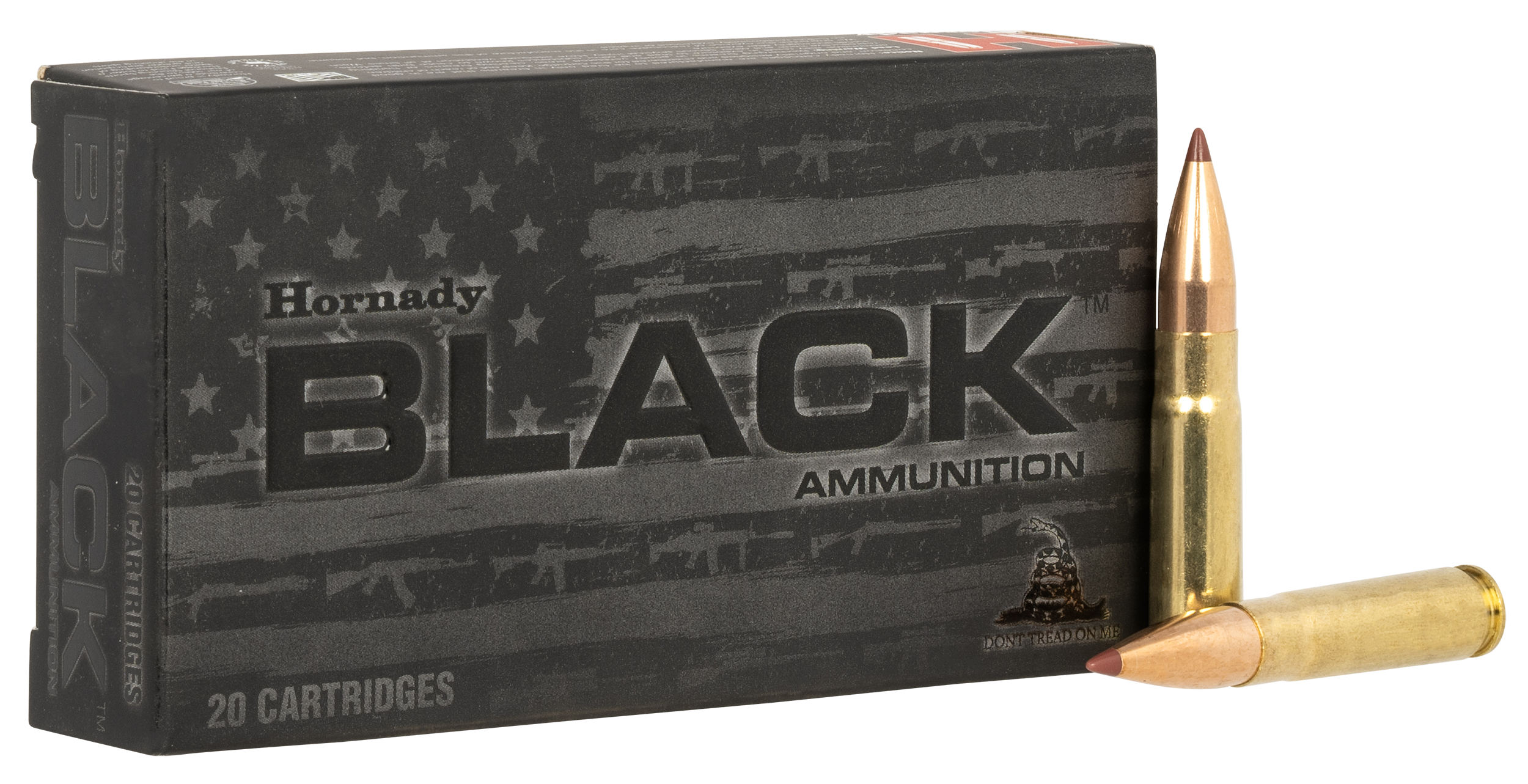
Hornady lists its 110-grain V-MAX BLACK load at 2,375 fps from a 16-inch test barrel. That number is why light supersonic .300 Blackout has its own lane in this cartridge’s family – it’s not pretending to be a heavy subsonic option, it’s giving the shooter a faster, flatter baseline for the distances .300 Blackout actually gets used at. If your rifle runs a shorter barrel than Hornady’s 16-inch test gun, don’t assume you’ll see that number; you’ll see your number, and the only way to know it is to shoot it.
The value here is clarity, and clarity is cheap to buy. A light supersonic load is the easiest, least expensive way to learn what your rifle does with a conventional trajectory before you spend money on a heavier, slower category. It’s a sensible first purchase for zero confirmation and accuracy work. If you want the same 110-grain weight from a different construction in the current catalog, Hornady’s BLACK 110-grain NTX is a real, current entry at the same weight class – a different bullet, same starting point for the comparison.
Here’s where it lands: for the shooter whose priority is a quiet, legally suppressed setup, this category is the wrong tool, full stop – supersonic ammunition produces the crack a suppressor cannot remove, because the crack comes from the bullet, not the muzzle. For the shooter who needs the supersonic half of what .300 Blackout is for, this is one of the two or three categories worth actually testing before you decide anything else.
2. Federal Power-Shok 150 Grain: the conventional soft-point lane
Federal’s Power-Shok .300 Blackout load is a 150-grain soft point at 1,900 fps. This is the cartridge in its plainest, least complicated hunting form – a moderate-speed supersonic load with conventional soft-point construction, and no specialty bullet label required to make a sensible decision. Federal calls it an affordable traditional hunting line; that’s Federal’s own marketing language, not an independent field result, and I’d rather you judge it on the number than the adjective.
The more useful point is what this load’s existence tells you about the cartridge: .300 Blackout was never built as a long-range magnum, and a 150-grain soft point is the honest middle ground between the light, fast loads above and the heavy subsonic loads below. Its real argument is compact-rifle efficiency at modest field distances, and that argument only holds if the bullet construction and your local hunting regulations actually fit the hunt you’re planning.
Get the testing sequence right before you trust it in the field: confirm accuracy, confirm zero, and confirm the bullet’s compatibility with the game and the state rules that apply to you. A soft point looking familiar is not the same thing as a soft point being cleared for the job.
3. Hornady 190 Grain Sub-X: the subsonic-expanding concept
Hornady’s 190-grain Sub-X sits in their dedicated .300 Blackout Subsonic line, and the weight isn’t the interesting part. The interesting part is that Hornady built the bullet to expand at low, subsonic velocities in the first place – which is the actual engineering problem the heavy, quiet half of .300 Blackout has to solve. A bullet that stays subsonic is not automatically a bullet that does useful terminal work once it gets there; construction is what decides that, not the “sub” in the name.
That makes Sub-X the more relevant category for anyone researching lawful suppressed use, over a generic 220-grain match-style round that was never designed to expand at all. Treat Hornady’s own description of it as a manufacturer’s claim worth taking seriously, and still verify it for accuracy in your own rifle before you build a plan around it.
Here’s where it lands: subsonic .300 Blackout gives up velocity on purpose, and that means range and energy both stay modest by design. “Subsonic expanding” is a specialized answer to a specialized envelope – not a quiet substitute for an all-purpose hunting round, and I wouldn’t sell it to you as one.
4. Federal American Eagle Suppressor 220 Grain: the practical OTM reference
Federal’s American Eagle Rifle Suppressor line lists a 220-grain open-tip-match bullet at 1,000 fps, with a published table showing 970 fps at 100 yards and 944 fps at 200 yards. Federal describes it as built from selected components and clean-burning powders for suppressed firearms – again, that’s Federal’s language about its own product, worth noting as a claim rather than an independent finding. If you want a current, in-production 220-grain subsonic reference to compare it against, Scorpion Ammo’s 220-grain Subsonic and Winchester’s Super Suppressed 200-grain OTR are both real, current entries in the same heavy-subsonic weight range, though neither is the identical product – treat them as points of comparison, not substitutes.
The number is the whole argument here: at 1,000 fps you are buying a heavy bullet and buying out of the ballistic crack, not building a flat-trajectory, high-energy rifle. Its honest first job is range practice, zero verification, and reliable-function testing in a legal suppressed setup. Don’t let “open-tip-match” quietly turn into “expanding hunting bullet” in your head – the label describes the bullet’s construction category, not its terminal intent.
One more thing worth pricing in before you build a plan around this specific load: when I checked, Federal’s product page listed it as currently unavailable. An excellent load on paper is still a poor system choice if you can’t buy enough of it to sight in, practice, and hold a known zero. A load you can actually keep in stock beats a load that only exists in a spec sheet.
5. SIG SAUER 220 Grain Tactical Rifle OTM: short-barrel-context data
SIG SAUER’s 220-grain subsonic OTM is listed at 1,000 fps and 488 foot-pounds of muzzle energy, tied to a 9-inch test barrel, with staked primers and sealed case mouths called out as product features. None of that makes it a universal answer for a “mission” – what it makes it is a genuinely useful factory reference for anyone who wants published data actually connected to a compact-barrel test condition, instead of a number borrowed from a longer gun.
That test-barrel detail is the whole lesson of this entry. .300 Blackout conversations throw velocity numbers around constantly without saying whether they came from a 9-inch, a 16-inch, or something else entirely, and that turns an honest comparison into a misleading one fast. SIG’s 9-inch figure and Hornady’s 16-inch 110-grain figure from category one aren’t competing numbers – they’re describing two different loads under two different conditions, and comparing them directly is comparing apples to a different orchard.
For legal suppressed range use, this load belongs in the same disciplined category as Federal’s 220-grain OTM above: test it for accuracy and function, remember that a suppressor changes sound and gas behavior but never removes the need for hearing protection, and don’t let match-style bullet nomenclature answer a hunting question it was never built to answer.
What the five loads teach
Once you stop treating “300 Blackout” as a single description instead of a family of five or six different jobs, the market gets easy to read. Light supersonic ammunition favors velocity. Midweight soft points give the cartridge a conventional hunting lane. Heavy subsonic loads chase a low sonic signature for lawful suppressed use, but they split sharply between expanding and match-style construction underneath that shared “subsonic” label – and mixing those two up is the single most common mistake I see people make with this cartridge.
Group the catalog by weight instead of by brand and the picture gets even sharper. The 110-grain class splits into Hornady’s NTX expanding bullet and Hornady’s CX monolithic bullet – same weight, two different terminal answers. The 125-grain class splits the same way, between American Gunner’s hollow-point match design and Fiocchi’s SST polymer-tip design. Neither split is about one brand beating another. It’s the same lesson twice: the weight tells you the speed range, and the construction tells you the job.
The first box you buy shouldn’t be chosen by a slogan on the label. Run the sequence in order: identify the role, check the laws that apply to it, choose a bullet construction that actually matches the role, verify accuracy and function in your own rifle, and keep supersonic loads, subsonic loads, magazines, and zero data clearly and physically segregated. That last step isn’t paperwork for its own sake – .300 Blackout and .223/5.56 cartridges get confused in mixed-platform environments often enough that it’s a real safety practice, not a suggestion.
That five-load list also isn’t the whole catalog, and the rest of it matters for the boring but essential job of practice ammunition. On the supersonic FMJ side, our database currently carries Federal’s American Eagle 150-grain FMJ, Remington’s UMC 150-grain FMJ, Hornady’s Frontier 125-grain FMJ, Wolf Polyformance’s 145-grain FMJ, Sellier & Bellot’s 147-grain FMJ, and Winchester USA’s 147-grain FMJ – six inexpensive ways to put rounds through the rifle without touching your hunting or suppressed-use budget at all. On the more specialized side, Hornady’s American Gunner 125-grain HP Match and Fiocchi’s Hyperformance 125-grain SST give the light-supersonic category two more genuine choices, and Magtech’s 200-grain Subsonic FMJ is a budget entry into the heavy subsonic side without paying for match-grade construction you may not need for range work. None of that changes the argument above. It just means the argument has a lot more real ammunition to test it against than five hero loads can show by themselves.
The two-zero problem
Here’s the actual cost most people don’t price in before they buy into both halves of this cartridge: a light supersonic load and a heavy subsonic load are, for zeroing purposes, two different ballistic plans wearing one chamber. Hornady’s 110-grain V-MAX at 2,375 fps and a 220-grain product at 1,000 fps are not going to share a point of impact, and the gap between them isn’t a minor correction you dial out with one turret click – it’s a different trajectory table entirely.
The professional answer is documentation, and documentation is cheaper than guessing wrong at the range. Keep a separate record for every verified load – the same discipline behind our own methodology: actual barrel length, optic setting, environmental conditions, and confirmed point of impact. If you’re feeding both categories through the same rifle with the same magazines, label them clearly and keep the ammunition physically separated – not because you’re disorganized, but because the supersonic/subsonic split is the entire reason this cartridge exists in the first place, and treating it casually defeats the point of owning it. This is also where a budget subsonic round like Magtech’s 200-grain Subsonic FMJ earns its keep – it’s cheap enough to burn through a proper zero-confirmation session without treating every subsonic round like a precious resource, the same way Scorpion’s 220-grain Subsonic does at the heavier end.
The same logic applies to your optics. A new box of ammunition is not, by itself, a reason to buy a new scope or a more complicated reticle. It’s a reason to go confirm, carefully, what your existing sighting system actually does with that specific load. A simple zero you’ve verified beats a theoretical capability you haven’t tested, every time, and it costs a lot less to maintain.
Here’s the number worth pricing in before any of this: confirming a new zero and building real comfort with a load takes a full box or two, not a single magazine. Budget for that in inexpensive FMJ rounds – Remington’s UMC 150-grain FMJ, Hornady’s Frontier 125-grain FMJ, Wolf Polyformance’s 145-grain FMJ, or Sellier & Bellot’s 147-grain FMJ – before you ever touch premium ammunition for the actual hunt or the suppressed session it’s meant for. That’s the honest price of a real confirmation, not a corner you get to skip.
How to read a factory ammunition page
A factory product page is useful, and it’s the raw material we build our own .300 Blackout database from using the same methodology every time. It’s not a test report, and it’s worth knowing the difference before you spend money on the strength of one. Federal’s 150-grain Power-Shok page tells you the load is a soft point at 1,900 fps – that’s the label, not a field result, and their 150-grain FMJ page does the same job for the practice-ammo side of the lineup. Hornady’s 110-grain page gives you a 16-inch test-barrel context for its 2,375-fps figure. SIG’s 220-grain product gives you a 9-inch test-barrel context for its subsonic data. All three are honest numbers. None of the three is a promise about what your rifle will do.
Those figures let you compare categories fairly, but the final evaluation still happens on the range, in your rifle, not on the page – and if that range session produces your own chronograph numbers, submitting them is how the next reader gets a real data point instead of another catalog figure. Treat a manufacturer’s claim about expansion or reliability as exactly that – a claim – until you’ve done your own lawful validation for your own purpose. That’s not skepticism as a personality trait. It’s how you avoid turning a catalog table into a field assumption, which is the mistake that actually gets people in trouble.
Availability belongs in that same evaluation, and it’s the part people skip. If a load is hard to source, ask yourself honestly whether you can buy enough of it to sight in, practice, and hold a consistent setup over time. A rare, perfect load that’s out of stock everywhere is worth less than a good load your local shop always has, and I’ll take the boring, available option over the impressive, unavailable one every single time.
The hierarchy that actually holds up: reliability and a documented point of impact come first, product category comes second, and an impressive number on a box comes dead last. That’s especially true here, where a fast 110-grain load and a heavy 220-grain subsonic load are both completely legitimate choices and almost never interchangeable ones.
When you’re not sure where to start, simplify on purpose: pick one job, one load category, one documented zero. The cartridge stops being confusing the moment you stop asking it to be two different rifles at the same time.
Bottom line
None of these five loads is the universal answer, and none of them is trying to be. Hornady’s 110-grain V-MAX represents the light supersonic category. Federal’s 150-grain Power-Shok represents the conventional soft point. Hornady’s 190-grain Sub-X represents the low-velocity-expansion category. Federal’s and SIG’s 220-grain OTMs both represent heavy subsonic factory references built around the same published 1,000-fps figure, from two different test-barrel lengths.
Choose the role before you choose the box. That’s the whole discipline that turns .300 Blackout from a confusing headstamp into a useful, well-organized system – and it’s the same discipline that makes any cartridge worth owning twice over, once for the job it’s actually doing and once for what you paid to find that out. If a heavy subsonic OTM ever goes out of stock the way Federal’s did above, Winchester’s Super Suppressed 200-grain OTR and Hornady’s Custom 110-grain CX are two more current entries worth keeping on your shortlist rather than waiting on a single SKU to come back.
If you want the same job-first approach applied to a completely different platform, our blog runs it the same way across calibers: Top 5 17 HMR loads, lead-free 17 HMR options, Top 10 6.5 Creedmoor loads, and lead-free 6.5 Creedmoor options. Our full .300 Blackout database and methodology explain how we source and check the numbers behind pieces like this one, and if you’ve got your own chronograph data on any of these loads, sending it our way helps the next reader start from more than a box label.
Factory specifications and availability can change. Verify current laws, manufacturer data, correct-caliber compatibility, and rifle-specific performance before use.