

Non-Toxic Options for Restricted Areas and Concerned Hunters
Lead-free .17 HMR is a short list. The caliber fires a 15–17 grain projectile at extreme velocity — designing a non-toxic bullet that survives the bore without fouling, expands reliably on impact, and doesn’t generate dangerous pressure spikes is a genuine engineering challenge. As of 2025–2026, only two manufacturers produce currently available lead-free .17 HMR factory ammunition in the US market.
This guide covers all three lead-free .17 HMR loads that have existed in factory production, including one that is discontinued but still found at retail. If you’re hunting in a lead-restricted zone — California condor habitat, certain wildlife areas, or any land where non-toxic ammunition is legally required — these are your only factory options.
Standard lead-core picks are covered separately: Top 5 Best .17 HMR Ammo →
Why Lead-Free .17 HMR Is Different
Standard .17 HMR bullets use a lead core jacketed in gilding metal or copper. Lead-free designs replace the core entirely with a harder material — typically a compressed polymer-metal compound (as in Hornady NTX) or a sintered/bonded copper alloy (as in CCI’s TNT Green design using Speer bullets).
Harder bullets behave differently in semi-automatic actions. CCI explicitly warns against using TNT Green in semi-automatic .17 HMR rifles without consulting the firearm manufacturer. Hornady NTX does not carry the same blanket warning but is primarily recommended for bolt-action use. If you run a Savage A17 or similar semi-auto, read the semi-auto section below before buying.
All three loads in this guide are lighter than standard .17 HMR loads — 15.5 gr or 16 gr vs the standard 17 gr or 20 gr. This is a consequence of the bullet material: non-toxic compounds are less dense than lead, so the same bullet volume weighs less. Manufacturers compensate partially with higher muzzle velocities.
#1 — CCI TNT Green .17 HMR 16 gr Lead-Free HP
The only lead-free .17 HMR hollow point in current production.
CCI TNT Green uses the Speer TNT Green bullet — a non-toxic hollow point built from a compressed material that replaces lead without a polymer tip. At 2,500 fps advertised muzzle velocity from a 24″ test barrel, it is the fastest lead-free .17 HMR load currently available and the only one with a hollow point cavity rather than a polymer tip initiator.
The hollow point design means terminal performance depends on impact velocity. At .17 HMR energies inside 100 yards, the TNT Green expands reliably on small game and varmints. Past 125 yards, where velocity has dropped significantly, expansion becomes less predictable — this is a consistent characteristic of HP designs vs polymer-tipped at this caliber.
At 16 gr it is slightly heavier than the Hornady NTX at 15.5 gr, which gives it a small energy advantage at the muzzle. Pricing is typically $24–26 per box of 50 — a $3–5 premium over standard lead-core CCI loads, consistent with the lead-free surcharge seen across all calibers and manufacturers.
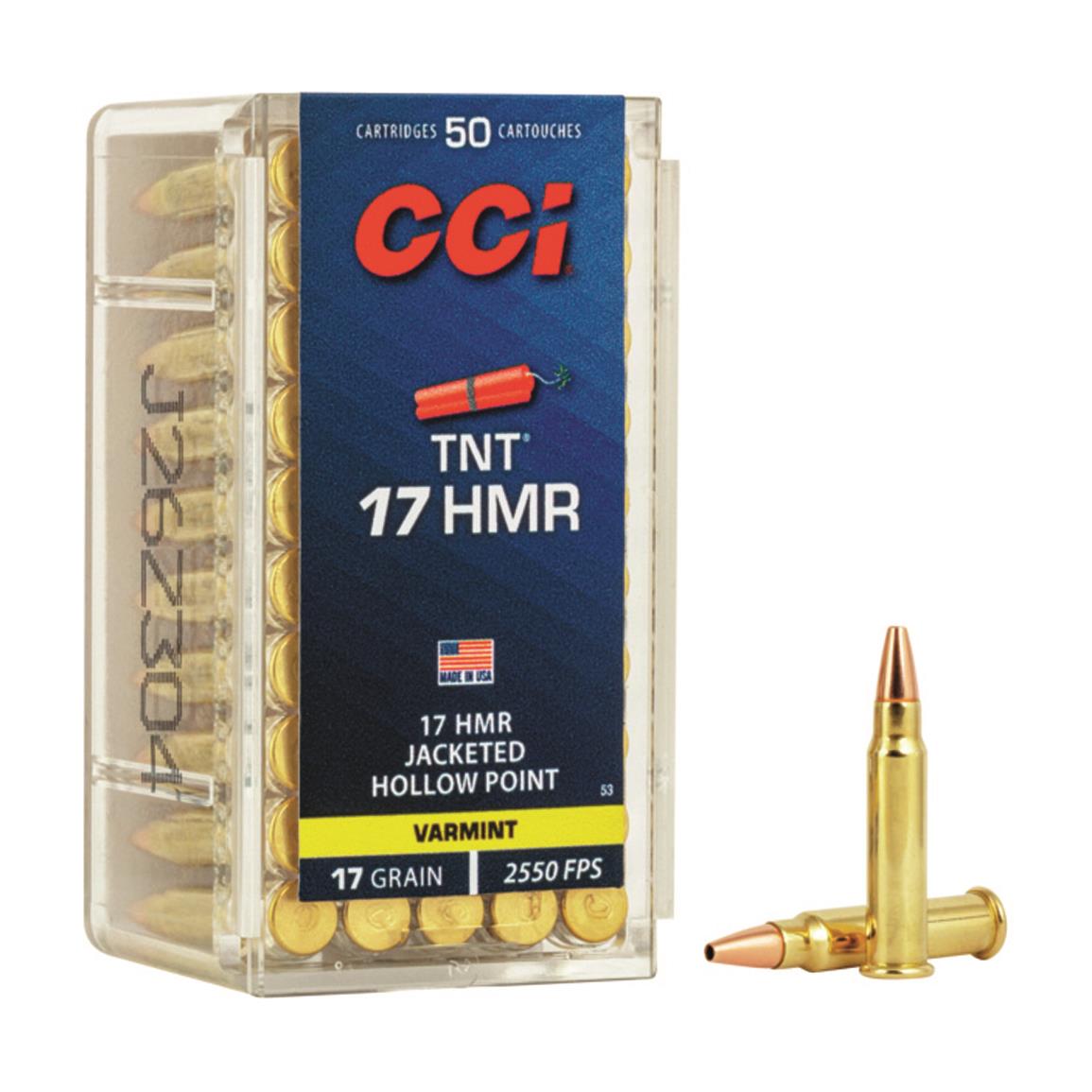
CCI, .17 HMR TNT, JHP, 17 Grain, 50 Rounds


⚠️ Semi-auto warning: CCI’s official product page states this load should not be used in semi-automatic firearms without consulting the firearm manufacturer. This applies specifically to gas-operated semi-auto .17 HMR rifles. Bolt-action use has no such restriction.
Best for: Bolt-action varmint hunting in lead-restricted areas, California condor zones, hunters who prefer HP terminal behavior over polymer tip fragmentation.
→ Full report: CCI TNT Green .17 HMR 16 gr Lead-Free HP
#2 — Hornady Varmint Express .17 HMR 15.5 gr NTX
The polymer-tipped lead-free option. Better BC, more consistent expansion at range.
Hornady NTX (Non-Toxic eXpanding) uses a lead-free polymer-tipped bullet — the same basic architecture as the V-Max but without any lead in the construction. The polymer tip initiates expansion on impact, which gives the NTX more consistent terminal performance at lower impact velocities than a hollow point design. At the ranges where .17 HMR drops below reliable HP-expansion thresholds, the NTX’s tip-initiated expansion continues to function.
Advertised muzzle velocity is 2,525 fps from a 24″ test barrel — 25 fps slower than CCI TNT Green but with a better BC from the tipped design (~0.200 G1 estimated). The trajectory is slightly flatter than the TNT Green past 100 yards as a result.
At 15.5 gr it is the lightest load in this guide. The lighter bullet means less energy at the muzzle than the 16 gr TNT Green, but the BC advantage partially offsets this at distance. For strictly practical varmint hunting inside 125 yards, the difference between TNT Green and NTX is minimal. For shots past 125 yards, the NTX’s tipped design and BC give it a measurable edge.

Hornady Varmint Express 17 HMR 15.5 Gr Lead-Free (Box)
Pricing runs $25–27 per box of 50 — typically $1–2/box more than CCI TNT Green, putting it at the top of the lead-free price range.
Best for: Lead-restricted area hunting, shooters who want polymer-tip performance in a non-toxic load, longer-range work where BC matters.
→ Full report: Hornady Varmint Express .17 HMR 15.5 gr NTX
#3 — Winchester Varmint LF .17 HMR 15.5 gr NTX (Discontinued)
Same bullet as Hornady NTX. Worth buying if you find remaining stock.
⚠️ This load is discontinued. Winchester Varmint LF .17 HMR is no longer in production as of the time of this writing. Remaining inventory continues to appear at some retailers and through secondary markets. It is included here because shooters actively search for it and because remaining stock is legitimate factory ammunition worth buying if the price is reasonable.
Winchester Varmint LF used the same Hornady NTX 15.5 gr bullet as the #2 pick on this list. Terminal performance, BC, and velocity figures (advertised at 2,550 fps, 25 fps faster than Hornady’s own loading) were essentially identical. It was the third lead-free option in the caliber and provided price competition that kept NTX pricing in check during its production years.
With Winchester Varmint LF gone, Hornady NTX and CCI TNT Green are the only two remaining options. If you find Winchester Varmint LF at a reasonable price ($22–25/box), it is a valid purchase for stock. Do not pay a premium for it — the remaining two active options are equally capable.
Best for: Existing inventory purchases only. Not a primary recommendation due to discontinuation.
→ Full report: Winchester Varmint LF .17 HMR 15.5 gr NTX
Quick Comparison
| Load | Weight | Bullet | Adv. Velocity | Status | Semi-Auto Safe? | Price/box |
|---|---|---|---|---|---|---|
| CCI TNT Green | 16 gr | Lead-Free HP | 2,500 fps | ✅ Active | ⚠️ Consult mfr | ~$24–26 |
| Hornady NTX | 15.5 gr | NTX Polymer Tip | 2,525 fps | ✅ Active | Not specified | ~$25–27 |
| Winchester Varmint LF | 15.5 gr | NTX Polymer Tip | 2,550 fps | ❌ Discontinued | Not specified | ~$22–25 if found |
All velocity figures are manufacturer-stated from test barrels (typically 24″). Real-world results vary by barrel length, temperature, and lot. See individual SKU report pages for community-submitted measured data.
Semi-Automatic Rifles and Lead-Free .17 HMR
This is the most important practical question for lead-free .17 HMR buyers. The short answer: use bolt-action if possible.
Gas-operated semi-automatic .17 HMR rifles — including the popular Savage A17 — were designed and tested with standard lead-core ammunition. Lead-free bullets are harder, and harder projectiles can generate different pressure profiles, engage the rifling differently, and behave differently in the gas system. CCI specifically warns against TNT Green in semi-autos without manufacturer consultation. Hornady does not publish the same warning for NTX but also does not claim semi-auto compatibility.
If you own a semi-auto .17 HMR and need lead-free ammunition, contact your rifle manufacturer directly and ask whether they have tested or approve the specific load. Do not assume that any lead-free .17 HMR load is safe in your semi-auto based on the lead-core performance you’ve seen.
What About CCI VNT — Is It Lead-Free?
No. CCI VNT (.17 HMR 17 gr Varmint Tipped, SKU 959CC) is sometimes marketed with language about “minimized lead exposure” and the name stands for “Varmint Not Toxic.” However, CCI VNT is not a lead-free load — it uses a lead-core bullet with a copper jacket and polymer tip. The “Not Toxic” name refers to reduced lead vaporization at impact compared to older designs, not to a lead-free bullet construction.
CCI VNT does not meet California AB 711 lead-free requirements or any other legal lead-free hunting mandate. For restricted areas, only TNT Green and Hornady NTX qualify as truly non-toxic factory loads.
FAQ
Are lead-free .17 HMR loads legal for hunting in California?
Yes — both CCI TNT Green and Hornady NTX qualify as non-toxic ammunition under California’s lead ammunition regulations (AB 711). Winchester Varmint LF also qualified when it was in production. CCI VNT does not qualify despite its name. Always verify current regulations with California DFW before the season — regulations can change.
Why are lead-free .17 HMR loads slower than standard loads of the same bullet weight?
They aren’t, directly — but the comparison is complicated by the fact that lead-free .17 HMR loads are all lighter (15.5–16 gr) than the standard 17 gr or 20 gr lead-core options. The lighter bullets actually allow higher muzzle velocities. The real difference is that at the same bullet weight, lead-free designs would run slightly slower due to higher bore friction from the harder material. Manufacturers compensate with lighter bullet weights to maintain or exceed velocity figures.
Is there any difference in accuracy between lead-free and standard .17 HMR loads?
Community data on this is limited — see the submission pages for TNT Green and NTX as data accumulates. The general expectation from precision rimfire shooters is that tipped designs (NTX) are competitive with standard tipped loads for accuracy, while the TNT Green HP may show slightly more group variance at 100 yards. This has not been established with enough data to state definitively.
Will more lead-free .17 HMR options become available?
The market for .17 HMR is relatively small compared to centerfire and .22 LR, which limits manufacturer investment in specialty loads. With Winchester Varmint LF discontinued, the lead-free segment has shrunk to two options. It is possible that expanding lead-free hunting regulations in other states could drive new development, but as of 2025–2026 no new lead-free .17 HMR loads have been announced by any manufacturer.
Last updated: May 2026 · List covers factory ammunition only · Prices are approximate US retail, subject to change