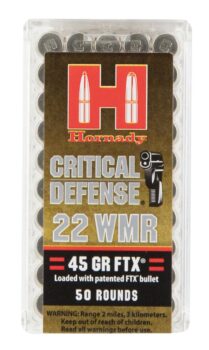
Hornady Critical Defense .22 Mag/WMR 45 Gr FTX
Hornady Critical Defense .22 Mag/WMR 45 Gr FTX (Box)
| Feature | Detail |
|---|---|
| Primary Use | Personal defense, concealed carry |
| Bullet Type | FTX (Flex Tip Expanding) jacketed hollow point with polymer tip |
| Bullet Weight | 45 gr |
| Case Material | Nickel-plated brass |
| Primer Type | Rimfire |
| Packaging | 50 rounds per box |
| Typical Price | $19.99/box ยท $0.40/round |
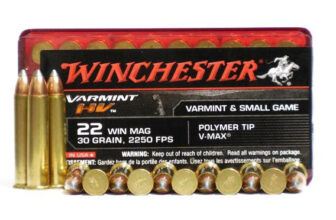
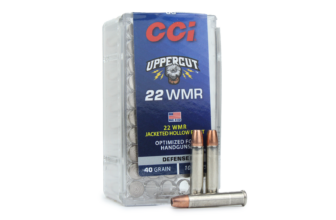
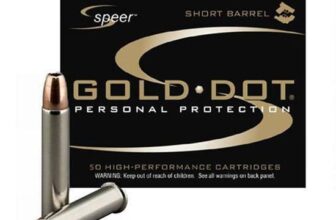
| Closest Competitors | CCI Maxi-Mag 40 gr TMJ, Winchester Supreme Elite .22 WMR 34 gr JHP, Speer Gold Dot .22 WMR 40 gr GDHP |
Official Specs
| Spec | Value | Source |
|---|---|---|
| Muzzle Velocity (fps) | 1000 | Hornady official product page – 1.875″ test barrel |
| Muzzle Energy (ft-lbs) | 100 | Hornady official product page – 1.875″ test barrel |
| Bullet Weight | 45 gr | Hornady official product page |
| Bullet Type | FTX (Flex Tip Expanding) | Hornady official product page |
| BC G1 | 0.110 | Ammunition To Go ballistic data |
| BC G7 | 0.047 | Ammunition To Go ballistic data |
| Manufacturer SKU | 83200 | Hornady official product page |
| UPC | 090255832006 | Sportsmanโs Guide product listing |
| Reloadable | No | Hornady official product page – rimfire cartridge |
Note on velocity and energy: Hornady lists this load at 1000 fps and 100 ft-lbs from a 1.875″ barrel. Longer barrels can produce different chronograph results, so real-world numbers should still be treated as barrel-dependent.
Note on BC: Hornady does not appear to publish BC values for this specific rimfire load on the product page. The G1 and G7 values above are taken from Ammunition To Go ballistic data and should be treated as secondary-source ballistic inputs, not manufacturer-published BC values.
Hornady Critical Defense .22 Mag/WMR 45 Gr FTX (Box) $19.99 in stock
Ballistics Table
Calculated estimate. Real-world results vary by barrel length, temperature,altitude, firearm condition, and lot variation. This table should be used as a general ballistic reference, not as a substitute for live-fire verification.
Zeroed at 50 yards. Sight height 1.5″ above bore. Estimated muzzle velocity: ~1,025 fps from a handgun-length test barrel. This estimate is consistent with independent short-barrel chronograph testing but should not be treated as a Hornady-published specification.
| Yards | ~Velocity (fps) | ~Energy (ft-lbs) | ~Trajectory (in) |
|---|---|---|---|
| 0 | ~1,025 | ~105 | -1.5 |
| 25 | ~980 | ~96 | +0.7 |
| 50 | ~930 | ~86 | 0.0 |
| 75 | ~885 | ~78 | -3.4 |
| 100 | ~845 | ~71 | -9.0 |
Key takeaway: At practical defensive handgun distances – typically under 15 yards – trajectory is not the limiting factor. The bigger question is whether the round retains enough velocity from your specific barrel to expand consistently.
The Hornady FTX Bullet in .22 WMR
The Flex Tip Expanding (FTX) bullet is the central engineering argument for this load. Instead of relying on an open hollow point cavity that can clog with fabric, the FTX uses a soft polymer insert. On impact, that tip is designed to drive back into the bullet and help initiate expansion.
This design was originally developed for lever-action cartridges (the LEVERevolution line), where pointed bullets normally create safety issues in tubular magazines. In the Critical Defense line, the same basic idea is applied to personal-protection ammunition: controlled expansion, reduced clogging, and more consistent terminal behavior through clothing.
Best Uses
Good fit:
- Primary or backup defensive load for small-frame .22 WMR revolvers such as the Smith & Wesson 351 series, Ruger LCRx .22 WMR, or similar lightweight carry guns
- Semi-automatic .22 WMR pistols where feeding reliability with polymer-tip ammunition is confirmed
- Low-recoil defensive option for shooters who cannot reliably manage centerfire recoil
- Practice with the same point-of-impact family as defensive rimfire loads, once confirmed in the individual gun
Not the right tool for:
- Primary defensive use where a centerfire option is available – especially 9mm, .38 Special +P, or .380 ACP from a reliable firearm
- Long-range varmint use where Hornady V-MAX or other high-velocity .22 WMR loads are better suited
- Bulk plinking – it is too expensive for high-volume casual shooting
- Reloading projects – .22 WMR is rimfire and not practically reloadable
Reliability Notes
No structured submissions yet.
Based on manufacturer claims and open-source published testing, the following observations are reasonable:
- Hornady states the nickel-plated brass case improves feeding reliability in semi-automatic firearms
- The FTX polymer tip presents a rounded, consistent nose profile compared to sharp-edged hollow points
- Small-frame .22 WMR revolvers are generally less sensitive to bullet profile than semi-automatic pistols
- Semi-automatic .22 WMR pistols can be ammunition-sensitive, so users should confirm reliability with several magazines before relying on this load
Community Feedback Summary
- No structured Ammo Reports user feedback has been submitted yet for this load
- Independent gel testing generally shows penetration in the 10-12″ range from short barrels, but expansion can vary significantly depending on test setup
- Short-barrel revolvers often produce velocities below published rifle-load expectations; this load is more realistic because it is marketed toward defensive use rather than varmint performance
- Users commonly compare this load against Speer Gold Dot .22 WMR 40 gr, which is another premium short-barrel defensive option
- Some testing shows expansion around .35-.40 caliber in bare ballistic gelatin from standard test barrels, though denim-covered gel results vary more widely
- Feeding reliability is generally reported as good in semi-automatic .22 WMR pistols, with the polymer tip providing a more consistent nose profile than open hollow points
- No active recalls or safety notices for this load have been identified at time of publication
Competitors
| Load | Weight | Bullet | BC G1 | Adv. Velocity | Price/box | Notes |
|---|---|---|---|---|---|---|
| CCI Maxi-Mag 40 gr TMJ | 40 gr | Total Metal Jacket | Not published | ~1,875 fps (rifle) | ~$14-$16 | Budget alternative; no expansion, training/plinking use |
| CCI Maxi-Mag 40 gr JHP | 40 gr | Jacketed Hollow Point | Not published | ~1,875 fps (rifle) | ~$15-$18 | Standard defensive JHP; no polymer tip; expansion less consistent |
| Speer Gold Dot .22 WMR 40 gr | 40 gr | Gold Dot GDHP | Not published | ~1,500 fps (pistol) | ~$22-$26 | Premium alternative; bonded core; purpose-built for short barrels |
| Winchester Supreme Elite .22 WMR 34 gr JHP | 34 gr | Jacketed Hollow Point | Not published | ~2,000 fps (rifle) | ~$18-$22 | Lighter and faster; expansion at velocity but less mass retention |
| Federal Premium .22 WMR 50 gr JHP | 50 gr | Jacketed Hollow Point | Not published | ~1,530 fps (rifle) | ~$16-$20 | Heavier bullet; traditional JHP without polymer tip |
| Hornady Critical Defense .22 WMR 45 gr FTX – this load | 45 gr | FTX polymer tip | Not published | Not published | $19.99 | – |
The Speer Gold Dot 40 gr is the most direct premium competitor and is specifically engineered for short-barrel performance – buyers choosing between the two should prioritize that comparison. The CCI Maxi-Mag JHP is the standard budget reference point but lacks the FTX tipโs anti-clog design. No competitors in this comparison carry an active recall or have been discontinued at time of publication.
Price Reality
- Typical retail: $17.99-$22.99 per 50-round box depending on retailer and market conditions
- Per-round cost: approximately $0.36-$0.46/round
- Value position: premium defensive rimfire load, not bulk training ammo
- Best buy threshold: under $20/box is a reasonable price for this load when in stock
Prices change. Check the Where to Buy block for current listings.
Where to Buy
Hornady Critical Defense .22 Mag/WMR 45 Gr FTX (Box)
Affiliate links. These do not influence ratings, data, or any editorial content on this page.
FAQ
Does the FTX bullet actually expand reliably from a short-barrel .22 WMR revolver?
This is the most important practical question for buyers of this load. Published gel testing by independent outlets consistently shows that expansion is less reliable from barrels shorter than 2″ due to the lower velocity delivered – typically under 900 fps from a 1.875″ snub-nose. The FTX polymer tip improves expansion consistency compared to a standard open hollow point, but it does not fully overcome the physics of low velocity. From a 4″ barrel, expansion is generally more reliable and consistent.
How does the .22 WMR Critical Defense compare to .22 LR defensive loads?
The 45-gr FTX load gives .22 WMR a clear energy advantage over most .22 LR defensive loads, especially from barrels over 3″. However, the practical defensive difference depends heavily on firearm reliability, shot placement, and penetration. A reliable .22 WMR revolver with this load is generally stronger than a micro .22 LR, but it still does not match common centerfire defensive rounds.
Is this load suitable for small game or varmint hunting?
The Critical Defense line is engineered around personal protection, not meat preservation or long-range varmint performance. It can work on small pests at close range, but for hunting or pest control, Hornady V-MAX, CCI Maxi-Mag, or other purpose-built .22 WMR loads usually make more sense.
What barrel length does Hornady use for the official velocity?
Hornady lists the velocity data for this load with a 1.875″ barrel. That matters because .22 WMR velocity can change significantly between short revolver barrels, longer handgun barrels, and rifle barrels. For defensive use, the short-barrel number is usually more relevant than rifle-length velocity claims.
Does the nickel-plated case make a practical difference?
For most users, the nickel case is a small but useful feature. It improves corrosion resistance, makes the cartridge easier to see during chamber checks, and can help extraction or feeding in some firearms. It is not magic, but for a carry or bedside-defense rimfire load, it is a sensible upgrade.