Winchester White Box, .223 Remington, 55 Grain, FMJ
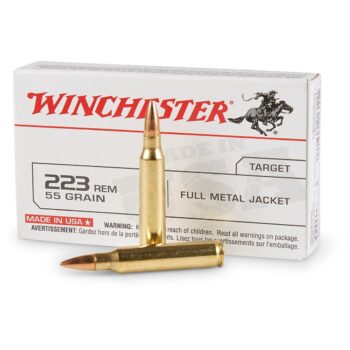
| Field | Detail |
|---|---|
| Primary Use | Target shooting, range training, high-volume practice |
| Bullet Type | Full Metal Jacket (lead core, gilding metal jacket, flat base) |
| Bullet Weight | 55 Grain |
| Case Material | Brass |
| Primer Type | Boxer, centerfire |
| Packaging | 20 rounds per box |
| Typical Price | $13.77/box โ $0.69/round |
| Closest Competitors | Federal American Eagle .223 Rem 55 gr FMJ (AE223J), Hornady American Gunner .223 Rem 55 gr HP, PMC Bronze .223 Rem 55 gr FMJ-BT |
Official Specs
| Spec | Value | Source |
|---|---|---|
| Muzzle Velocity (fps) | โ | Not published by Winchester for this SKU |
| Muzzle Energy (ft-lbs) | โ | Not published |
| Bullet Weight | 55 gr | Manufacturer label |
| Bullet Type | Full Metal Jacket | Manufacturer label |
| BC G1 | โ | Not published |
| BC G7 | โ | Not published |
| Manufacturer SKU | W223K | Manufacturer (commonly listed; verify at point of purchase) |
| UPC | โ | Not confirmed from available data |
| Reloadable | Yes | Brass case, Boxer primer |
Note: Winchester does not publish muzzle velocity, muzzle energy, or ballistic coefficient data for the White Box .223 Rem 55 gr FMJ on their consumer product pages. The ballistics table below uses a commonly referenced industry estimate of 3,240 fps for a 55 gr .223 FMJ from a 24-inch test barrel โ this figure is consistent with SAAMI reference data for this bullet weight and caliber, but it is not a Winchester-published specification. All derived values are labeled “Calculated.” Community-submitted chronograph data will be added as it becomes available.
Ballistics Table
Calculated estimate. Real-world results vary by barrel length, temperature, altitude, and lot. Community submissions will provide measured muzzle velocity for comparison.
Assumptions: 55 gr FMJ, estimated G1 BC of 0.243 (industry reference value for standard 55 gr .223 FMJ), estimated muzzle velocity 3,240 fps, sight height 1.5″ above bore, zero at 100 yards, standard atmosphere (59ยฐF, sea level).
| Yards | Velocity (fps) | Energy (ft-lbs) | Trajectory (in) |
|---|---|---|---|
| 0 | ~3,240 | ~1,282 | -1.5 |
| 100 | ~2,854 | ~995 | 0.0 โ zero |
| 200 | ~2,499 | ~763 | -3.4 |
| 300 | ~2,172 | ~576 | -13.5 |
| 400 | ~1,874 | ~429 | -32.9 |
| 500 | ~1,608 | ~316 | -65.2 |
All values marked ~ are calculated estimates, not manufacturer-published data.
Key takeaway: At a 100-yard zero, this load holds a practical flat trajectory out to roughly 200 yards with only 3.4 inches of drop โ well within the margin for range work and informal target shooting. Beyond 300 yards, drop accelerates significantly and wind drift becomes a meaningful factor with the relatively modest ballistic coefficient of a standard flat-base FMJ. This load is optimized for short-to-medium range practice, not extended-range precision work. Shooters using carbine-length barrels (16 inches) should expect muzzle velocity roughly 150โ200 fps lower than the 24-inch test barrel reference, which will steepen the drop curve noticeably at 300 yards and beyond.
Best Uses
Good fit:
- High-volume range sessions where per-round cost is the primary concern
- Zeroing and function-testing AR-15 and bolt-action .223/5.56 platforms
- Drills requiring consistent cycling in semi-automatic rifles
- Training new shooters on fundamental marksmanship at distances under 200 yards
- Situations where brass recovery and reloading the cases afterward is part of the workflow
Not the right tool for:
- Hunting โ FMJ bullets are prohibited for deer and most big game hunting in the majority of U.S. states due to inadequate terminal expansion
- Precision or long-range competition where ballistic coefficient and lot-to-lot consistency are critical
- Varmint hunting where rapid fragmentation or expansion is required for clean, humane kills
- Jurisdictions with lead-core bullet restrictions (e.g., California condor zones, certain public lands) โ this load contains a lead core
- Situations requiring published, traceable velocity data for legal or forensic documentation
Reliability Notes
No structured submissions yet.
Based on manufacturer claims and open-source user observations, the Winchester White Box line is described as producing consistent primer ignition and reliable feeding in standard AR-15 platforms. The brass case is reported by multiple open sources to resize and reload without unusual difficulty, which is consistent with Winchester’s use of standard Boxer-primed brass. No pattern of failure-to-feed or extraction issues specific to this load has been identified in publicly available sources. These observations come from manufacturer claims and open community sources โ not structured, controlled submissions to this database.
Competitors
| Load | Weight | Bullet | BC G1 | Muzzle Velocity | Price/box (approx.) | Notes |
|---|---|---|---|---|---|---|
| Federal American Eagle .223 Rem 55 gr FMJ (AE223J) | 55 gr | FMJ-BT | ~0.255 | 3,240 fps (published) | ~$14โ$16 | Boat-tail design; published velocity; widely stocked |
| PMC Bronze .223 Rem 55 gr FMJ-BT | 55 gr | FMJ-BT | ~0.255 | 3,200 fps (published) | ~$12โ$14 | Budget alternative; boat-tail; published specs |
| Hornady American Gunner .223 Rem 55 gr HP | 55 gr | Hollow Point | ~0.270 | 3,240 fps (published) | ~$16โ$19 | Premium alternative; better terminal performance for varmints |
| Remington UMC .223 Rem 55 gr FMJ | 55 gr | FMJ | ~0.243 | 3,240 fps (published) | ~$13โ$15 | Direct comparable; flat-base FMJ; similar price tier |
| Wolf Gold .223 Rem 55 gr FMJ | 55 gr | FMJ-BT | ~0.255 | 3,150 fps (published) | ~$11โ$13 | Budget alternative; brass case; manufactured by CBC/Magtech |
Note: The Federal AE223J and PMC Bronze both use a boat-tail base, which provides a marginally higher BC and slightly better long-range performance compared to the Winchester White Box flat-base design. The Hornady American Gunner HP is the premium alternative listed and offers meaningful terminal performance advantages for varmint applications. None of the competitors listed above carry an active recall as of the time of this writing.
Price Reality
- At the listed price of $13.77 per box of 20, the per-round cost is $0.69/round
- Case pricing (typically 500 rounds / 25 boxes) is not confirmed from available data; buyers should verify current bulk pricing at point of purchase
- PMC Bronze .223 55 gr FMJ-BT typically runs $0.55โ$0.65/round, making it a comparable or slightly cheaper option with a boat-tail bullet
- Federal American Eagle AE223J typically runs $0.65โ$0.75/round and includes published velocity specs โ a marginal premium for traceable data
- Wolf Gold .223 55 gr typically runs $0.55โ$0.62/round โ the most budget-friendly brass-cased option in this comparison
- A fair benchmark for this load is $0.60โ$0.72/round; prices above $0.80/round for this specific load represent a meaningful premium over market alternatives
- Buyers purchasing 20-round boxes pay a per-round penalty compared to bulk 500-round or 1,000-round case purchases when available
Prices change. Check the Where to Buy block for current listings.
Where to Buy
Winchester White Box, .223 Remington, 55 Grain, FMJ, 20 Rounds
Affiliate links. These do not influence ratings, data, or any editorial content on this page.
FAQ
Does the Winchester White Box .223 Rem 55 gr FMJ use a boat-tail or flat-base bullet?
The Winchester White Box 55 gr FMJ uses a flat-base construction, not a boat-tail. This is a meaningful distinction for buyers comparing it to loads like the Federal American Eagle AE223J or PMC Bronze, both of which use a boat-tail base. The boat-tail design reduces base drag and produces a slightly higher ballistic coefficient, which translates to less drop and less wind drift beyond 300 yards. For range practice inside 200 yards, the difference is negligible. Shooters planning to stretch this load to 300 yards or beyond will see a modest but real performance gap versus boat-tail alternatives.
Why doesn’t Winchester publish a muzzle velocity for this load?
Winchester does not consistently publish detailed ballistic specifications for their White Box value-tier ammunition on retail product pages. This is common practice for high-volume practice ammunition, where the manufacturer’s focus is on cost and reliability rather than precision documentation. Independent chronograph testing by open-source communities suggests the load performs near the SAAMI reference velocity of approximately 3,240 fps from a 24-inch test barrel, but this is not a confirmed manufacturer figure. Buyers who require a published, documented velocity โ for competition scoring, ballistic solver input, or other purposes โ should consider the Federal American Eagle AE223J, which carries a manufacturer-stated muzzle velocity.
Can this ammunition be used for coyote or varmint hunting?
A full metal jacket bullet is generally a poor choice for varmint hunting. FMJ projectiles are designed to maintain their shape through impact and do not expand reliably in soft tissue, which means they transfer energy inefficiently and often produce a narrow, non-expanding wound channel. For varmints such as coyotes, prairie dogs, or groundhogs, expanding projectiles โ hollow points, soft points, or polymer-tipped designs โ are strongly preferred for both effectiveness and humane performance. Additionally, FMJ bullets are explicitly prohibited for deer and other big game hunting in most U.S. states. This load is correctly categorized as a range and practice round, not a hunting load.
Is the brass from Winchester White Box .223 worth saving for reloading?
Winchester White Box ammunition uses brass cases with Boxer primers, which makes the spent brass compatible with standard reloading equipment. Open-source reloading communities generally regard Winchester brass as serviceable and consistent, though not in the same tier as premium brass from manufacturers like Lapua or Norma. For shooters who reload, recovering and processing the brass from this load is a reasonable way to reduce the effective per-round cost over time. This page covers factory ammunition only and does not include reloading data; consult a current reloading manual for appropriate load data if processing this brass.
How does this load perform in shorter AR-15 carbine barrels compared to the ballistics table?
The ballistics estimates on this page are based on a 24-inch test barrel, which is the standard SAAMI reference length. Most AR-15 carbines use 16-inch barrels, and some pistol-configuration rifles use barrels as short as 10.5 inches. As a general reference, each inch of barrel lost from the 24-inch standard costs approximately 20โ30 fps of muzzle velocity for .223 Remington loads in this weight class. A 16-inch carbine barrel would be expected to produce roughly 150โ200 fps less than the table values, placing muzzle velocity closer to 3,040โ3,090 fps. This affects both the energy column and the trajectory column โ drop at 300 yards will be noticeably greater than the table suggests, and shooters should confirm their actual zero with live fire rather than relying on calculated estimates alone.