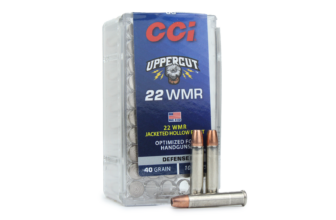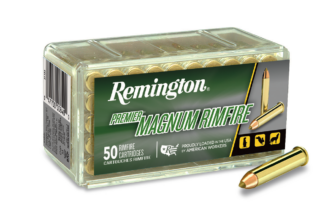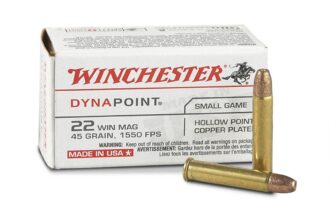
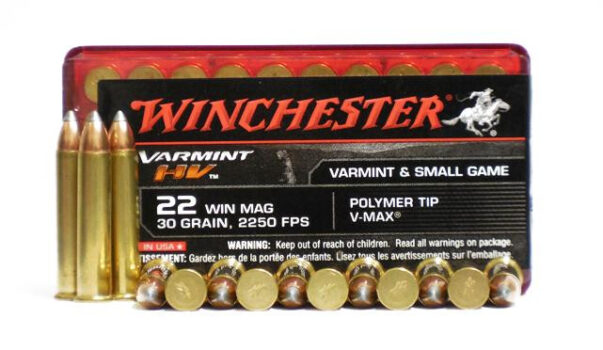
Winchester .22 WMR 30 Grain V-Max
| Feature | Detail |
|---|---|
| Primary Use | Small game hunting, pest control, plinking, target shooting |
| Bullet Type | Hornady V-Max Polymer-Tip Varmint Bullet |
| Bullet Weight | 30 grain |
| Case Material | Brass |
| Primer Type | Rimfire |
| Packaging | 50 rounds per box |
| Typical Price | $22.49/box · ~$0.45/round |
| Closest Competitors | CCI Maxi-Mag 30gr V-Max, Hornady 30gr V-Max, Federal Premium 30gr V-Shok |
Official Specs
| Spec | Value | Source |
|---|---|---|
| Muzzle Velocity (fps) | — | Not published |
| Muzzle Energy (ft-lbs) | — | Not published |
| Bullet Weight | 30 gr | Manufacturer |
| Bullet Type | Hornady V-Max Polymer-Tip | Manufacturer |
| BC G1 | — | Not published |
| BC G7 | — | Not published |
| Manufacturer SKU | — | Not published |
| UPC | — | Not published |
| Reloadable | No | Rimfire construction |
Note: Winchester has not published muzzle velocity or muzzle energy for this specific load through its official product pages at the time of this writing. The ballistics table below uses a calculated estimate based on comparable 30gr .22 WMR loads from the same velocity class. All values are approximations and should not be treated as manufacturer-stated data. Community submissions will provide measured real-world velocity for comparison.
Note: BC values (G1 and G7) for the Hornady V-Max 30gr projectile in .22 WMR are not published by Winchester for this load. Hornady lists a G1 BC of approximately 0.125 for the 30gr V-Max in their own standalone product data, but this figure applies to Hornady’s own loading conditions and should not be assumed identical for this Winchester loading.
Ballistics Table
Calculated estimate. Real-world results vary by barrel length, temperature, altitude, and lot. Community submissions will provide measured muzzle velocity for comparison.
Zeroed at 50 yards. Sight height: 1.5″ above bore. Estimated muzzle velocity: ~2,200 fps (based on comparable 30gr .22 WMR factory loads).
| Yards | Velocity (fps) | Energy (ft-lbs) | Trajectory (in) |
|---|---|---|---|
| 0 | ~2,200 | ~322 | -1.5 |
| 25 | ~2,068 | ~285 | +0.4 |
| 50 | ~1,940 | ~251 | 0.0 ← zero |
| 75 | ~1,817 | ~220 | -1.7 |
| 100 | ~1,699 | ~192 | -5.1 |
| 125 | ~1,586 | ~167 | -10.6 |
| 150 | ~1,479 | ~146 | -18.4 |
| 175 | ~1,379 | ~127 | -28.9 |
| 200 | ~1,287 | ~110 | -42.4 |
| 225 | ~1,204 | ~97 | -59.3 |
| 250 | ~1,131 | ~85 | -80.1 |
Key takeaway: The 30 grain V-Max in .22 WMR launches at a brisk estimated velocity that delivers meaningful energy inside 100 yards — the practical sweet spot for this cartridge. Beyond 100 yards, trajectory drop becomes significant and wind drift increases noticeably, which limits ethical hunting range on small game to approximately 100–125 yards under field conditions. Inside that window, the polymer-tip bullet initiates rapid expansion on impact, making it well suited for clean, efficient terminal performance on small varmints. Shooters should confirm zero with actual chronograph data, as barrel length has a meaningful effect on velocity in this caliber.
The Hornady V-Max Bullet in .22 WMR
The V-Max projectile is a Hornady-designed polymer-tipped varmint bullet used by multiple ammunition manufacturers under licensing or supply arrangements. Its defining feature is a red polymer tip seated in a thin gilding metal jacket over a lead core. On impact, the tip is driven rearward into the bullet, initiating rapid, controlled expansion even at the moderate velocities typical of rimfire cartridges.
In the context of 22 WMR, this matters because the cartridge operates at velocities where some hollow-point designs may fail to expand reliably — particularly at longer range as velocity bleeds off. The V-Max’s mechanical initiation mechanism makes it more consistent across a wider velocity window than traditional hollow points, which is why it has become a preferred bullet style for this cartridge among varmint hunters.
The thin jacket construction also means the V-Max is not intended for use on medium or large game. It is optimized for rapid energy transfer and fragmentation on small-bodied animals, not for deep penetration. Shooters selecting this load for anything beyond varmint and small game applications should consider a heavier, more controlled-expansion option.
Best Uses
Good fit:
- Prairie dog, ground squirrel, and similar small varmint hunting inside 100 yards
- Rabbit and squirrel hunting where rapid expansion and minimal meat damage are balanced objectives
- Plinking and informal target shooting where the flat-shooting trajectory of the .22 WMR is preferred over .22 LR
- Pest control around farm and ranch settings where a reliable rimfire cartridge is appropriate
- Training and practice with a magnum rimfire platform before transitioning to centerfire varmint cartridges
Not the right tool for:
- Shots beyond 125 yards where wind drift and drop make ethical hits on small targets unreliable
- Medium game — the V-Max bullet is not designed for the penetration depth required on animals larger than small game
- Jurisdictions or ranges that prohibit lead-core ammunition — this is a lead-core load
- Self-defense applications — rimfire ignition reliability and bullet construction are not optimized for defensive use
- Suppressed fire — while .22 WMR can be used with suppressors, the load is not specifically optimized for subsonic or suppressed use
Reliability Notes
No structured submissions yet.
Based on manufacturer product description and open-source user reporting, the Winchester V-Max line in .22 WMR has a general reputation for consistent ignition across a range of temperatures, which is a known challenge for rimfire cartridges. The polymer-tip design is noted in open sources as providing more uniform feeding in semi-automatic platforms compared to some hollow-point profiles, though this is platform-dependent and not a manufacturer claim. Winchester’s production standards for 22 WMR ammunition are considered consistent with major-brand quality expectations. No structured reliability data — including failure-to-fire rates, accuracy groupings, or velocity standard deviation — has been submitted to this database for this specific load. All notes above come from open sources and manufacturer claims, not structured data.
Competitors
| Load | Weight | Bullet | BC G1 | Adv. Velocity | Price/box | Notes |
|---|---|---|---|---|---|---|
| CCI Maxi-Mag 30gr V-Max | 30 gr | Hornady V-Max | ~0.125 | ~2,200 fps | ~$18–$22 | Same bullet; budget-friendly alternative |
| Hornady Varmint Express 30gr V-Max | 30 gr | Hornady V-Max | ~0.125 | ~2,200 fps | ~$20–$24 | Same bullet; Hornady’s own loading |
| Federal Premium V-Shok 30gr Speer TNT | 30 gr | Speer TNT HP | ~0.110 | ~2,200 fps | ~$20–$25 | Different bullet design; comparable velocity class |
| CCI Maxi-Mag 40gr JHP | 40 gr | Jacketed HP | ~0.100 | ~1,875 fps | ~$14–$18 | Heavier bullet; more penetration, less velocity; budget option |
| Hornady Critical Defense 45gr FTX | 45 gr | FTX Flex Tip | ~0.120 | ~1,000 fps | ~$22–$28 | Premium defensive load; not a varmint option; different use case |
| Winchester Super-X 40gr JHP | 40 gr | Jacketed HP | ~0.095 | ~1,910 fps | ~$14–$18 | Winchester’s own heavier offering; more penetration-focused |
Note: The CCI Maxi-Mag 30gr V-Max and Hornady Varmint Express 30gr V-Max use the same Hornady V-Max projectile as this Winchester load. Differences in performance between these three loads, if any, are attributable to powder charge, case volume, and quality control rather than bullet design.
Price Reality
- At the listed price of $22.49 per box of 50, this load comes in at approximately $0.45 per round
- This positions it at the higher end of the .22 WMR price range, which typically spans $0.25–$0.50 per round depending on load and market conditions
- The CCI Maxi-Mag 30gr V-Max — which uses the identical bullet — is frequently available for $18–$22 per box, making it a meaningful price difference for the same terminal performance
- The Winchester Super-X 40gr JHP and similar heavier JHP loads often retail for $14–$18 per box, offering a budget alternative if the V-Max design is not a requirement
- A fair price benchmark for this load is $18–$22 per box; paying above $23–$24 per box suggests market scarcity or markup above normal retail — worth comparing current listings before purchasing
Prices change. Check the Where to Buy block for current listings.
Where to Buy
Winchester .22 WMR 30 Grain V-Max
Affiliate links. These do not influence ratings, data, or any editorial content on this page.
FAQ
Does the V-Max bullet in this Winchester load actually expand at .22 WMR velocities?
The Hornady V-Max is specifically engineered to initiate expansion via its polymer tip rather than relying solely on hydraulic pressure from velocity. This makes it more reliable at expansion initiation across a wider velocity range than many hollow-point designs. In .22 WMR, which produces moderate velocities compared to centerfire varmint cartridges, this mechanical initiation is a meaningful advantage — particularly at the lower end of the velocity range encountered at 100+ yards. That said, expansion performance still degrades as velocity drops, and shots beyond 125 yards on small game should be approached conservatively.
How does this Winchester load compare to the CCI Maxi-Mag 30gr V-Max, which uses the same bullet?
Both loads use the Hornady V-Max 30gr projectile, so terminal bullet performance is expected to be equivalent. The practical differences come down to price — the CCI load is typically $3–$5 cheaper per box — and potentially minor velocity differences attributable to powder selection and case specifications. Without published velocity data from Winchester for this load, a direct comparison is not possible from spec sheets alone. Buyers who are cost-sensitive and not brand-loyal to Winchester should compare current pricing before purchasing, as the CCI Maxi-Mag V-Max may offer the same terminal performance at a lower cost.
Is this load appropriate for squirrel or rabbit hunting, or is it too destructive?
The V-Max bullet is designed for rapid expansion and fragmentation on small-bodied varmints, which can result in more tissue disruption than a standard lead round-nose or hollow-point. For squirrel and rabbit hunting where meat preservation is a priority, this load may cause more damage than desired on close-range shots. At longer ranges — 75 to 100 yards — reduced velocity at impact moderates expansion somewhat, which can improve meat condition. Hunters who prioritize meat quality may prefer a 40 grain JHP or FMJ load in .22 WMR, while those focused on clean, humane kills on varmints will find the V-Max construction well suited to the task.
What barrel length does this load assume, and does it matter for .22 WMR?
Winchester has not published a test barrel length for this load. Barrel length has a significant effect on .22 WMR velocity — more so than with many centerfire cartridges — because the propellant continues to generate pressure over a longer burn relative to the cartridge’s total energy output. A 16″ rifle barrel will produce meaningfully higher velocity than a 9″ pistol barrel, with some sources reporting differences of 200–400 fps depending on the specific load. Shooters using this ammunition in a handgun-length platform should expect substantially lower velocity and energy than the rifle-based estimates in the ballistics table above.
Is this load subject to any lead restrictions for hunting use?
This is a lead-core ammunition load and is subject to any jurisdiction-specific regulations restricting or prohibiting lead projectiles for hunting. California’s Condor Zone and expanded non-lead zones require non-lead ammunition for all hunting, which would exclude this load. Several other states and federal lands have specific non-lead requirements for certain species or areas. Hunters should verify current regulations in their specific hunting area before selecting this load. No lead-free alternative is offered by Winchester in this exact configuration at the time of this writing.