 Ammo Reports Team
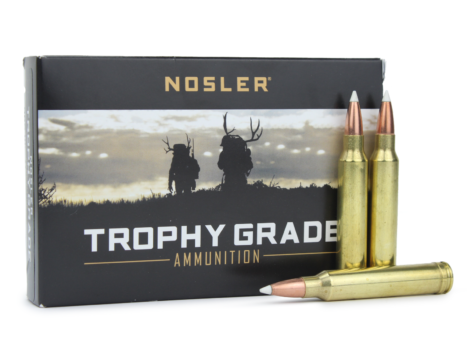
Nosler Trophy Grade 300 Win Mag 180 Gr AccuBond
At a Glance
| Feature | Detail |
|---|---|
| Primary Use | Medium to large game hunting |
| Bullet Type | Nosler AccuBond — bonded lead core, white polymer tip, copper alloy jacket |
| Bullet Weight | 180 gr |
| Case Material | Brass |
| Primer Type | Boxer (standard for Nosler Trophy Grade; type not individually published) |
| Packaging | 20 rounds per box |
| Typical Price | $94.74/box · $4.74/round |
| Closest Competitors | Federal Trophy Bonded Tip 300 Win Mag 180 gr · Hornady Precision Hunter 300 Win Mag 178 gr ELD-X · Winchester Expedition Big Game 300 Win Mag 180 gr AccuBond |
Official Specs
| Spec | Value | Source |
|---|---|---|
| Muzzle Velocity (fps) | 2,950 | Product description (secondary source — not confirmed on Nosler.com at time of writing) |
| Muzzle Energy (ft-lbs) | — | Not published |
| Bullet Weight | 180 gr | Manufacturer |
| Bullet Type | AccuBond (bonded core, white polymer tip) | Manufacturer |
| BC G1 | — | Not published for this SKU |
| BC G7 | — | Not published for this SKU |
| Manufacturer SKU | — | Not published in available data |
| UPC | — | Not published in available data |
| Reloadable | Yes | Brass case, Boxer primer |
Note: Muzzle energy is not listed in available product data. A calculated estimate based on 2,950 fps / 180 gr yields approximately 3,478 ft-lbs (see Ballistics Table below, labeled Calculated). BC values for G1 and G7 are not individually published for this Trophy Grade load in the sources reviewed; Nosler publishes bullet-level BC data separately on their component bullet pages, but factory-loaded Trophy Grade listings do not always carry forward that figure. SKU and UPC were not available in the product data supplied.
Note on velocity source: The 2,950 fps figure appears in the product listing description. This is treated as a secondary source. Nosler’s own published data for this load should be verified directly at Nosler.com before making precision trajectory decisions.


Ballistics Table
Calculated estimate. Real-world results vary by barrel length, temperature, altitude, and lot. Community submissions will provide measured muzzle velocity for comparison.
Inputs: 180 gr AccuBond · 2,950 fps MV · G1 BC 0.507 (Nosler published component bullet value, used as best available proxy) · 1.5" sight height · 200 yd zero · standard atmosphere (59°F, sea level)
| Yards | Velocity (fps) | Energy (ft-lbs) | Trajectory (in) |
|---|---|---|---|
| 0 | 2,950 | 3,478 | −1.5 |
| 100 | 2,756 | 3,034 | +1.9 |
| 200 | 2,569 | 2,638 | 0.0 ← zero |
| 300 | 2,389 | 2,282 | −7.7 |
| 400 | 2,215 | 1,960 | −22.3 |
| 500 | 2,048 | 1,676 | −45.6 |
| 600 | 1,888 | 1,424 | −79.4 |
| 700 | 1,735 | 1,203 | −125.8 |
| 800 | 1,590 | 1,010 | −187.2 |
All values are Calculated. G1 BC 0.507 is sourced from Nosler’s component AccuBond bullet data (180 gr, .308 dia) and applied as a proxy — factory load BC is not independently confirmed. Trajectory will shift meaningfully with barrel length variations (24" assumed) and altitude.
Key takeaway: At a 200-yard zero, this load holds roughly +1.9 inches at 100 yards — a flat, practical hold for most hunting scenarios. The 300 Win Mag retains over 2,280 ft-lbs at 300 yards, which is well above the commonly cited 1,500 ft-lb threshold for elk-class game. By 500 yards the drop exceeds 45 inches, making precise range estimation and holdover critical. For shots inside 400 yards on large game, this load remains a capable and relatively flat performer.
The AccuBond Bullet — What Makes It Different
The Nosler AccuBond is a bonded-core hunting bullet, meaning the lead core is chemically fused to the copper alloy jacket during manufacturing. This bonding process is the defining characteristic: it prevents the jacket and core from separating on impact, which is a known failure mode in unbonded cup-and-core designs when terminal velocities are high or bone is struck. The white polymer tip serves two functions — it initiates expansion reliably at a range of impact velocities, and it improves the bullet’s ballistic coefficient by streamlining the nose profile compared to a traditional soft-point.
What distinguishes AccuBond from Nosler’s older Partition design is the construction philosophy. The Partition uses a physical wall of jacket material to separate the front and rear lead cores, ensuring rear-core retention even if the front core is lost. AccuBond instead keeps a single bonded core intact through the full penetration event, typically retaining 65–75% of original weight. This makes it a hybrid in practical terms — it expands aggressively enough to transfer energy efficiently, but retains enough mass for deep penetration through the shoulder or heavy muscle of large animals. For 300 Winchester Magnum at the velocities this load generates, that balance is particularly relevant because impact velocities at close range are high enough to cause jacket separation in less robust bullet designs.
Best Uses
Good fit:
- Elk, moose, and large mule deer at ranges from close timber shots out to approximately 400 yards
- Mixed-condition hunts where shots may be quartering-away, broadside, or through heavy shoulder — bonded construction handles angled penetration well
- Hunters who want a single load for a trip covering both medium game (whitetail, black bear) and large game (elk, caribou)
- Situations where terminal performance consistency matters more than maximum BC — AccuBond is not the highest-BC option but is one of the more proven terminal performers in this class
- Hunters in jurisdictions where lead-core projectiles are permitted and bonded construction is preferred over fragmenting designs
Not the right tool for:
- Varmint or predator hunting — 180 gr at 2,950 fps is excessive and causes excessive meat damage on small animals
- Lead-free restricted areas (California condor zone, certain national parks) — AccuBond contains a lead core and does not qualify as non-toxic
- Extreme long-range precision shooting beyond 600 yards where a higher BC projectile (e.g., 212 gr ELD-X or 215 gr Berger Hybrid) would offer a measurable advantage in wind drift and drop
- Budget-conscious shooters who need high-volume practice ammunition — at approximately $4.74/round, this is a premium hunting load, not a range round
Reliability Notes
No structured submissions yet.
Based on manufacturer claims and open-source information: Nosler’s Trophy Grade line is loaded at Nosler’s own facility in Bend, Oregon, using Nosler brass — which the manufacturer describes as being held to tighter dimensional tolerances than generic commercial brass. The AccuBond bullet has been in commercial production since 2003 and has an extensive published record of terminal performance data from Nosler’s own testing. Manufacturer literature states that bonded-core retention typically falls in the 65–75% weight range across a variety of impact conditions. No active recall or safety notice for this product was identified at the time of writing. These notes reflect manufacturer claims and open sources, not structured field data.
Competitors
| Load | Weight | Bullet | BC G1 | Adv. Velocity | Price/box (approx.) | Notes |
|---|---|---|---|---|---|---|
| Federal Trophy Bonded Tip 300 Win Mag 180 gr | 180 gr | Trophy Bonded Tip (bonded, polymer tip) | 0.480 | 2,960 fps | ~$75–$85 | Budget-relative alternative; bonded construction; slightly lower BC |
| Hornady Precision Hunter 300 Win Mag 178 gr ELD-X | 178 gr | ELD-X (Heat Shield tip, InterLock bonded) | 0.552 | 2,960 fps | ~$65–$80 | Higher BC; strong long-range option; slightly lighter bullet |
| Winchester Expedition Big Game 300 Win Mag 180 gr AccuBond | 180 gr | Nosler AccuBond (same bullet) | 0.507 | 2,950 fps | ~$70–$85 | Uses the same AccuBond bullet; may offer cost savings over Nosler-branded load |
| Nosler Trophy Grade 300 Win Mag 200 gr AccuBond | 200 gr | Nosler AccuBond | 0.588 | 2,725 fps | ~$95–$105 | Heavier bullet; higher BC; better for very large or dangerous game |
| Barnes VOR-TX 300 Win Mag 180 gr TTSX | 180 gr | Barnes TTSX (lead-free, all-copper) | 0.459 | 2,960 fps | ~$80–$95 | Lead-free option; required for restricted zones; lower BC but excellent penetration |
| Berger Extreme Outer Limits 300 Win Mag 215 gr Hybrid OTM | 215 gr | Berger Hybrid OTM | 0.730 | 2,750 fps | ~$100–$120 | Premium long-range alternative; not optimized for close-range hunting terminal performance |
Price Reality
- Typical retail price: approximately $90–$100 per 20-round box; case pricing (typically 10 boxes) is not widely listed for this SKU but would typically fall in the $880–$960 range before shipping
- Per-round cost: approximately $4.50–$5.00 depending on retailer and timing
- The Winchester Expedition Big Game load using the identical AccuBond bullet frequently retails for $10–$20 less per box — making it a meaningful comparison for cost-conscious buyers who want the same projectile
- Hornady Precision Hunter in the same caliber typically runs $65–$80 per box, offering a higher-BC bullet at a lower price point — though terminal design philosophy differs
- Federal Trophy Bonded Tip is generally the most affordable bonded-tip option in this caliber at $75–$85 per box
- A price above $105 per box for this specific load should be considered above market; at that level, the Nosler 200 gr or premium Berger loads become more competitive on a value basis
Prices change. Check the Where to Buy block for current listings.
Where to Buy
Nosler Trophy Grade 300 Win Mag 180 Gr AccuBond (Box)
Affiliate links. These do not influence ratings, data, or any editorial content on this page.
FAQ
Q: How does the AccuBond bullet differ from the Nosler Partition in this application?
The Nosler Partition uses a dual-core construction with a physical copper partition separating the front and rear lead sections — the rear core is mechanically retained even if the front core is lost on impact. The AccuBond instead uses a single chemically bonded core, which means the entire bullet tends to stay together through penetration rather than by design separation. In practical hunting terms for 300 Win Mag at typical hunting ranges, both bullets perform well on large game, but the AccuBond’s streamlined polymer tip gives it a better ballistic coefficient, making it the better choice where trajectory matters — such as longer shots on open terrain. The Partition remains preferred by some hunters for extremely close-range, high-velocity impacts on very large or dangerous game where maximum structural integrity is the priority.
Q: Is this load suitable for elk at 400 yards?
At 400 yards, the calculated retained energy is approximately 1,960 ft-lbs — above the commonly cited 1,500 ft-lb threshold for elk-class animals. The AccuBond bullet is also designed to expand reliably at reduced impact velocities, which is a relevant concern at extended range since velocity (and therefore hydraulic pressure on the tip) decreases with distance. That said, 400-yard shots require a shooter who has confirmed their zero, knows their exact drop at that distance, and can accurately estimate range. The ballistics are adequate; the limiting factor at that distance is almost always the shooter and conditions, not the ammunition.
Q: Can this load be used in California or other lead-restricted hunting zones?
No. The Nosler AccuBond contains a bonded lead core and does not qualify as a non-toxic or lead-free projectile under California’s condor zone regulations or similar restrictions in other jurisdictions. Hunters required to use lead-free ammunition should consider the Barnes VOR-TX 300 Win Mag 180 gr TTSX or similar all-copper loads specifically marketed as lead-free. Always verify current regulations with the relevant state or federal wildlife agency before the season, as lead restrictions have expanded in recent years.
Q: The Winchester Expedition Big Game load uses the same AccuBond bullet — is there a meaningful difference?
Both loads use the Nosler AccuBond projectile at 180 gr, and both list 2,950 fps as muzzle velocity. The primary difference is the brass and loading source — Nosler Trophy Grade uses Nosler-branded brass loaded in-house, while Winchester Expedition uses Winchester brass and loading facilities. Nosler’s brass is generally regarded as being held to tighter dimensional tolerances, which can matter for reloaders who intend to reuse the cases. For a hunter who will not reload, the terminal performance of the two loads should be functionally identical, making the Winchester option worth considering if it is priced lower at the time of purchase.
Q: What barrel length does the 2,950 fps velocity figure assume?
The product listing does not specify a test barrel length. Industry standard for 300 Winchester Magnum factory ammunition testing is typically a 24-inch barrel. Hunters using rifles with 22-inch or 26-inch barrels should expect a velocity difference of roughly 25–50 fps per inch relative to a 24-inch baseline — meaning a 22-inch barrel may yield approximately 2,850–2,900 fps, while a 26-inch barrel may approach 3,000 fps. These differences are modest at hunting ranges but become more meaningful in calculated trajectory tables beyond 500 yards. If precise long-range data is needed, chronograph testing with your specific rifle is always recommended.