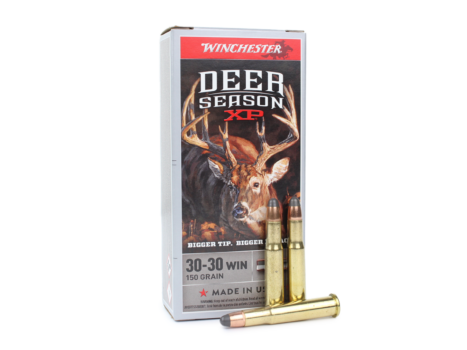
 Ammo Reports Team
| Feature | Detail |
|---|---|
| Primary Use | White-tailed deer hunting, medium game |
| Bullet Type | Extreme Point Polymer-Tipped Lead-Core Jacketed Soft Point |
| Bullet Weight | 150 grain |
| Case Material | Brass |
| Primer Type | Boxer (factory primer size not verified) |
| Packaging | 20 rounds per box |
| Typical Price | $38.99/box — $1.95/round |
| Closest Competitors | Federal Power-Shok 30-30 Win 150 gr SP, Hornady LEVERevolution 30-30 Win 160 gr FTX, Remington Core-Lokt 30-30 Win 150 gr SP |
Official Specs
| Spec | Value | Source |
|---|---|---|
| Muzzle Velocity (fps) | 2320 | Winchester 2026 catalog, p. 31 |
| Muzzle Energy (ft-lbs) | 1792 | Winchester 2026 catalog, p. 31 |
| Bullet Weight | 150 gr | Winchester 2026 catalog, p. 31 |
| Bullet Type | Extreme Point polymer tip | Winchester 2026 catalog, p. 31 |
| BC G1 | 0.215 | Winchester 2026 catalog, p. 31 |
| BC G7 | – | Not found in verified official manufacturer sources |
| Manufacturer SKU | X3030DS | Winchester 2026 catalog, p. 31 |
| UPC | – | Not found in verified official manufacturer sources |
| Reloadable | Yes – brass case | Case/primer construction; exact primer specification unverified |
| Case Material | Brass | Case/primer construction; exact primer specification unverified |
| Primer | Boxer; factory primer size not verified | Case/primer construction; exact primer specification unverified |
Verified factory load: Winchester X3030DS, .30-30 Winchester, 150 gr. Source: Winchester 2026 catalog, p. 31. G7 BC and UPC were not found in the verified official sources. Source discrepancy: the 2026 Winchester catalog lists 2320 fps and 1792 ft-lb; the current online product list lists 2390 fps and 1902 ft-lb. The catalog values are used here. Its published trajectory is reproduced without recalculation; the separate model may differ.


Ballistics Table
Manufacturer data and calculated estimates are separated below. All trajectories shown use a 100-yard zero.
Official manufacturer ballistics. Winchester 2026 catalog, p. 31. Original published distances through 300 yards; unlisted distances are not interpolated. Test barrel: 24 inches. Sight height is not specified in the cited Winchester table.
| Yards | Official velocity (fps) | Official energy (ft-lb) | Official trajectory (in) |
|---|---|---|---|
| 0 | 2320 | 1792 | – |
| 100 | 1951 | 1267 | 0 |
| 200 | 1621 | 875 | -7.2 |
| 300 | 1343 | 601 | -26.9 |
Calculated estimate – not manufacturer data. 0-300 yards, 50-yard increments. G1 point-mass model (py-ballisticcalc); 150 gr, muzzle velocity 2320 fps, G1 BC 0.215, 100-yard zero, sight height 1.5 inches, sea level, 59°F, 29.92 inHg, 0% humidity, no wind. Sight height is an explicitly assumed model input. Actual results vary with firearm, ammunition lot and conditions.
| Yards | Calculated velocity (fps) | Calculated energy (ft-lb) | Calculated trajectory (in) |
|---|---|---|---|
| 0 | 2320 | 1793 | -1.5 |
| 50 | 2128 | 1508 | 0.2 |
| 100 | 1945 | 1260 | -0.0 |
| 150 | 1772 | 1046 | -2.5 |
| 200 | 1611 | 864 | -7.8 |
| 250 | 1463 | 713 | -16.5 |
| 300 | 1331 | 590 | -29.2 |
Key takeaway: The manufacturer table and the 50-yard model serve different purposes and should not be treated as interchangeable measurements. Energy alone does not establish a guaranteed hunting range or terminal performance.
The Extreme Point Bullet Design
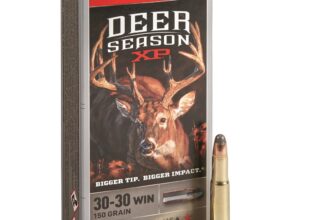
The defining feature of the Winchester Deer Season XP line is the Extreme Point projectile, which uses an oversized polymer tip relative to the bullet diameter. The intent is mechanical: a larger tip accelerates and widens the initial impact diameter on contact, initiating expansion more reliably at the moderate velocities the .30-30 generates compared to faster magnum cartridges.
The bullet also features a tapered jacket that is thinner at the nose and progressively thicker toward the base. This construction is engineered to allow controlled expansion at the front while the heavier base retains mass and drives penetration. The result is a bullet that Winchester positions as expanding more consistently than a traditional soft-point at .30-30 velocities, while still delivering deep penetration suitable for deer-sized game through typical shot angles.
This design philosophy matters particularly for the .30-30 because the cartridge’s velocity at 150–200 yards drops into a range where older cup-and-core soft points can sometimes fail to expand reliably. The polymer tip helps address that limitation without requiring the shooter to limit range further.
Best Uses
Good fit:
- White-tailed deer hunting at ranges inside 175 yards
- Hunting in dense timber or brush where shots are typically close and quick
- Lever-action rifles chambered in 30-30 Winchester (Winchester Model 94, Marlin 336, Henry rifles)
- Hunters who want a purpose-designed deer bullet rather than a general-purpose soft point
- Hunters transitioning from older soft-point loads who want improved expansion consistency at .30-30 velocities
- Medium-sized game such as black bear at close range where shot placement is controlled
Not the right tool for:
- Long-range shots beyond 200 yards — drop and retained energy make precise ethical shots difficult
- Tubular magazines on lever-action rifles are compatible here (the Extreme Point tip is designed to be safe in tube magazines), but always verify your specific rifle’s manual before loading
- Elk or moose — the 150 gr bullet weight and .30-30 energy levels are generally considered marginal for large heavy-bodied game
- Semi-automatic or bolt-action platforms not designed for the .30-30 cartridge
- Varmint or predator hunting where rapid fragmentation is preferred over controlled expansion
Reliability Notes
No structured submissions yet.
Based on manufacturer claims and open-source reporting, the following observations are noted — these come from manufacturer documentation and publicly available user feedback, not structured test data:
- Winchester states the Extreme Point tip is designed to be safe in tubular lever-action magazines, which is a practical distinction from standard pointed spitzer bullets that cannot be safely stacked tip-to-primer in tube magazines.
- The tapered jacket construction is described by Winchester as producing consistent expansion across the velocity range typical of the 30-30 Winchester cartridge, including at distances where velocity has dropped from muzzle levels.
- Open-source field reports frequently note clean, one-shot performance on white-tailed deer at ranges inside 100 yards, consistent with the bullet’s stated design intent.
- No active recall or safety notice has been identified for this load at time of publication.
- Brass cases are reported to be of standard Winchester quality, suitable for a single reload cycle by experienced handloaders, though this page covers factory ammunition only.
Competitors
| Load | Weight | Bullet | BC G1 | Muzzle Velocity | Price/box | Notes |
|---|---|---|---|---|---|---|
| Hornady LEVERevolution 30-30 Win 160 gr FTX | 160 gr | FTX Flex Tip | 0.330 | 2400 fps | ~$35–$42 | Manufacturer reference: 82730. |
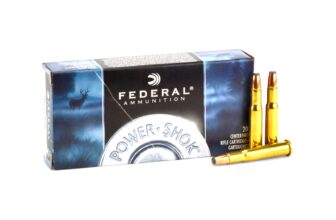
| Federal Power-Shok 30-30 Win 150 gr SP | 150 gr | Jacketed Soft Point | 0.218 | 2390 fps | ~$22–$28 | Manufacturer reference: 3030A. |
| Remington Core-Lokt 30-30 Win 150 gr SP | 150 gr | Core-Lokt Soft Point | 0.193 | 2390 fps | ~$24–$30 | Manufacturer reference: R30301. |
| Federal Trophy Bonded 30-30 Win 150 gr Trophy Bonded | 150 gr | Trophy Bonded Tip | – | – | ~$42–$50 | Exact factory identity/specifications not verified. Original price estimate is not verified. |
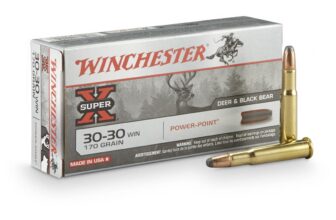
| Winchester Super-X 30-30 Win 150 gr Power-Point | 150 gr | Power-Point JSP | 0.218 | 2390 fps | ~$26–$32 | Manufacturer reference: X30306. |
Notes: The Hornady LEVERevolution FTX is the most direct performance competitor, offering a meaningfully higher published BC and similar muzzle velocity at a comparable price point. The Federal Power-Shok and Remington Core-Lokt represent the budget tier — proven performers at lower cost, though without the engineered polymer tip. No competitor loads listed here carry an active recall at time of publication.
Price Reality
- Typical retail range: $35.00–$42.00 per 20-round box; case pricing (typically 10 boxes/200 rounds) generally falls in the $340–$400 range when available.
- Per-round cost: Approximately $1.75–$2.10 depending on retailer and market conditions; the listed price of $38.99 puts the per-round cost at $1.95.
- Versus Federal Power-Shok 150 gr: Power-Shok typically runs $22–$28/box, making the Deer Season XP approximately $10–$15 more expensive per box for the polymer-tip upgrade.
- Versus Hornady LEVERevolution 160 gr FTX: LEVERevolution is priced similarly at $35–$42/box, making it a near-direct price competitor with a higher published BC — buyers should compare both at current prices.
- Versus Winchester Super-X Power-Point: Winchester’s own lower-tier offering typically runs $26–$32/box, meaning the Deer Season XP commands a roughly $7–$10 premium for the Extreme Point bullet design.
- Fair price benchmark: Anything above $44.00 per box for this load should be treated as elevated pricing. At $38.99, the listed price is within the normal market range.
Prices change. Check the Where to Buy block for current listings.
Where to Buy
Winchester Deer Season XP 30-30 Winchester 150 Grain Extreme Point (Box)
Affiliate links. These do not influence ratings, data, or any editorial content on this page.
FAQ
Q: Is the Extreme Point tip safe to use in a lever-action rifle with a tubular magazine?
This review concerns the exact .30-30 Winchester factory load identified in Official Specs. Follow the firearm manual and the ammunition manufacturer’s compatibility instructions for tubular magazines. Bullet-tip material alone does not prove magazine compatibility; this conclusion must not be generalized to other tipped bullets or other calibers.
Q: How does this load compare to the Hornady LEVERevolution 160 gr FTX for deer hunting?
This load’s verified specifications are 150 gr, 2320 fps and G1 BC 0.215. Compare factory tables only when their zero and test conditions are stated. The Ballistics Table separates published manufacturer values from the 50-yard calculated model; it does not establish comparative terminal performance.
Q: What is the effective ethical range of this load on white-tailed deer?
This load’s verified specifications are 150 gr, 2320 fps and G1 BC 0.215. Compare factory tables only when their zero and test conditions are stated. The Ballistics Table separates published manufacturer values from the 50-yard calculated model; it does not establish comparative terminal performance.
What official velocity and ballistic coefficient does the manufacturer publish for this load?
Winchester publishes 2320 fps and a G1 BC of 0.215 for X3030DS. The earlier statement that these specifications were unpublished was incorrect.
Q: Can this load be used for game larger than deer, such as black bear?
The Winchester Deer Season XP is designed and marketed for deer-sized game, and Winchester does not specifically recommend it for larger species. At close range with controlled shot placement, the 150 gr Extreme Point bullet at .30-30 velocities can be effective on black bear, and many hunters in traditional lever-gun country have used similar loads for this purpose for decades. However, for larger or tougher game where deep penetration through heavy bone and muscle is a priority, a heavier, bonded-core or hard-cast bullet designed specifically for that application is a more appropriate choice. The Deer Season XP’s expansion-optimized design prioritizes energy transfer over maximum penetration depth.