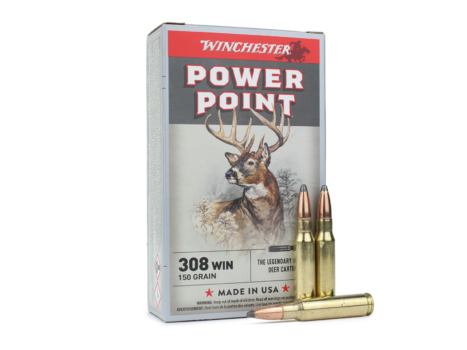
 Ammo Reports Team
| Official Spec | Value |
|---|---|
| Manufacturer | Winchester |
| Cartridge | 308 Winchester |
| Product Line | Power-Point / Super-X |
| Bullet Name / Type | Power-Point jacketed soft point |
| Bullet Weight | 150 gr |
| SKU / Part Number | X3085 |
| UPC | 020892200395 – retailer-listed |
| Rounds per Box | 20 |
| Muzzle Velocity | 2,820 fps |
| Muzzle Energy | 2,648 ft-lbs |
| Ballistic Coefficient G1 | Not found |
| Ballistic Coefficient G7 | Not found |
| Case Material | Brass – retailer-listed |
| Primer | Boxer – retailer-listed |
| Reloadable | Yes – retailer-listed |
| Test Barrel Length | Not found |
| Zero Distance | Not found |
| Sight Height | Not found |
| Intended Use | Deer hunting; big game hunting |
| Product Status | Current |
| Closest Competitors | Federal Power-Shok .308 Win 150 gr SP, Remington Core-Lokt .308 Win 150 gr PSP, Hornady American Whitetail .308 Win 150 gr InterLock SP, Federal Fusion .308 Win 150 gr, Hornady SST .308 Win 150 gr, Winchester Deer Season XP .308 Win 150 gr |
Data is based on official manufacturer sources. Found an error? Send us the source link.
Values labeled retailer-listed are retained only where the manufacturer does not publish the identifier or packaging detail.
Ballistics Table
Winchester manufacturer data. No calculated wind values are mixed into this table.
| Yards | Velocity (fps) | Energy (ft-lbs) |
|---|---|---|
| 0 | 2,820 | 2,648 |
The Power-Point Bullet Design
The Winchester Power-Point is one of the longest-running hunting bullet designs in American factory ammunition. Its defining characteristic is a series of notches cut into the jacket mouth, which are engineered to initiate and direct petal formation during expansion. Rather than relying solely on jacket thickness taper — the method used by many conventional soft points — the notched jacket creates predetermined split points that promote consistent, symmetrical mushrooming across a range of impact velocities.
This design philosophy prioritizes reliable expansion at moderate velocities, which matters in real hunting scenarios where shots are not always taken at peak muzzle velocity. A bullet that expands predictably at 1,800 fps (a typical 200-yard impact velocity for this load) is more valuable in the field than one optimized only for close-range, high-velocity impacts. The lead core is not bonded to the jacket, which means the Power-Point is not designed for the deep penetration or weight retention associated with premium bonded or partition-style bullets. At typical deer hunting distances and impact velocities, the Power-Point’s expansion is well-documented and functional. At very high impact velocities — such as close-range shots on heavily muscled animals — jacket separation and core loss are possible, which is a known limitation of non-bonded designs generally.
The Power-Point lineage predates most modern premium hunting bullets by decades, and its continued production reflects its track record on North American game rather than any technological novelty.
Best Uses
Good fit:
- Whitetail deer and mule deer hunting inside 300 yards
- Black bear hunting at moderate ranges with careful shot placement
- Feral hog control where lead-free regulations do not apply
- Hunters seeking a proven, widely available factory load at a mid-tier price point
- Shooters whose rifles are already zeroed and load-tested with this specific bullet weight (150 gr is among the most common .308 Win configurations)
- General-purpose big game hunting where premium bonded bullets are not required by conditions
Not the right tool for:
- Hunting in jurisdictions with lead-free ammunition regulations (California condor zones, certain federal lands) — the Power-Point is a traditional lead-core design
- Elk, moose, or large bear where deep penetration and high weight retention are critical — non-bonded construction limits performance on heavy bone and dense muscle
- Long-range hunting beyond 400 yards where a higher BC projectile provides meaningfully better wind resistance and retained energy
- Competitive precision rifle shooting — this is a hunting load, not a match-grade cartridge
- Hunters who require the most consistent lot-to-lot velocity uniformity available — Super-X is a value-tier line and is not manufactured to match-grade tolerances
Reliability Notes
No structured submissions yet.
Based on manufacturer claims and open-source information: Winchester describes the Super-X Power-Point as delivering consistent expansion across a range of impact velocities, citing the notched jacket as the primary mechanism for controlled mushrooming. The load has been commercially available for decades, and open-source hunting forums and published ammunition tests consistently report functional expansion on deer-sized game at typical field distances. No structured velocity deviation or pressure anomaly data is available for this specific SKU from independent laboratory sources. Users on hunting forums have noted that brass case quality is generally consistent with Winchester’s standard production, making once-fired cases suitable for reloading. No active recall or safety notice has been identified for this load. All notes here reflect manufacturer claims or open-source community observations, not structured test data.
Competitors
The complete comparison set from the original report is preserved below. Internal links appear only where an exact published Ammo Reports review exists.
| Load | Weight | Bullet | BC G1 | Advertised Velocity | Notes |
|---|---|---|---|---|---|
| Federal Power-Shok .308 Win 150 gr SP | 150 gr | Jacketed Soft Point | Not verified | 2,820 fps | Budget alternative; similar non-bonded construction; widely available |
| Remington Core-Lokt .308 Win 150 gr PSP | 150 gr | Pointed Soft Point | Not verified | 2,820 fps | Comparable non-bonded JSP; Core-Lokt has a long track record on deer |
| Hornady American Whitetail .308 Win 150 gr InterLock SP | 150 gr | InterLock SP | Not verified | 2,820 fps | Slightly higher BC; InterLock ring aids jacket-core retention; mid-tier pricing |
| Federal Fusion .308 Win 150 gr | 150 gr | Bonded SP | Not verified | 2,820 fps | Premium alternative; bonded construction for better weight retention on larger game |
| Hornady SST .308 Win 150 gr | 150 gr | SST (polymer tip) | 0.415 | 2,820 fps | Higher BC; polymer tip initiates expansion; better long-range performance |
| Winchester Deer Season XP .308 Win 150 gr | 150 gr | Extreme Point (polymer tip) | Not verified | 2,820 fps | Winchester’s own polymer-tip alternative; budget-to-mid pricing; same manufacturer |
Price and Availability
Retail availability changes by seller, location, and lot. Use the retailer links above to check current stock and checkout totals.
Where to Buy
FAQ
Does the Power-Point bullet design actually perform differently from a standard jacketed soft point?
The notched jacket on the Power-Point is a functional engineering distinction, not just a marketing label. The cuts in the jacket mouth create defined initiation points for petal formation, which promotes more symmetrical mushrooming compared to plain-jacket soft points that rely entirely on jacket thickness taper. In practice, this means the Power-Point tends to expand more consistently across a range of impact velocities — particularly at the lower end of the velocity range encountered at longer distances. That said, it is a non-bonded design, so jacket-core separation at very high impact velocities (close-range shots, for example) remains a possibility shared with most traditional soft points. For standard deer hunting distances, the design difference is meaningful but not dramatic compared to other quality soft points.
How does this load compare to the Winchester Deer Season XP .308 Win 150 gr?
Both loads are Winchester products at a similar price point, but they use fundamentally different bullet designs. The Deer Season XP uses an Extreme Point polymer-tipped bullet with a larger-diameter tip designed to initiate rapid expansion, which Winchester markets specifically for whitetail deer. The Super-X Power-Point uses a traditional notched jacketed soft point with a longer track record across a wider range of game. The Deer Season XP typically offers a higher BC and faster expansion initiation, which can be advantageous at longer ranges or for hunters who prioritize quick energy transfer. The Power-Point’s softer expansion profile may be preferable for hunters targeting larger or tougher animals where slightly deeper penetration is valued. Both are non-bonded designs with similar limitations on heavy game.
Is 150 grains the right bullet weight for .308 Winchester deer hunting, or should I consider 165 or 180 grain?
The 150 gr loading is the most common and arguably the most versatile weight for .308 Winchester in hunting applications. It offers a flat enough trajectory for shots to 300 yards without demanding significant holdover, while delivering sufficient energy for clean harvests on deer-sized game. The 165 gr and 180 gr options carry more energy at distance and penetrate deeper, making them better suited for elk, moose, or large black bear where bone mass and muscle depth demand more bullet weight. For whitetail deer, mule deer, and pronghorn, 150 gr is a well-established and effective choice. Hunters who regularly shoot both deer and larger game may prefer a heavier load for versatility, but for dedicated deer hunting, 150 gr in .308 Win is not a compromise — it is a primary recommendation.
Can this ammunition be used in .308 Winchester semi-automatic rifles, or is it bolt-action only?
The Winchester Super-X Power-Point in .308 Winchester is loaded to standard SAAMI pressure specifications and is compatible with any firearm chambered in .308 Winchester, including semi-automatic platforms such as the AR-10, M1A/M14-pattern rifles, and similar designs. There is no special consideration required for gas-operated semi-automatic use with this load. Hunters using semi-automatic .308 platforms for deer or hog hunting will find this ammunition functions reliably under standard operating conditions. As always, confirm that your specific firearm’s gas system and magazine are compatible with the bullet’s overall length, which is standard for 150 gr .308 Win factory loads.
Does the Super-X Power-Point meet lead-free requirements for hunting in California or on federal lands with condor zone restrictions?
No. The Winchester Super-X Power-Point uses a traditional lead-core, copper-jacketed bullet and does not meet California’s lead-free ammunition requirements under AB 711, which mandates non-lead projectiles for all hunting statewide. It also does not comply with U.S. Fish & Wildlife Service lead-free requirements for hunting in designated condor zones on federal lands. Hunters in California or affected federal areas must select a certified non-lead alternative such as a Barnes TSX, Hornady GMX, or Federal Trophy Copper load in .308 Winchester. Outside of these regulatory zones, the Power-Point is legal for use in all standard hunting applications across North American jurisdictions.