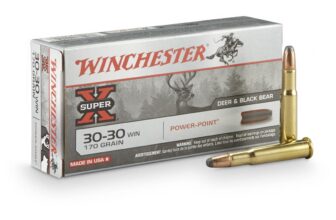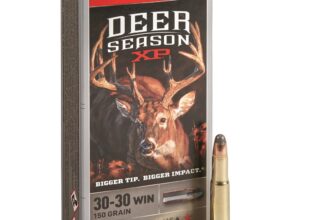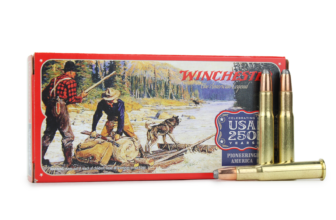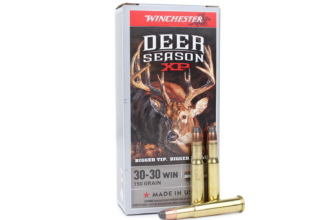
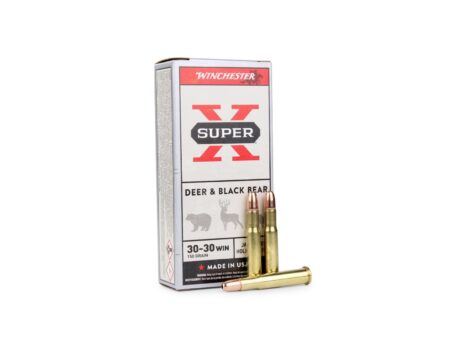
 Ammo Reports Team
| Field | Detail |
|---|---|
| Primary Use | Deer and medium-large game hunting from lever-action rifles |
| Bullet Type | Jacketed Hollow Point (JHP) |
| Bullet Weight | 150 gr |
| Case Material | Brass |
| Primer Type | Boxer (factory primer size not verified) |
| Packaging | 20 rounds per box |
| Typical Price | $41.99/box — $2.10/round |
| Closest Competitors | Federal Power-Shok 30-30 Win 150 gr JSP, Remington Core-Lokt 30-30 Win 150 gr SP, Hornady LEVERevolution 30-30 Win 160 gr FTX |
Official Specs
| Spec | Value | Source |
|---|---|---|
| Muzzle Velocity (fps) | 2390 | Winchester 2026 catalog, p. 31 |
| Muzzle Energy (ft-lbs) | 1902 | Winchester 2026 catalog, p. 31 |
| Bullet Weight | 150 gr | Winchester 2026 catalog, p. 31 |
| Bullet Type | Super-X Hollow Point | Winchester 2026 catalog, p. 31 |
| BC G1 | 0.218 | Winchester 2026 catalog, p. 31 |
| BC G7 | – | Not found in verified official manufacturer sources |
| Manufacturer SKU | X30301 | Winchester 2026 catalog, p. 31 |
| UPC | – | Not found in verified official manufacturer sources |
| Reloadable | Yes – brass case | Case/primer construction; exact primer specification unverified |
| Case Material | Brass | Case/primer construction; exact primer specification unverified |
| Primer | Boxer; factory primer size not verified | Case/primer construction; exact primer specification unverified |
Verified factory load: Winchester X30301, .30-30 Winchester, 150 gr. Source: Winchester 2026 catalog, p. 31. G7 BC and UPC were not found in the verified official sources.


Ballistics Table
Manufacturer data and calculated estimates are separated below. All trajectories shown use a 100-yard zero.
Official manufacturer ballistics. Winchester 2026 catalog, p. 31. Original published distances through 300 yards; unlisted distances are not interpolated. Test barrel: 24 inches. Sight height is not specified in the cited Winchester table.
| Yards | Official velocity (fps) | Official energy (ft-lb) | Official trajectory (in) |
|---|---|---|---|
| 0 | 2390 | 1902 | – |
| 100 | 2019 | 1357 | 0 |
| 200 | 1685 | 945 | -7.7 |
| 300 | 1398 | 651 | -27.9 |
Calculated estimate – not manufacturer data. 0-300 yards, 50-yard increments. G1 point-mass model (py-ballisticcalc); 150 gr, muzzle velocity 2390 fps, G1 BC 0.218, 100-yard zero, sight height 1.5 inches, sea level, 59°F, 29.92 inHg, 0% humidity, no wind. Sight height is an explicitly assumed model input. Actual results vary with firearm, ammunition lot and conditions.
| Yards | Calculated velocity (fps) | Calculated energy (ft-lb) | Calculated trajectory (in) |
|---|---|---|---|
| 0 | 2390 | 1902 | -1.5 |
| 50 | 2197 | 1608 | 0.2 |
| 100 | 2013 | 1350 | -0.0 |
| 150 | 1839 | 1126 | -2.3 |
| 200 | 1675 | 935 | -7.2 |
| 250 | 1524 | 773 | -15.2 |
| 300 | 1386 | 640 | -26.9 |
Key takeaway: The manufacturer table and the 50-yard model serve different purposes and should not be treated as interchangeable measurements. Energy alone does not establish a guaranteed hunting range or terminal performance.
The JHP Bullet in a Lever-Action Context
The use of a jacketed hollow point in the 30-30 Win warrants a brief explanation. Most classic 30-30 loads use flat-nose or round-nose soft point bullets — a design requirement driven by the tubular magazines of lever-action rifles like the Winchester Model 94 and Marlin 336. Pointed spitzer bullets are unsafe in tubular magazines because recoil can cause the tip of one cartridge to detonate the primer of the cartridge ahead of it.
A JHP with a flat or blunt nose profile avoids this hazard entirely. The Winchester Super X JHP uses a hollow cavity at the tip that is recessed rather than protruding, maintaining safe stacking in tubular magazines while still providing the rapid, controlled expansion characteristic of hollow point construction. This gives hunters the terminal performance benefits of a hollow point — faster expansion, larger wound channel — without compromising the mechanical safety of the action.
It is worth noting that this design differs from the Hornady FTX approach, which uses a flexible polymer tip to simulate a spitzer profile safely. The Winchester JHP relies on a more traditional geometry and is well-suited to hunters who prefer proven, conventional construction over newer elastomer-tip technology.
Best Uses
Good fit:
- Whitetail deer hunting at ranges within 175 yards, particularly in wooded or brushy terrain
- Lever-action rifles including the Winchester Model 94, Marlin 336, and similar platforms with tubular magazines
- Hunters who want reliable hollow point expansion on medium-sized game without the cost premium of bonded or polymer-tip loads
- Situations where a flat-nose JHP is required for tubular magazine safety
- General-purpose 30-30 plinking and range work where the same load will be used for hunting, maintaining consistent point of impact
Not the right tool for:
- Shots beyond 200 yards — trajectory drop and energy loss make ethical harvests increasingly difficult past that distance
- Large, heavy game such as elk or moose, where deeper penetration from a bonded or partition bullet is preferable
- Hunters in jurisdictions with lead-free ammunition requirements — this is a traditional lead-core JHP
- Bolt-action or single-shot rifles where a higher-BC spitzer bullet would be a better choice for the same caliber
- Situations requiring maximum retained weight and controlled expansion at low impact velocities (close-range, heavy brush shots may benefit from a flat-nose soft point instead)
Reliability Notes
No structured submissions yet.
Based on manufacturer claims and open-source product descriptions, the Winchester Super X line has a long production history and is widely regarded as a consistent performer in terms of primer ignition and case integrity. The Super X designation has been in continuous production for decades, suggesting stable quality control in brass and primer seating. The JHP construction is described by Winchester as engineered for controlled expansion, though no independent lab data on expansion diameter or retained weight is available in the current product listing. No recall notices or safety advisories are associated with this load at time of writing. All reliability observations here come from manufacturer claims or open sources, not structured data.
Competitors
| Load | Weight | Bullet | BC G1 | Adv. Velocity | Price/box | Notes |
|---|---|---|---|---|---|---|
| Federal Power-Shok 30-30 Win 150 gr JSP | 150 gr | Jacketed Soft Point | 0.218 | 2390 fps | ~$28–$34 | Manufacturer reference: 3030A. |
| Remington Core-Lokt 30-30 Win 150 gr SP | 150 gr | Soft Point (Core-Lokt) | 0.193 | 2390 fps | ~$30–$36 | Manufacturer reference: R30301. |
| Hornady LEVERevolution 30-30 Win 160 gr FTX | 160 gr | FTX (Flex Tip) | 0.330 | 2400 fps | ~$38–$46 | Manufacturer reference: 82730. |
| Winchester Super X 30-30 Win 150 gr PP (Power Point) | 150 gr | Power Point SP | 0.218 | 2390 fps | ~$30–$38 | Manufacturer reference: X30306. |
| Browning BXR 30-30 Win 155 gr | 155 gr | Rapid Expansion Matrix Tip | – | – | ~$35–$42 | Exact factory identity/specifications not verified. Original price estimate is not verified. |
| Barnes VOR-TX 30-30 Win 150 gr TSX | 150 gr | TSX FN, all-copper | 0.184 | 2335 fps | ~$48–$58 | Manufacturer reference: 21535 / BB30301. |
Price Reality
- At $41.99 per box of 20, this load comes to approximately $2.10 per round
- That positions it above budget 30-30 options like Federal Power-Shok (~$1.40–$1.70/round) and Remington Core-Lokt (~$1.50–$1.80/round)
- It is roughly comparable to Hornady LEVERevolution pricing, though LEVERevolution offers a measurable ballistic coefficient advantage at the same price tier
- The Barnes VOR-TX lead-free option typically runs $2.40–$2.90/round, making the Winchester Super X JHP a mid-range choice by comparison
- A fair price benchmark for this load is $35–$44 per box; listings above $46 should be considered overpriced unless supply conditions are exceptional
- Case pricing (typically 10 boxes / 200 rounds) is not confirmed in available data; buyers interested in volume purchases should verify case availability directly
Prices change. Check the Where to Buy block for current listings.
Where to Buy
Winchester Super X 30-30 Win 150 Gr JHP (Box)
Affiliate links. These do not influence ratings, data, or any editorial content on this page.
FAQ
Is the Winchester Super X 30-30 Win 150 gr JHP safe to use in a lever-action rifle with a tubular magazine?
This review concerns the exact .30-30 Winchester factory load identified in Official Specs. Follow the firearm manual and the ammunition manufacturer’s compatibility instructions for tubular magazines. Bullet-tip material alone does not prove magazine compatibility; this conclusion must not be generalized to other tipped bullets or other calibers.
How does this load compare to the Hornady LEVERevolution 160 gr FTX for deer hunting?
This load’s verified specifications are 150 gr, 2390 fps and G1 BC 0.218. Compare factory tables only when their zero and test conditions are stated. The Ballistics Table separates published manufacturer values from the 50-yard calculated model; it does not establish comparative terminal performance.
What game is the Winchester Super X 30-30 Win 150 gr JHP appropriate for?
This load is well-suited for whitetail deer, black bear (at close range), and similarly sized medium-large game. The 150 gr JHP at typical 30-30 velocities delivers adequate energy and expansion for clean harvests on deer-sized animals within 175 yards. It is not recommended for elk, moose, or other large heavy-boned game, where a heavier, bonded bullet with higher sectional density and deeper penetration is more appropriate. For feral hogs, this load is effective at close to moderate range but hunters targeting large boars may prefer a harder or bonded construction for better penetration through shoulder bone.
Does this load use the same bullet as the Winchester Super X Power Point 30-30 load?
No. While both are part of the Winchester Super X product family and share the same caliber and bullet weight, they use different bullet designs. The Power Point uses Winchester’s notched jacketed soft point — a cup-and-core design with a notched jacket to promote consistent expansion. The JHP variant uses a hollow point cavity to initiate expansion, which typically expands more rapidly on impact. The Power Point is arguably the more traditional 30-30 hunting bullet; the JHP offers a different expansion profile that may produce a larger initial wound channel. Neither design is objectively superior — selection depends on hunting conditions and personal preference.
Is this ammunition reloadable?
Yes. The Winchester Super X line uses brass cases with Boxer primers, which are fully reloadable. Spent brass can be resized, reprimed, and reloaded using standard 30-30 Win reloading dies. However, this page covers factory ammunition only and does not provide reloading data. Hunters who plan to reload their brass should inspect cases after firing for signs of case head separation or excessive stretching, as is standard practice with any straight-wall or bottleneck rifle cartridge.