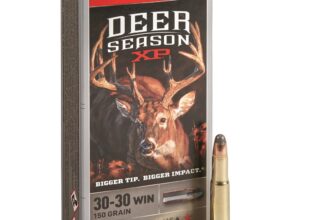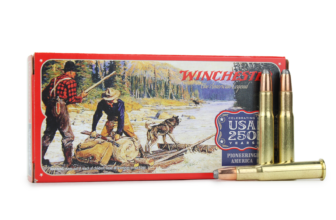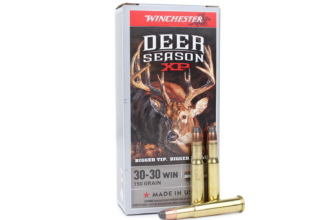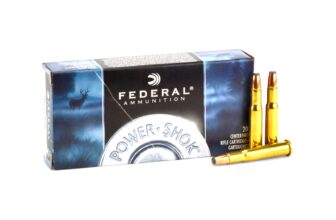
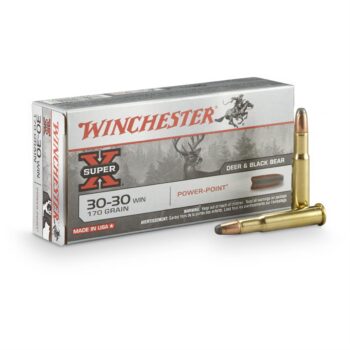
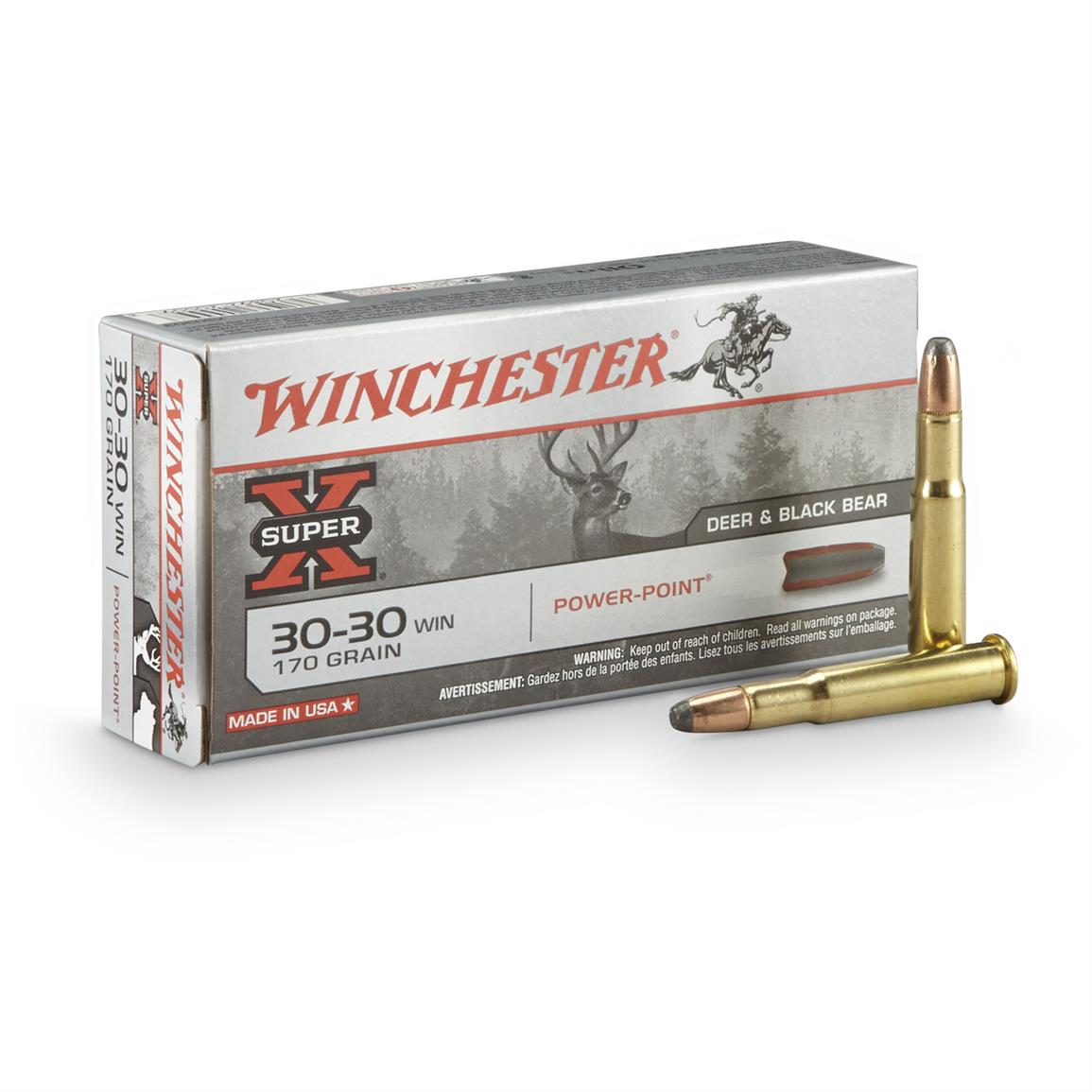
Winchester Super-X, .30-30 Winchester, PP, 170 Grain
 Ammo Reports Team


| Feature | Detail |
|---|---|
| Primary Use | White-tailed deer hunting, medium-large game |
| Bullet Type | Power-Point — soft-point with exposed lead tip and notched jacket |
| Bullet Weight | 170 grain |
| Case Material | Brass |
| Primer Type | Boxer (factory primer size not verified) |
| Packaging | 20 rounds per box |
| Typical Price | $29.44/box — $1.47/round |
| Closest Competitors | Federal Power-Shok .30-30 170 gr SP, Remington Core-Lokt .30-30 170 gr SP, Hornady LEVERevolution .30-30 160 gr FTX |
Official Specs
| Spec | Value | Source |
|---|---|---|
| Muzzle Velocity (fps) | 2200 | Winchester 2026 catalog, p. 31 |
| Muzzle Energy (ft-lbs) | 1827 | Winchester 2026 catalog, p. 31 |
| Bullet Weight | 170 gr | Winchester 2026 catalog, p. 31 |
| Bullet Type | Power-Point soft point | Winchester 2026 catalog, p. 31 |
| BC G1 | 0.241 | Winchester 2026 catalog, p. 31 |
| BC G7 | – | Not found in verified official manufacturer sources |
| Manufacturer SKU | X30303 | Winchester 2026 catalog, p. 31 |
| UPC | – | Not found in verified official manufacturer sources |
| Reloadable | Yes – brass case | Case/primer construction; exact primer specification unverified |
| Case Material | Brass | Case/primer construction; exact primer specification unverified |
| Primer | Boxer; factory primer size not verified | Case/primer construction; exact primer specification unverified |
Verified factory load: Winchester X30303, .30-30 Winchester, 170 gr. Source: Winchester 2026 catalog, p. 31. G7 BC and UPC were not found in the verified official sources.

Ballistics Table
Manufacturer data and calculated estimates are separated below. All trajectories shown use a 100-yard zero.
Official manufacturer ballistics. Winchester 2026 catalog, p. 31. Original published distances through 300 yards; unlisted distances are not interpolated. Test barrel: 24 inches. Sight height is not specified in the cited Winchester table.
| Yards | Official velocity (fps) | Official energy (ft-lb) | Official trajectory (in) |
|---|---|---|---|
| 0 | 2200 | 1827 | – |
| 100 | 1879 | 1332 | 0 |
| 200 | 1591 | 955 | -8.4 |
| 300 | 1346 | 683 | -30.8 |
Calculated estimate – not manufacturer data. 0-300 yards, 50-yard increments. G1 point-mass model (py-ballisticcalc); 170 gr, muzzle velocity 2200 fps, G1 BC 0.241, 100-yard zero, sight height 1.5 inches, sea level, 59°F, 29.92 inHg, 0% humidity, no wind. Sight height is an explicitly assumed model input. Actual results vary with firearm, ammunition lot and conditions.
| Yards | Calculated velocity (fps) | Calculated energy (ft-lb) | Calculated trajectory (in) |
|---|---|---|---|
| 0 | 2200 | 1827 | -1.5 |
| 50 | 2033 | 1560 | 0.3 |
| 100 | 1874 | 1325 | -0.0 |
| 150 | 1723 | 1121 | -2.8 |
| 200 | 1582 | 945 | -8.5 |
| 250 | 1452 | 796 | -17.7 |
| 300 | 1334 | 672 | -31.0 |
Key takeaway: The manufacturer table and the 50-yard model serve different purposes and should not be treated as interchangeable measurements. Energy alone does not establish a guaranteed hunting range or terminal performance.
The Winchester Power-Point Bullet
The Power-Point designation refers to a specific soft-point bullet construction that Winchester has produced for decades. The jacket is notched near the tip — a feature Winchester calls the "Power-Point notch" — which is designed to initiate and direct expansion reliably upon impact. The exposed lead tip deforms on contact, and the notched jacket peels back in a controlled pattern intended to produce a wide wound channel while retaining sufficient weight for penetration on medium game.
This construction is a traditional cup-and-core design, meaning the lead core is swaged into a gilding-metal jacket. It is not a bonded bullet, so core-jacket separation is possible at high impact velocities or when bone is struck at close range. For .30-30 Winchester at the velocities involved — typically 1,800–2,200 fps across hunting distances — this is rarely a practical concern, and the Power-Point has a long field record on white-tailed deer.
The flat-nose profile is a practical requirement for safe use in tubular magazines common to lever-action rifles. A pointed or polymer-tipped bullet seated in a tubular magazine can, under recoil, cause the tip of one cartridge to contact the primer of the cartridge ahead of it — a serious safety hazard. The flat-nose design eliminates this risk entirely, which is why the 170 gr flat-nose remains the dominant configuration for .30-30 Winchester hunting ammunition in this weight class.
Best Uses
Good fit:
- White-tailed deer hunting at woods-range distances (inside 150 yards)
- Hunting from tree stands or blinds where shots are typically under 100 yards
- Lever-action rifles with tubular magazines — flat-nose profile is safe by design
- Hunters who prioritize proven, traditional bullet performance over premium construction
- Black bear hunting at close range in dense cover
- Jurisdictions where lead-core bullets are not restricted
Not the right tool for:
- Open-country shots beyond 200 yards — trajectory and energy loss become limiting factors
- Situations requiring a bonded bullet for deep penetration through heavy shoulder bone on large game
- Jurisdictions with lead-free ammunition requirements — this is a lead-core bullet
- Hunters seeking maximum retained weight for elk-sized game — a heavier, bonded load is more appropriate
- Rifles with box magazines where a pointed bullet would be safe — the flat-nose sacrifices BC unnecessarily in that context
Reliability Notes
No structured submissions yet.
Based on manufacturer claims and open-source information, the Super-X Power-Point line has been in continuous production for many decades and is one of the most widely distributed .30-30 Winchester loads in North America. Winchester describes the load as designed for consistent ignition and reliable expansion across a range of temperatures — a relevant claim for hunters in cold-weather climates. The brass case and boxer primer construction are consistent with standard quality control in Winchester’s commercial ammunition lines. No recall notices are associated with this SKU at time of publication. All performance claims above come from manufacturer-published materials or open-source ballistic references, not structured field data.
Competitors
| Load | Weight | Bullet | BC G1 | Adv. Velocity | Price/box | Notes |
|---|---|---|---|---|---|---|
| Federal Power-Shok .30-30 170 gr SP | 170 gr | Soft-point flat-nose | 0.254 | 2200 fps | ~$27–$30 | Manufacturer reference: 3030B. |
| Remington Core-Lokt .30-30 170 gr SP | 170 gr | Core-Lokt soft-point | 0.254 | 2200 fps | ~$28–$32 | Manufacturer reference: R30302. |
| Hornady LEVERevolution .30-30 160 gr FTX | 160 gr | FTX polymer-tipped | 0.330 | 2400 fps | ~$33–$38 | Manufacturer reference: 82730. |
| Winchester Super-X .30-30 150 gr PP | 150 gr | Power-Point | 0.218 | 2390 fps | ~$28–$31 | Manufacturer reference: X30306. |
| Hornady American Whitetail .30-30 150 gr SP | 150 gr | InterLock soft-point | 0.186 | 2390 fps | ~$28–$33 | Manufacturer reference: 80801. |
| Federal Trophy Bonded .30-30 170 gr TBST | 170 gr | Trophy Bonded Soft-Point | – | – | ~$38–$45 | Exact factory identity/specifications not verified. Original price estimate is not verified. |
Price Reality
- At $29.44 per box of 20, this load sits at approximately $1.47 per round, which is within the normal range for mid-tier .30-30 Winchester hunting ammunition.
- Federal Power-Shok in the same weight typically runs $27–$30 per box, making it the closest budget alternative at a marginal savings.
- Remington Core-Lokt runs approximately the same price or slightly higher, offering comparable performance with a different core-retention approach.
- Hornady LEVERevolution commands a $4–$9 premium per box for meaningfully better ballistic performance at distance — a worthwhile upgrade for hunters who regularly take shots past 150 yards.
- A case price (typically 10 boxes, 200 rounds) for this load runs approximately $280–$310 when available, bringing the per-round cost to roughly $1.40–$1.55.
- Paying more than $38 per box for this specific load would be above fair market value unless supply is genuinely constrained. The Power-Point is a standard, widely available load and should not command a scarcity premium under normal market conditions.
Prices change. Check the Where to Buy block for current listings.
Where to Buy
Winchester Super-X, .30-30 Winchester, PP, 170 Grain, 20 Rounds
Affiliate links. These do not influence ratings, data, or any editorial content on this page.
FAQ
Q: Is the Winchester Super-X Power-Point 170 gr safe to use in a lever-action rifle with a tubular magazine?
This review concerns the exact .30-30 Winchester factory load identified in Official Specs. Follow the firearm manual and the ammunition manufacturer’s compatibility instructions for tubular magazines. Bullet-tip material alone does not prove magazine compatibility; this conclusion must not be generalized to other tipped bullets or other calibers.
Q: How does the Power-Point compare to the Hornady LEVERevolution FTX at hunting distances?
This load’s verified specifications are 170 gr, 2200 fps and G1 BC 0.241. Compare factory tables only when their zero and test conditions are stated. The Ballistics Table separates published manufacturer values from the 50-yard calculated model; it does not establish comparative terminal performance.
Q: Is this load appropriate for elk, or is it limited to deer-sized game?
The 170 grain Power-Point can take elk under the right conditions — specifically, close-range shots with careful bullet placement into the vital zone, avoiding heavy shoulder bone. However, the .30-30 Winchester cartridge as a whole is generally considered marginal for elk, and a standard cup-and-core bullet like the Power-Point does not offer the deep penetration and core retention that a bonded bullet provides. If elk hunting with a .30-30 is the goal, a premium bonded load such as the Federal Trophy Bonded or a similar construction is a more appropriate choice. For white-tailed deer and black bear at woods distances, the 170 gr Power-Point is well within its effective range.
Q: Does this ammunition work in .30-30 AI (Ackley Improved) or other wildcat chambers?
This is a factory load headstamped for standard .30-30 Winchester chambers. It will chamber and fire in a .30-30 Ackley Improved rifle, and doing so is a common practice for fire-forming brass. However, velocity and pressure behavior in a wildcat chamber differ from a standard chamber, and Winchester makes no performance claims for non-standard chamberings. AmmoReports covers factory ammunition in standard chambers only; consult a qualified gunsmith or the chambering’s documentation for guidance on wildcat use.
Q: What is the effective maximum range for ethical deer hunting with this load?
This load’s verified specifications are 170 gr, 2200 fps and G1 BC 0.241. Compare factory tables only when their zero and test conditions are stated. The Ballistics Table separates published manufacturer values from the 50-yard calculated model; it does not establish comparative terminal performance.