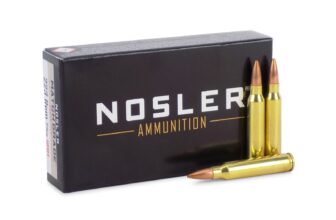
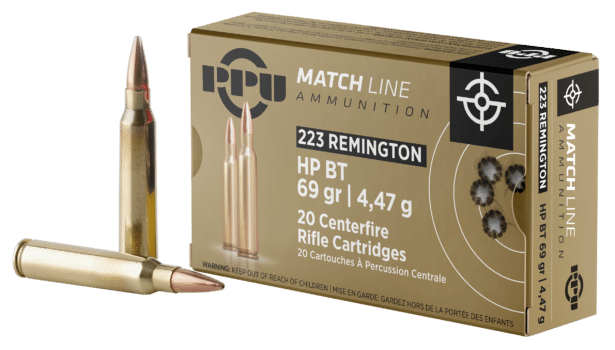
PPU Match 223 Rem 69 Gr HPBT

0
PPU Match 223 Rem 69 Gr HPBT 20 Rounds (Box)


FeatureDetail
Primary UsePrecision target shooting / long-range rifle competition
Bullet TypeHollow Point Boat Tail (HPBT)
Bullet Weight69 gr
Case MaterialBrass
Primer TypeBoxer (standard; lead-based โ€” type not specified by manufacturer)
Packaging20 rounds per box
Typical Price$22.49/box ยท $1.12/round
Closest CompetitorsFederal Gold Medal Match 223 Rem 69 Gr BTHP ยท Hornady Match 223 Rem 68 Gr BTHP ยท Black Hills Match 223 Rem 69 Gr HPBT

Official Specs

SpecValueSource
Muzzle Velocity (fps)โ€”Not published
Muzzle Energy (ft-lbs)โ€”Not published
Bullet Weight69 grManufacturer
Bullet TypeHollow Point Boat Tail (HPBT)Manufacturer
BC G1โ€”Not published
BC G7โ€”Not published
Manufacturer SKUโ€”Not published
UPCโ€”Not published
ReloadableYesManufacturer (brass/Boxer)

Note โ€” Velocity & Energy: PPU does not publish muzzle velocity or muzzle energy for this load in available product documentation. The ballistics table below uses a calculated estimate based on comparable 69 gr HPBT loads fired from a 24-inch test barrel. Real-world results from 16-inch or 18-inch barrels will be meaningfully lower. Community submissions will be used to populate measured values when available.

Note โ€” BC: No ballistic coefficient (G1 or G7) has been published by PPU for this specific load. The value used in the ballistics table below is a commonly accepted industry estimate for 69 gr HPBT projectiles (~0.301 G1 / ~0.152 G7) and is labeled accordingly.

Ballistics Table

Calculated estimate. Real-world results vary by barrel length, temperature,altitude, and lot. Community submissions will provide measured muzzlevelocity for comparison.

Assumptions: Muzzle velocity ~2,950 fps (estimated, 24″ barrel); BC G1 ~0.301 (industry estimate for 69 gr HPBT); sight height 1.5″ above bore; 100 yd zero; sea level; 59ยฐF; no wind.

YardsVelocity (fps)Energy (ft-lbs)Trajectory (in)
0~2,950~1,334-1.5
100~2,692~1,1110.0 โ† zero
200~2,447~917-3.5
300~2,213~750-13.5
400~1,991~607-31.5
500~1,782~487-59.8

Key takeaway: At a calculated 2,950 fps muzzle velocity, this 69 gr HPBT load maintains supersonic flight well past 500 yards, which is the primary reason match shooters choose heavier .223 projectiles over lighter 55 gr or 62 gr options. The relatively flat trajectory out to 300 yards makes it forgiving for practical target work, while the drop beyond 400 yards demands precise range estimation and dial or holdover corrections. Shooters using 16-inch carbine-length barrels should anticipate muzzle velocities roughly 150โ€“200 fps lower than the 24-inch test barrel estimates shown here, compressing the effective supersonic envelope slightly. The boat tail base reduces base drag and aids stability through transonic transition compared to flat-base designs.

The 69 gr HPBT in .223 Rem โ€” Why This Weight Exists

The 69-grain hollow point boat tail occupies a specific performance niche in .223 Rem / 5.56 NATO loading. Standard military and budget commercial loads typically use 55 gr or 62 gr projectiles, which stabilize readily in 1:9 or faster twist barrels but sacrifice ballistic coefficient at distance. The 69 gr bullet offers a meaningfully higher BC than lighter .224-caliber projectiles, extending effective range and reducing wind drift โ€” both critical factors in NRA High Power, F-Class, and service rifle competition.

PPU (Prva Partizanska Uzinica), a Serbian state-founded manufacturer with decades of NATO-standard production history, developed its Match line to address the competitive shooting segment. The HPBT design used in this load is a conventional open-tip match (OTM) bullet; the hollow point is a manufacturing artifact of the jacket-drawing process rather than an expansion mechanism, and the projectile is not designed or optimized for terminal expansion on game. This distinction matters for both regulatory and performance expectations.

Twist rate compatibility is a practical concern: 1:8 or 1:9 twist barrels are generally required to stabilize 69 gr .224 projectiles reliably. Rifles with 1:12 twist (common in older .223 bolt guns) may not stabilize this bullet weight adequately, producing keyholing or degraded accuracy.

Best Uses

Good fit:

  • NRA High Power and service rifle competition at 200โ€“600 yard stages
  • F-Class or informal long-range paper target shooting
  • Precision bolt-gun accuracy testing and load development benchmarking
  • Training at extended distances where 55 gr loads become wind-sensitive
  • Shooters seeking a match-grade load at a mid-tier price point

Not the right tool for:

  • Hunting โ€” the HPBT/OTM design is not optimized for reliable terminal expansion on game, and may be prohibited under certain state hunting regulations for deer or varmints depending on jurisdiction
  • Carbine-length ARs with 1:12 twist barrels โ€” bullet weight likely exceeds stabilization threshold
  • High-volume range training where per-round cost needs to be minimized
  • Self-defense or duty use โ€” hollow cavity does not function as a defensive expanding bullet in this construction
  • Shooters who require published velocity data for precise ballistic solver input without additional chronograph work

Reliability Notes

No structured submissions yet.

From manufacturer claims and open sources (not structured data): PPU’s Match line is marketed as using dedicated match-grade brass with consistent wall thickness and weight-sorted projectiles, attributes the manufacturer associates with reduced velocity spread and improved group consistency. The Boxer-primed brass is described as reloadable, which is consistent with PPU’s broader commercial production standards. Open-source user observations across shooting forums suggest PPU Match ammunition generally delivers acceptable accuracy in the 0.75โ€“1.25 MOA range from quality bolt-action platforms, though these reports are anecdotal and barrel-dependent. No pattern of documented feeding, extraction, or primer reliability issues specific to this load was identified in available open sources at time of publication.

Competitors

LoadWeightBulletBC G1Adv. VelocityPrice/boxNotes
Federal Gold Medal Match 223 Rem 69 Gr BTHP69 grSierra MatchKing BTHP0.301~2,950 fps (24″)~$27โ€“$30Premium benchmark; uses same Sierra SMK projectile widely referenced in competition
Hornady Match 223 Rem 68 Gr BTHP68 grHornady BTHP0.310~2,850 fps (24″)~$25โ€“$281 gr lighter; slightly higher published BC; well-documented competition record
Black Hills Match 223 Rem 69 Gr HPBT69 grSierra MatchKing HPBT0.301~2,850 fps (24″)~$28โ€“$33Same bullet weight and projectile type; premium U.S. manufacturer; often preferred for service rifle
Winchester USA MATCH 223 Rem 69 Gr BTHP69 grSierra MatchKing BTHP0.301~2,950 fps (24″)~$22โ€“$26Budget-to-mid tier; comparable price point to PPU; uses same Sierra projectile
Sellier & Bellot 223 Rem 69 Gr HPBT69 grHPBT~0.295~2,887 fps (published)~$18โ€“$22Budget alternative; European manufacture; published velocity available; lower per-round cost
Nosler Match Grade 223 Rem 69 Gr HPBT69 grCustom Competition HPBT0.305~3,000 fps (published)~$32โ€“$38Premium alternative; published velocity and BC; higher price tier

Price Reality

  • Typical retail range: $20โ€“$25 per 20-round box; case pricing (500 rounds / 25 boxes) typically falls in the $480โ€“$560 range when available
  • Per-round cost: approximately $1.12/round at the $22.49 reference price
  • Federal Gold Medal Match 69 gr runs approximately $1.35โ€“$1.50/round โ€” PPU offers a meaningful savings over that benchmark
  • Hornady Match 68 gr typically runs $1.25โ€“$1.40/round โ€” again, PPU is priced below this tier
  • Sellier & Bellot 69 gr HPBT is the closest budget competitor at roughly $0.90โ€“$1.10/round
  • Fair price benchmark: $22โ€“$25/box represents fair market value for this load; pricing above $28/box (absent supply disruption) would be difficult to justify against Federal or Hornady Match alternatives that offer published ballistic data and documented competition pedigree

Prices change. Check the Where to Buy block for current listings.

Where to Buy

PPU Match 223 Rem 69 Gr HPBT 20 Rounds (Box)

PPU Match 223 Rem 69 Gr HPBT ammunition is designed for precision target shooting, delivering exceptional stability and accuracy with its 69-grain hollow point boat tail bullet. With reliable brass casings and primers, this ammunition offers the performance that discerning shooters demand.

Affiliate links. These do not influence ratings, data, or any editorial content on this page.

FAQ

Does the hollow point in this bullet expand like a hunting or defensive bullet?

No. The hollow point boat tail construction used in PPU Match โ€” and in virtually all match-grade HPBT ammunition โ€” is an open-tip match (OTM) design. The small hollow cavity at the tip is a byproduct of the jacket-drawing manufacturing process, not a feature engineered to initiate expansion on impact. The jacket mouth forms the tip, leaving an opening, but the bullet is not designed to expand reliably at typical rifle velocities against soft tissue. Hunters and defensive shooters should select purpose-built expanding projectiles for those applications. This load is optimized for precision accuracy, not terminal performance.

What twist rate does my barrel need to stabilize the 69 gr bullet?

A 1:8 or 1:9 twist barrel is generally required to adequately stabilize a 69 gr .224-caliber projectile. A 1:9 twist is the most commonly cited minimum, and many competitive shooters prefer 1:8 for margin. Barrels with a 1:12 twist โ€” found in some older bolt-action .223 rifles โ€” will likely fail to stabilize this bullet weight, resulting in tumbling, keyholing on paper targets, and severely degraded accuracy. If you are unsure of your barrel’s twist rate, check the barrel markings, manufacturer specifications, or measure the rifling directly before purchasing heavier match projectiles.

How does PPU Match 69 gr compare to Federal Gold Medal Match 69 gr for competition use?

Both loads use a 69 gr HPBT projectile, and Federal’s version specifically uses the Sierra MatchKing โ€” a bullet with an extensively documented competition record. PPU does not specify the projectile source, which matters to some competitive shooters who want known lot-to-lot consistency from a named component manufacturer. Federal Gold Medal Match also publishes muzzle velocity, making ballistic solver input more straightforward. The PPU load offers a cost advantage of roughly $5โ€“$8 per box, which is meaningful for high-volume training. For major competition, many shooters prefer Federal or Black Hills for documented data; for practice and club-level matches, PPU’s price-to-performance ratio is competitive.

Is PPU Match brass reloadable, and is it consistent enough for reloading?

The brass casings are Boxer-primed and reloadable, which is a practical advantage over Berdan-primed or steel-cased alternatives. PPU brass has a general reputation in the handloading community for being serviceable and durable through multiple reloading cycles, though it is not typically considered equivalent to Lapua or Norma brass in terms of weight consistency and wall uniformity. However, this page covers factory ammunition only โ€” reloading data, component assessments, and handload performance fall outside the scope of this reference.

Can this ammunition be used in a 5.56 NATO-chambered rifle?

Yes. 223 Rem ammunition is safe to fire in a rifle chambered for 5.56 NATO. The 5.56 NATO chamber has slightly more headspace and a longer throat (leade) than the SAAMI .223 Rem specification, meaning .223 Rem factory loads fire without pressure concerns in 5.56 chambers. The reverse is not universally true โ€” 5.56 NATO military ammunition should not be fired in a rifle chambered strictly to SAAMI .223 Rem dimensions without verifying the firearm manufacturer’s guidance, as higher 5.56 pressures can exceed .223 Rem chamber design limits. PPU Match 223 Rem is a commercial SAAMI-spec load and is appropriate for both .223 Rem and 5.56 NATO chambers.


We will be happy to hear your thoughts

Leave a reply

Ammo Reports
Logo