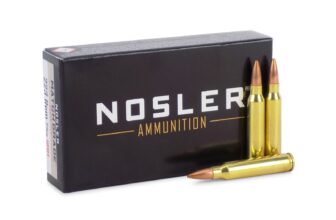
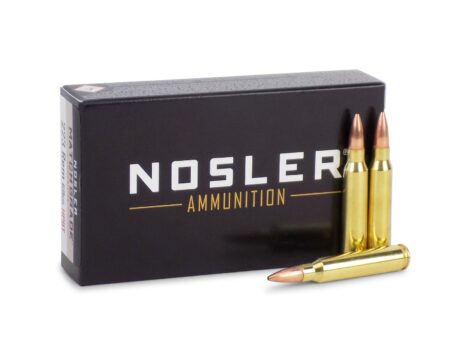
Nosler Match Grade 223 Remington 69 Grain Custom Competition HPBT

0
Nosler Match Grade 223 Remington 69 Grain Custom Competition HPBT (Box)


FeatureDetail
Primary UseCompetitive target shooting, precision rifle matches
Bullet TypeCustom Competition Hollow Point Boat Tail (HPBT)
Bullet Weight69 grains
Case MaterialBrass
Primer TypeBoxer
Packaging20 rounds per box
Typical Price$38.99/box โ€” $1.95/round
Closest CompetitorsSierra MatchKing 69 gr HPBT (various loadings), Hornady Match 68 gr BTHP, Federal Gold Medal Match 69 gr Sierra MatchKing

Official Specs

SpecValueSource
Muzzle Velocity (fps)โ€”Not published
Muzzle Energy (ft-lbs)โ€”Not published
Bullet Weight69 grManufacturer
Bullet TypeCustom Competition HPBTManufacturer
BC G1โ€”Not published
BC G7โ€”Not published
Manufacturer SKUโ€”Not published
UPCโ€”Not published
ReloadableYesBrass case, Boxer primer

Note: Nosler does not publish muzzle velocity, muzzle energy, or ballistic coefficient data for this specific factory load in publicly available documentation. The ballistics table below uses calculated estimates based on published data for comparable 69-grain HPBT loads fired from a 24-inch test barrel. Community-submitted chrono data will be incorporated as it becomes available.

Ballistics Table

Calculated estimate. Real-world results vary by barrel length, temperature,altitude, and lot. Community submissions will provide measured muzzlevelocity for comparison.

Assumptions: ~2,950 fps muzzle velocity (typical for 69 gr .223 Rem from 24″ barrel), G1 BC ~0.370 (representative of 69 gr HPBT class), 1.5″ sight height, 100-yard zero.

YardsVelocity (fps)Energy (ft-lbs)Trajectory (in)
0~2,950~1,334-1.5
100~2,727~1,1400.0 โ† zero
200~2,513~968+3.6
300~2,308~8160.0
400~2,112~683-13.2
500~1,925~567-37.8

Key takeaway: The 69-grain HPBT retains velocity well through 300 yards, making it well-suited for the typical distances encountered in High Power and Service Rifle competition. Wind drift, rather than drop, becomes the dominant challenge past 300 yards. Shooters using 20-inch AR-pattern barrels should expect muzzle velocity approximately 75โ€“100 fps lower than these estimates, which will steepen the trajectory noticeably at 400โ€“500 yards. The boat-tail base helps the bullet maintain stability and resist transonic instability better than flat-base designs at extended ranges.

The Custom Competition HPBT Bullet

The Custom Competition bullet used in this load is Nosler’s purpose-built match projectile, distinct from the company’s hunting-oriented lines such as the Ballistic Tip or Partition. The hollow-point cavity in a match HPBT is not designed for terminal expansion โ€” it exists as a manufacturing artifact of the jacket-forming process that produces a more consistent, concentric bullet than a standard lead-tip design. This translates directly to tighter group sizes at distance.

Nosler produces these bullets in-house and loads them over carefully selected propellant charges with the goal of minimizing velocity standard deviation (SD) and extreme spread (ES) โ€” the two metrics that matter most to competitive shooters. The boat-tail geometry reduces base drag, easing the bullet’s transition into supersonic flight and improving the effective ballistic coefficient compared to a flat-base projectile of the same weight and diameter. For competitors shooting High Power Rifle, NRA Long Range, or Precision Rifle Series (PRS) stages at 200โ€“600 yards, this design profile is essentially the industry standard.

Best Uses

Good fit:

  • High Power and Service Rifle competition at 200, 300, and 600-yard stages
  • Precision rifle practice where lot-to-lot consistency is more important than cost
  • Accuracy testing and load development comparison for AR-platform rifles with 1:8 or faster twist rates
  • Shooters who want a factory match load with a premium bullet without sourcing components separately
  • Indoor and outdoor benchrest practice at 100โ€“300 yards

Not the right tool for:

  • Hunting โ€” the hollow-point match design is not engineered for reliable terminal expansion on game, and many jurisdictions prohibit HPBT bullets for hunting use
  • High-volume range training where cost-per-round is a primary concern โ€” at ~$1.95/round, this load is priced for precision work, not bulk practice
  • Rifles with 1:12 twist barrels, which may not stabilize a 69-grain projectile reliably
  • Suppressor-host rifles where subsonic loads are preferred

Reliability Notes

No structured submissions yet.

Based on manufacturer claims and open-source user reports, the following notes are offered โ€” these come from manufacturer documentation and publicly available commentary, not structured test data:

  • Nosler states that Match Grade ammunition is assembled on precision equipment with tight tolerances on overall cartridge length (OAL) and concentricity, which is consistent with the standards expected of competition-grade factory ammunition.
  • The Custom Competition bullet is the same projectile Nosler sells as a component bullet, providing a meaningful reference point โ€” component-level reviews of this bullet consistently report low SD figures when loaded carefully.
  • Open-source reports suggest this load performs well in bolt-action rifles with 24-inch barrels and in AR-15 platforms with 18โ€“20-inch barrels, though no structured barrel-length comparison data is available.
  • No recall notices or safety advisories have been identified for this load as of the publication of this page.

Competitors

LoadWeightBulletBC G1Adv. VelocityPrice/boxNotes
Federal Gold Medal Match 69 gr SMK69 grSierra MatchKing HPBT~0.370~3,000 fps (24″)~$22โ€“$26Budget alternative; industry benchmark bullet
Hornady Match 68 gr BTHP68 grHornady BTHP~0.355~2,850 fps (24″)~$18โ€“$24Widely available; 1 gr lighter
Black Hills Match 69 gr Sierra MatchKing69 grSierra MatchKing HPBT~0.370~2,850 fps (24″)~$28โ€“$34Uses same SMK bullet; respected competition load
Lapua Scenar 69 gr HPBT69 grLapua Scenar HPBT~0.375~2,950 fps (24″)~$45โ€“$55Premium alternative; Lapua brass; higher cost
Winchester USA Ready Match 69 gr OT69 grOpen Tip Match~0.360~3,000 fps (24″)~$20โ€“$28Budget-friendly; less premium brass
Sierra MatchKing 69 gr factory (various)69 grSierra MatchKing HPBT~0.370Varies~$22โ€“$30Same bullet class; multiple factory loaders

Note: Advertised velocity figures above are sourced from individual manufacturers’ published data or widely cited open-source references and may reflect different barrel lengths. Direct comparison requires identical test conditions.

Price Reality

  • Typical retail range: $35โ€“$42 per 20-round box; case pricing (typically 500 rounds / 25 boxes) is not widely listed for this load
  • Per-round cost: approximately $1.75โ€“$2.10 depending on retailer and market conditions
  • Federal Gold Medal Match 69 gr typically runs $1.10โ€“$1.30/round โ€” a meaningful savings for high-volume competition shooters
  • Hornady Match 68 gr is generally available at $0.90โ€“$1.20/round, making it the clear budget choice in this bullet-weight class
  • Lapua Scenar factory loads run $2.25โ€“$2.75/round, placing Nosler Match Grade in the mid-to-upper tier
  • A fair price benchmark for this load is $38โ€“$42 per box. Pricing above $45 for a single 20-round box should be considered overpriced given current market availability of comparable loads.

Prices change. Check the Where to Buy block for current listings.

Where to Buy

Nosler Match Grade 223 Remington 69 Grain Custom Competition HPBT (Box)

Experience unmatched precision with Nosler Match Grade 223 Remington cartridges, featuring a 69-grain boat-tail hollow-point design engineered for accuracy. Perfect for serious competitors, these rounds allow you to concentrate on your shots without compromise.

Affiliate links. These do not influence ratings, data, or any editorial content on this page.

FAQ

Does the hollow point in this bullet cause any legal issues for competition use?
The hollow-point boat-tail design used in this load is legal for virtually all civilian target shooting competitions in the United States, including NRA High Power, PRS, and USPSA rifle divisions. Some jurisdictions restrict hollow-point ammunition for hunting, but competition use on approved ranges is generally unaffected. International competitors should verify local regulations before importing or transporting this ammunition. The hollow point in a match HPBT is a manufacturing feature, not a defensive-expansion mechanism, and is widely accepted in the competition community.

How does this load compare directly to Federal Gold Medal Match 69 gr?
Both loads use a 69-grain HPBT projectile, but the Nosler load uses the Custom Competition bullet rather than the Sierra MatchKing. Sierra’s MatchKing is arguably the most tested match bullet in this weight class and has an exceptionally long track record in competition. Nosler’s Custom Competition bullet is produced to comparable tolerances and is well-regarded, but Federal Gold Medal Match with the Sierra MatchKing typically retails for significantly less per round. For budget-conscious competitors, Federal’s offering is difficult to beat; for shooters who specifically prefer Nosler’s component bullet in a factory load, this Nosler product is a logical choice.

What twist rate is required to stabilize a 69-grain .223 bullet?
A 1:8 twist is the most common recommendation for reliable stabilization of 69-grain .224-diameter projectiles, and a 1:9 twist will typically stabilize this weight as well under most temperature conditions. A 1:12 twist barrel โ€” common in older AR-15 and bolt-action .223 rifles โ€” is generally not fast enough to stabilize a 69-grain bullet reliably, which can produce keyholing or poor accuracy. Shooters should confirm their barrel’s twist rate before purchasing this load. Most modern AR-15 rifles sold with 1:8 or 1:9 barrels are well-matched to this 69-grain bullet weight.

Is this load appropriate for varmint hunting?
The Custom Competition HPBT is engineered for accuracy, not terminal performance on game. While a 69-grain .223 projectile fired at match velocities will be lethal on small varmints at close range, this bullet is not designed to fragment or expand predictably the way a dedicated varmint bullet โ€” such as a Nosler Varmageddon or Hornady V-MAX โ€” would. For varmint hunting applications, a purpose-built frangible or polymer-tip varmint load will deliver more consistent terminal results. Additionally, some states restrict the use of hollow-point bullets for hunting specific species, so local regulations should always be consulted.

Why does Nosler not publish velocity data for this load?
Nosler does not consistently publish muzzle velocity or energy figures for all loads in the Match Grade line in publicly accessible formats, which is an uncommon practice among major ammunition manufacturers. This may reflect the company’s position that match ammunition performance is highly barrel-dependent, and publishing a single figure from a specific test barrel could be misleading to end users with different rifle configurations. Competitive shooters are strongly encouraged to chronograph this load from their own barrel to establish an accurate muzzle velocity baseline for ballistic solver inputs. Until manufacturer data is published or community submissions are received, all ballistic figures on this page should be treated as calculated estimates.


We will be happy to hear your thoughts

Leave a reply

Ammo Reports
Logo