 Ammo Reports Team
| Official Spec | Value |
|---|---|
| Manufacturer | Hornady |
| Cartridge | 22 ARC |
| Product Line | V-Match |
| Bullet Name / Type | ELD-VT – Extremely Low Drag Varmint/Target |
| Bullet Weight | 62 gr |
| Manufacturer SKU | 81542 |
| UPC | 090255815429 (Retailer listed) |
| Rounds per Box | 20 |
| Muzzle Velocity | 3300 fps |
| Muzzle Energy | 1499 ft-lbs |
| Ballistic Coefficient G1 | 0.395 |
| Ballistic Coefficient G7 | 0.199 |
| Case Material | Not found |
| Primer | Not found |
| Reloadable | Not found |
| Test Barrel Length | 24 in |
| Zero Distance | 200 yd |
| Sight Height | Not found |
| Intended Use | Varmint, predator, and target shooting |
| Product Status | Current product listing verified |
| Closest Competitors | Hornady Black 22 ARC 75 Gr Extremely Low Drag-Match, Federal American Eagle 22 ARC 62 Gr OTM, Nosler Match Grade 22 ARC 70 Gr RDF, Hornady V-Match 224 Valkyrie 60 Gr ELD-VT, Winchester USA Ready 22 ARC 62 Gr OTP |
Data is based on official manufacturer sources. Found an error? Send us the source link.
Official-data note: Product identity, item number, box count, test-barrel length, muzzle figures, and the 0-500 yard trajectory were checked against current Hornady material. BC values are from Hornady bullet data for the exact projectile. The UPC is retailer-listed. Case material, primer type, and reloadable status were not explicitly stated for the exact factory load.
Manufacturer: Hornady. Exact official product pages and technical documents are recorded in the editorial verification log. Any retailer-listed field is labeled.
Ballistics Table
Official Hornady manufacturer data. Test barrel: 24 inches. Manufacturer trajectory: 200-yard zero. Hornady does not list wind drift in the factory table.
| Distance | Velocity (fps) | Energy (ft-lbs) | Trajectory (in) |
|---|---|---|---|
| Muzzle | 3300 | 1499 | -1.5 |
| 100 | 3044 | 1275 | +1.1 |
| 200 | 2803 | 1081 | 0 |
| 300 | 2574 | 912 | -5.6 |
| 400 | 2357 | 765 | -16.4 |
| 500 | 2150 | 636 | -33.5 |
Source note: Hornady publishes exact velocity, energy, and trajectory through 500 yards for SKU 81542. Hornady does not publish values beyond 500 yards or wind drift for this table, so no calculated extensions are added.
Key takeaway: Hornady lists 3,300 fps and 1,499 ft-lbs at the muzzle. At 500 yards, the factory table reports 2,150 fps, 636 ft-lbs, and 33.5 inches of drop with the manufacturer 200-yard zero.
The ELD-VT Bullet and Why This Load Exists
The ELD-VT (Extremely Low Drag – Varmint/Target) is Hornady’s answer to a specific problem: conventional polymer-tipped varmint bullets can experience tip deformation during flight at very high velocities, degrading the ballistic coefficient mid-trajectory. Hornady’s solution, shared across the ELD family, is a Heat Shield tip made from a thermoplastic material engineered to resist aerodynamic heating and maintain its shape throughout the bullet’s flight. The result is a more consistent BC from muzzle to target compared to older-generation varmint tips.
Hornady designed the 22 ARC for AR-15 and bolt-action rifles, with a maximum overall length of 2.260 inches and a 1:7-inch twist specification. The V-Match item 81542 uses the 62 gr ELD-VT bullet for varmint, predator, and target applications. Use only a firearm and magazine specifically compatible with 22 ARC.
Best Uses
Good fit:
- Varmint and predator hunting where the 62 gr ELD-VT bullet is permitted and appropriate
- Coyote hunting where caliber regulations permit 22-caliber centerfire and a rapid-expansion bullet is preferred
- Precision target shooting and group testing on paper where the match-grade construction delivers consistent accuracy
- AR-15 platform shooters who have already invested in a 22 ARC-specific barrel and bolt and want a factory load optimized for the cartridge’s capability
- Varmint hunters who need a load that transitions cleanly between field and range use without swapping ammunition types
Not the right tool for:
- Deer or larger big-game hunting where a controlled-expansion bullet and a different caliber may be required; verify the applicable regulations before use
- Shooters who do not own a 22 ARC-chambered firearm — this cartridge is not interchangeable with .223 Rem, .224 Valkyrie, or any other 22-caliber centerfire
- Budget-conscious shooters doing high-volume practice, because this is a premium varmint and target load rather than bulk training ammunition
- Hunting areas where current regulations require lead-free projectiles, because ELD-VT is not a lead-free alternative
- Subsonic or suppressor-optimized applications — the ELD-VT is a supersonic, high-velocity design
Reliability Notes
Hornady describes V-Match ammunition as loaded with carefully selected components for consistent performance, but no standardized manufacturer reliability-test results were found for exact factory SKU 81542 across multiple firearms. Confirm feeding, extraction, ignition, accuracy, and point of impact in the specific 22 ARC rifle before field or competition use.
Competitors
| Competitor | Bullet Type | Weight | Muzzle Velocity | Comparison Note |
|---|---|---|---|---|
| Hornady Black 22 ARC 75 Gr Extremely Low Drag-Match | ELD Match – Extremely Low Drag Match | 75 gr | 3075 fps | Precision rifle, target shooting, and competition |
| Federal American Eagle 22 ARC 62 Gr OTM | OTM | 62 gr | Not verified | Original listed competitor – exact product not verified |
| Nosler Match Grade 22 ARC 70 Gr RDF | RDF | 70 gr | Not verified | Original listed competitor – exact load not verified |
| Hornady V-Match 224 Valkyrie 60 Gr ELD-VT | ELD-VT | 60 gr | Not verified | Varmint and target comparison in another cartridge |
| Winchester USA Ready 22 ARC 62 Gr OTP | Open Tip Performance | 62 gr | Not verified | Original listed competitor – exact product not verified |
Price Reality
Retail prices and availability change. Compare the current store listings below and verify item 81542 and the exact 20-round package before purchase. Price is not used to determine the technical data or editorial conclusion.
Where to Buy
Affiliate links. These do not influence ratings, data, or any editorial content on this page.
FAQ
What is the exact product reviewed on this page?
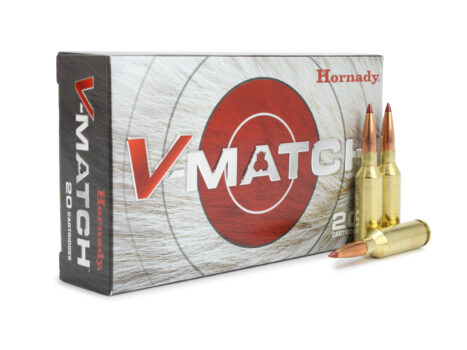
Hornady V-Match 22 ARC 62 Gr ELD-VT, factory item 81542, supplied in a 20-round box.
What muzzle velocity and energy does Hornady publish?
Hornady lists 3,300 fps and 1,499 ft-lbs from a 24-inch test barrel.
What zero does the Hornady trajectory table use?
The factory trajectory is zeroed at 200 yards. Hornady lists +1.1 inches at 100 yards and -33.5 inches at 500 yards.
What ballistic coefficients are officially published?
Hornady publishes a G1 BC of 0.395 and a G7 BC of 0.199 for the 62 gr ELD-VT bullet.
Does Hornady publish data beyond 500 yards or wind drift?
No. The verified Hornady table ends at 500 yards and does not list wind drift, so this review does not add calculated values.