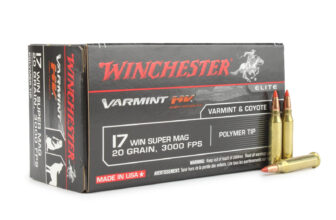
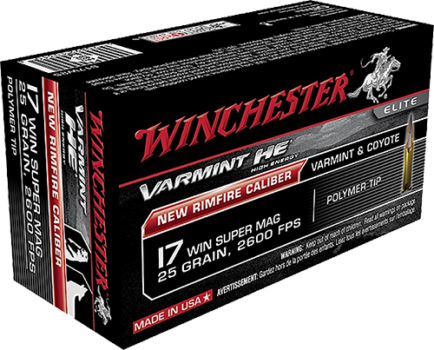
 Ammo Reports Team
| Feature | Detail |
|---|---|
| Primary Use | Varmint hunting |
| Bullet Type | Polymer Tip (lead-core, jacketed with polymer tip insert) |
| Bullet Weight | 25 gr |
| Case Material | Brass (rimfire) |
| Primer Type | Rimfire (integral) |
| Packaging | 50 rounds per box |
| Typical Price | $28.49/box · $0.57/round |
| Closest Competitors | Hornady Varmint Express 17 WSM 20 gr V-MAX, CCI 17 WSM 20 gr GamePoint, Federal V-Shok 17 WSM 20 gr Hornady V-MAX |
Official Specs
| Spec | Value | Source |
|---|---|---|
| Muzzle Velocity (fps) | 2,600 | Manufacturer / retailer listing |
| Muzzle Energy (ft-lbs) | 375 | Manufacturer / retailer listing |
| Bullet Weight | 25 gr | Manufacturer |
| Bullet Type | Polymer Tip | Manufacturer |
| BC G1 | — | Not published |
| BC G7 | — | Not published |
| Manufacturer SKU | — | Not published |
| UPC | — | Not published |
| Reloadable | No | Rimfire cartridge |
Note — BC: Winchester does not publish ballistic coefficient data for this load. The table below uses a community-standard estimated BC G1 of 0.140 for a 25 gr .172-caliber polymer-tip bullet. This is a calculated estimate, not a manufacturer-stated value.
Note — Muzzle Energy cross-check: A 25 gr bullet at 2,600 fps yields a calculated muzzle energy of approximately 375 ft-lbs (formula: mv²/450,437). The manufacturer-stated value of 375 ft-lbs is consistent with the stated velocity and is not flagged as an error.
Note — SKU/UPC: These identifiers were not present in the available product data. Verify with the retailer at point of purchase.


Ballistics Table
Calculated estimate. Real-world results vary by barrel length, temperature, altitude, and lot. Community submissions will provide measured muzzle velocity for comparison.
Zero: 50 yards | Sight height: 1.5″ above bore | BC G1: ~0.140 (estimated) | MV: 2,600 fps
| Yards | Velocity (fps) | Energy (ft-lbs) | Trajectory (in) |
|---|---|---|---|
| 0 | 2,600 | 375 | -1.5 |
| 25 | 2,467 | 338 | +0.5 |
| 50 | 2,338 | 304 | 0.0 ← zero |
| 75 | 2,213 | 272 | -1.8 |
| 100 | 2,092 | 243 | -5.0 |
| 125 | 1,975 | 216 | -9.8 |
| 150 | 1,862 | 192 | -16.3 |
| 175 | 1,754 | 171 | -24.8 |
| 200 | 1,650 | 151 | -35.5 |
| 225 | 1,551 | 133 | -48.7 |
| 250 | 1,457 | 118 | -64.8 |
Key takeaway: The 17 WSM launches this 25 gr load with meaningful authority for a rimfire cartridge, but the relatively modest estimated BC means wind drift and velocity bleed become significant factors beyond 150 yards. At 100 yards the bullet is already dropping approximately 5 inches below a 50-yard zero, which means holdover must be accounted for on any shot past that distance. For prairie dog or ground squirrel work inside 125 yards, the flat early trajectory makes target acquisition straightforward. Hunters pushing shots toward 200 yards should confirm actual drop figures against a confirmed zero before relying on these calculated estimates in the field.
Why This Load Exists — The 17 WSM Case
The .17 Winchester Super Magnum was introduced in 2013 as the most powerful rimfire cartridge in commercial production at the time. Winchester developed it by necking down a .27-caliber nail-gun blank case, producing a rimfire cartridge capable of pushing lightweight varmint bullets at velocities that previously required centerfire chamberings. The 25 gr Polymer Tip loading represents the heavier end of the 17 WSM bullet weight range, trading a small amount of raw velocity compared to the 20 gr offerings for improved sectional density and marginally better wind resistance — a practical tradeoff for hunters dealing with crosswind conditions common in open varmint country. The rimfire platform also means no spent brass collection is necessary, which suits high-volume prairie shooting scenarios.
Best Uses
Good fit:
- Prairie dog and ground squirrel control at ranges up to 125–150 yards
- Crow and jackrabbit hunting in open terrain
- Situations where a rimfire platform is preferred over centerfire for noise, cost, or regulatory reasons
- Hunters who want more bullet mass than the 20 gr offerings provide in windy conditions
- Pest control on agricultural land where centerfire overpenetration is a concern
Not the right tool for:
- Shots beyond 150 yards where wind drift and velocity loss become difficult to compensate for reliably
- Fox or coyote-sized animals — the 25 gr bullet at terminal velocities may not deliver consistent ethical kills on animals above approximately 10 lbs
- Firearms not specifically chambered for 17 WSM — this cartridge is not interchangeable with 17 HMR or 17 HM2
- Precision benchrest competition where published BC data is required for accurate ballistic solutions
- Jurisdictions where rimfire ammunition is restricted for specific hunting applications
Reliability Notes
No structured submissions yet.
Based on manufacturer claims and open-source product information: Winchester describes this load as designed for rapid expansion upon impact, which is consistent with the polymer tip bullet construction — the tip initiates expansion at the nose on contact, driving the jacket into the lead core. The High Energy designation in the product line name indicates Winchester positions this as a higher-velocity offering within the 17 WSM family, though the 2,600 fps figure is lower than the 20 gr loads in the same line, which is expected given the heavier bullet weight. No recall notices or documented reliability issues were identified in publicly available sources at the time of writing. All notes derive from manufacturer claims or open sources, not structured field data.
Competitors
| Load | Weight | Bullet | BC G1 | Adv. Velocity | Price/box | Notes |
|---|---|---|---|---|---|---|
| Hornady Varmint Express 17 WSM 20 gr V-MAX | 20 gr | V-MAX Polymer Tip | 0.185 | 3,000 fps | ~$18–$22 | Higher velocity; published BC; budget-friendly |
| CCI 17 WSM 20 gr GamePoint | 20 gr | JSP | ~0.120 | 2,850 fps | ~$16–$20 | Budget alternative; JSP construction; less tip-initiated expansion |
| Federal V-Shok 17 WSM 20 gr Hornady V-MAX | 20 gr | V-MAX Polymer Tip | 0.185 | 3,000 fps | ~$20–$25 | Uses same Hornady V-MAX bullet as Hornady-branded load |
| Winchester Varmint HV 17 WSM 20 gr Polymer Tip | 20 gr | Polymer Tip | ~0.170 | 3,000 fps | ~$22–$26 | Same Winchester line; lighter/faster alternative from same manufacturer |
| Browning BPR 17 WSM 20 gr BT Varmint | 20 gr | Polymer Tip BT | ~0.185 | 3,000 fps | ~$22–$28 | Premium finish; boattail design; limited availability in some markets |
The most direct competitors are all 20 gr loads — the 25 gr weight class has limited factory offerings in 17 WSM. Buyers choosing the Winchester 25 gr load are specifically trading velocity for heavier bullet mass; if maximum flat trajectory is the priority, the 20 gr field is broader and generally better-documented with published BC data.
Price Reality
- Typical retail range: $26–$32 per box of 50 rounds based on available listing data
- Per-round cost: approximately $0.52–$0.64 at typical retail
- The Hornady Varmint Express 17 WSM 20 gr frequently retails for $18–$22 per box, making it noticeably less expensive per round while offering a published BC and widely documented field performance
- The Federal V-Shok 17 WSM 20 gr sits in a similar price tier to the Hornady offering, also undercutting the Winchester 25 gr load on a per-round basis
- At $28.49 per box, this load is priced at the upper end of the 17 WSM market — a premium justified only if the heavier 25 gr bullet weight is specifically required
- Fair price benchmark: Above $33/box for a standard 50-round box of this load should be considered overpriced given current market comparables; below $26 represents a solid buy
Prices change. Check the Where to Buy block for current listings.
Where to Buy
Winchester Varmint He 17 WSM 25 Gr Polymer Tip (Box)
Affiliate links. These do not influence ratings, data, or any editorial content on this page.
FAQ
What is the difference between the Winchester 17 WSM 25 gr and the 20 gr loads in the same line?
The primary difference is bullet weight and muzzle velocity. The 25 gr load launches at approximately 2,600 fps, while Winchester’s 20 gr High Velocity 17 WSM loads reach around 3,000 fps. The heavier 25 gr bullet carries slightly more energy at the muzzle (375 ft-lbs vs. approximately 400 ft-lbs for the 20 gr) but retains mass better in crosswind conditions due to higher sectional density. For most varmint hunting inside 125 yards, the practical difference is minimal; beyond that distance, wind drift divergence between the two becomes more relevant.
Is the 17 WSM 25 gr Polymer Tip suitable for coyotes?
This load is not well-suited for coyote-sized animals. The 25 gr bullet at terminal velocities — particularly on shots beyond 75 yards where velocity has dropped — may not reliably produce the penetration depth needed for ethical kills on animals in the 20–40 lb range. The rapid-expansion polymer tip design is optimized for small varmints where explosive fragmentation is desirable. Hunters targeting coyotes should consider heavier centerfire calibers with appropriate bullet construction for that size class.
Can I fire 17 WSM ammunition in a 17 HMR rifle?
No. The 17 WSM and 17 HMR are entirely different and non-interchangeable cartridges. The 17 WSM uses a larger-diameter case derived from a nail-gun blank, while the 17 HMR is based on a necked-down .22 WMR case. Attempting to chamber 17 WSM rounds in a 17 HMR firearm is unsafe and physically prevented by the different case dimensions in properly headspaced chambers. Always verify the exact chambering stamped on the barrel before loading.
Why doesn’t Winchester publish a ballistic coefficient for this load?
Winchester does not publicly release BC data for the majority of its rimfire varmint ammunition lines. This is common across several manufacturers in the rimfire segment, where the expectation is that shooters are operating at shorter ranges where BC has less influence on practical accuracy. The absence of a published BC G1 or G7 value makes long-range ballistic calculator inputs less precise; the estimated BC of ~0.140 used in the table above is a reasonable approximation for a .172-caliber 25 gr polymer-tip bullet but should not be treated as a confirmed figure.
How does the polymer tip on this bullet function differently from a standard hollow point?
The polymer tip insert serves two purposes: it initiates expansion more reliably at lower impact velocities than a hollow point (whose cavity can become plugged with material on contact), and it improves the bullet’s ballistic profile by giving the nose a more aerodynamic shape than an open hollow point. On impact, the tip is driven rearward into the lead core, beginning jacket peel-back and rapid fragmentation. For small varmints, this produces the explosive terminal effect that varmint hunters typically seek. The tradeoff is that the bullet is not designed for deep penetration — it is optimized for rapid energy transfer in small-bodied animals.