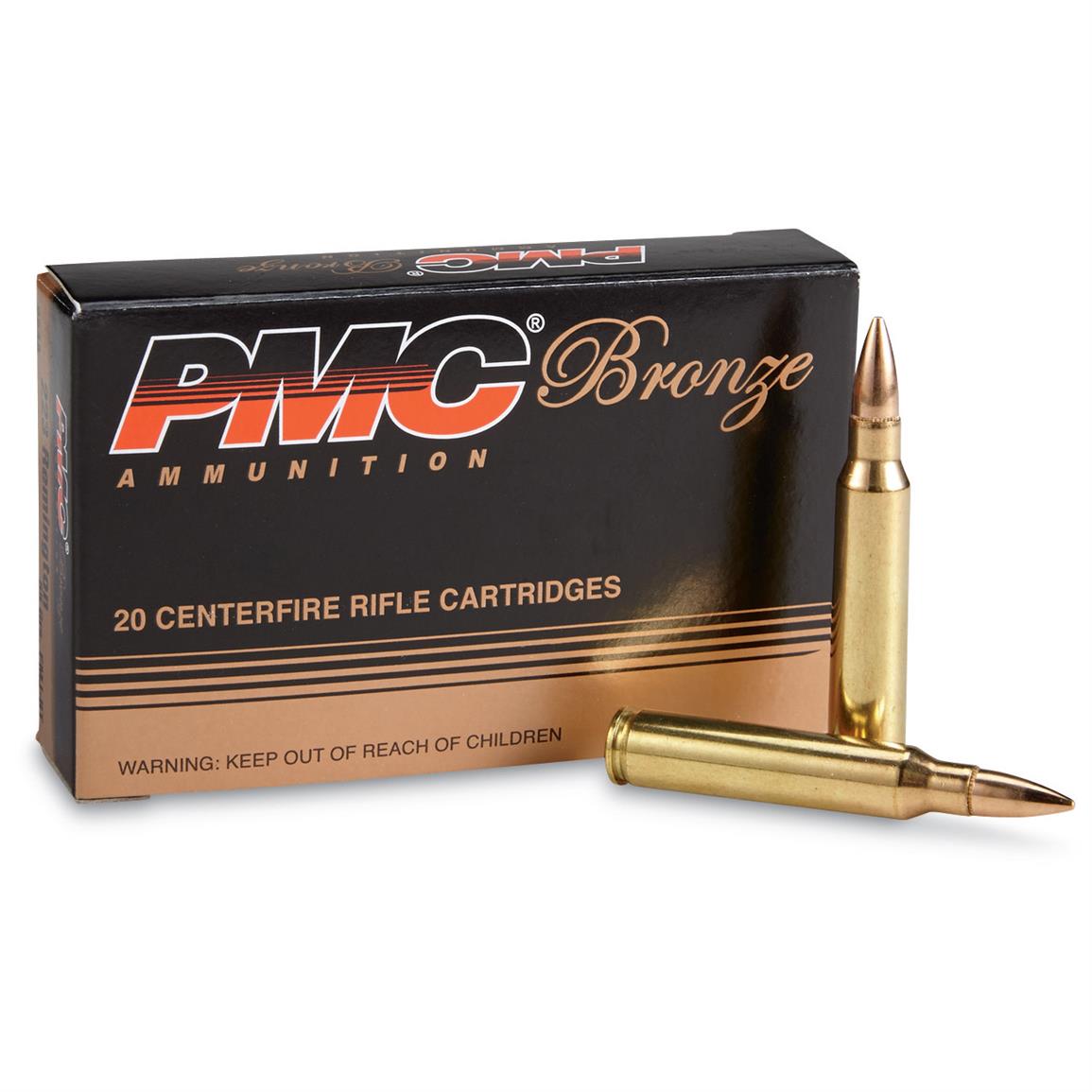
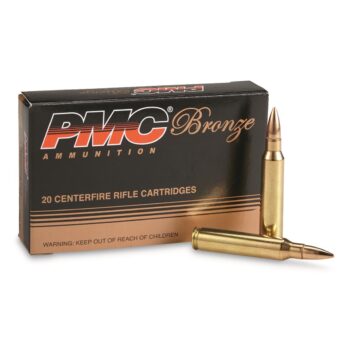
PMC Bronze, .223 Remington, FMJBT, 55 Grain

0
Box of PMC Bronze ammunition featuring 20 centerfire rifle cartridges, ideal for target practice and shooting sports.

Best deal at: sportsmansguide.comThe Sportsman's Guide
PMC Bronze, .223 Remington, FMJBT, 55 Grain
FieldDetail
Primary UseTarget shooting, training, plinking
Bullet TypeFull Metal Jacket Boat Tail (FMJBT)
Bullet Weight55 grain
Case MaterialBrass
Primer TypeBoxer
Packaging20 rounds per box
Typical Price$11.39/box ยท $0.57/round
Closest CompetitorsFederal American Eagle .223 Rem 55gr FMJ-BT (AE223), Hornady Steel Match .223 Rem 55gr FMJ-BT, Winchester USA .223 Rem 55gr FMJ (USA223R1)

Official Specs

SpecValueSource
Muzzle Velocity (fps)โ€”Not published by PMC for this SKU
Muzzle Energy (ft-lbs)โ€”Not published by PMC for this SKU
Bullet Weight55 grManufacturer
Bullet TypeFull Metal Jacket Boat Tail (FMJBT)Manufacturer
BC G1โ€”Not published
BC G7โ€”Not published
Manufacturer SKU223AManufacturer (commonly listed)
UPCโ€”Not confirmed from available data
ReloadableYesBrass case, Boxer primer

Note โ€” Missing Velocity & Energy: PMC does not consistently publish muzzle velocity or muzzle energy for the Bronze 223A load across its official channels. Industry references commonly cite approximately 3,240 fps from a 24″ test barrel, but this figure cannot be confirmed as an official manufacturer specification and is therefore excluded from the spec table. The ballistics table below uses a commonly referenced 3,240 fps estimate and is labeled accordingly. Community submissions of chronograph data from real-world barrel lengths are welcome.

Note โ€” Missing BC: PMC does not publish ballistic coefficient data for this projectile. The FMJBT design is consistent with G1 BCs in the 0.270โ€“0.295 range for 55gr .224 projectiles of this class, but no manufacturer-confirmed figure is available. The ballistics table uses a working estimate of G1 0.274 for calculation purposes only.

Ballistics Table

Calculated estimate. Real-world results vary by barrel length, temperature, altitude, and lot. Community submissions will provide measured muzzle velocity for comparison.

Inputs: MV ~3,240 fps (unconfirmed industry reference), G1 BC ~0.274 (estimated), sight height 1.5″, zero 100 yards, standard atmosphere (sea level, 59ยฐF).

YardsVelocity (fps)Energy (ft-lbs)Trajectory (in)
0~3,240~1,282โˆ’1.5
100~2,954~1,0650.0 โ† zero
200~2,682~878โˆ’7.1
300~2,424~717โˆ’21.5
400~2,180~580โˆ’45.5
500~1,951~464โˆ’82.6

Key takeaway: At typical training and target distances of 100โ€“200 yards, this load prints a flat, manageable trajectory with modest drop. By 300 yards, nearly 21 inches of drop must be compensated, which is workable with a properly zeroed optic but demands consistent holds. Energy retention past 400 yards falls below the 500 ft-lbs threshold commonly cited for reliable terminal performance on varmints, making this load most practical inside 300 yards for any task beyond punching paper. The 55-grain FMJBT profile offers a meaningful improvement in retained velocity over flat-base FMJ designs at extended range, though the difference is modest within typical carbine distances.

Best Uses

Good fit:

  • High-volume range training and drills where cost-per-round matters
  • Carbine qualification courses and law enforcement training scenarios
  • Plinking and recreational shooting at distances from 25 to 200 yards
  • Function testing and break-in shooting for new AR-15 or bolt-action .223 rifles
  • Steel target practice (verify target distance and hardness ratings per range rules)

Not the right tool for:

  • Hunting in jurisdictions that prohibit full metal jacket bullets for taking game โ€” check local regulations
  • Long-range precision work beyond 300 yards where wind drift and drop become increasingly difficult to manage with this BC class
  • Varmint hunting where rapid fragmentation is desired โ€” the FMJ construction does not expand reliably
  • Situations requiring lead-free or non-toxic projectiles (wildlife refuges, California hunting areas under AB 711)

Reliability Notes

No structured submissions yet.

Based on manufacturer claims and open-source user reports, the PMC Bronze line has a long-standing reputation for consistent primer seating and reliable ignition across a range of temperatures. The brass cases are described by PMC as reloadable and are noted in open sources as generally producing uniform neck tension. Some open-source forum discussions note that case mouth annealing is not performed on the Bronze line, which may be relevant to reloaders but does not affect factory performance. No patterns of failure-to-feed or failure-to-eject specific to this load have been identified in available open sources. All notes reflect manufacturer claims or informal open-source discussion โ€” not structured, verified submission data.

Competitors

LoadWeightBulletBC G1Muzzle VelocityPrice/Box (approx.)Notes
Federal American Eagle AE22355 grFMJ-BT~0.2703,240 fps (24″)~$11โ€“$13Same bullet class; widely available; comparable price point
Winchester USA USA223R155 grFMJ~0.2433,240 fps (24″)~$10โ€“$12Budget alternative; flat-base FMJ, slightly lower BC
Hornady American Gunner .22355 grHP~0.2703,240 fps (24″)~$13โ€“$15Hollow point; not legal for all uses; better terminal on varmints
Fiocchi .223 Rem 55gr FMJBT55 grFMJ-BT~0.2743,240 fps (24″)~$11โ€“$13Direct comparable; European manufacture; brass case
Black Hills .223 Rem 55gr FMJ55 grFMJ~0.2433,200 fps~$16โ€“$19Premium alternative; tighter QC tolerances; reloader-friendly brass
Speer Gold Dot .223 Rem 55gr55 grGDSP~0.2803,100 fps~$20โ€“$24Premium defensive/duty load; bonded core; significantly higher cost

Price Reality

  • Typical retail range: $10.50โ€“$13.00 per 20-round box depending on retailer and market conditions
  • Per-round cost: approximately $0.52โ€“$0.65 per round at standard retail pricing
  • At $11.39/box ($0.57/round), this load sits at the midpoint of budget brass-cased .223 โ€” competitive with Federal American Eagle and Fiocchi, and slightly above the cheapest steel-case imports
  • Winchester USA white-box 55gr FMJ often retails $1โ€“$2 less per box, making it the primary budget alternative in this class
  • Black Hills and Speer premium loads typically run $16โ€“$24 per box โ€” a 40โ€“110% premium over PMC Bronze for features (tighter tolerances, bonded cores) that are unnecessary for training use
  • Fair price benchmark: $12.00โ€“$13.00 per box represents the ceiling for this load under normal market conditions. Prices above $13.50 for a 20-round box of brass-cased 55gr .223 FMJ should prompt comparison shopping.

Prices change. Check the Where to Buy block for current listings.

Where to Buy

PMC Bronze, .223 Remington, FMJBT, 55 Grain, 20 Rounds

Experience reliable performance with PMC Bronze .223 Remington ammunition, featuring Full Metal Jacket Boat Tail (FMJBT) design for enhanced accuracy. Each box contains 20 rounds of 55-grain bullets, perfect for target shooting and training.

Affiliate links. These do not influence ratings, data, or any editorial content on this page.

FAQ

Is the PMC Bronze .223 55gr FMJBT the same as military M193 ball ammunition?
The M193 specification calls for a 55-grain FMJ-BT projectile at approximately 3,250 fps from a 20-inch barrel, and the PMC Bronze 55gr FMJBT is dimensionally and functionally similar. However, PMC does not certify this load as M193-compliant, and minor differences in powder charge, primer, and projectile construction may exist. For practical range use, the two are interchangeable. Shooters requiring strict mil-spec certification for specific applications should source ammunition with documented M193 compliance testing.

Will this ammunition stabilize properly in a 1:9 or 1:7 twist barrel?
A 55-grain .224 bullet of this length and construction stabilizes reliably in twist rates from 1:12 through 1:7. The most common AR-15 twist rates โ€” 1:9 and 1:8 โ€” are well-suited to this projectile weight. A 1:7 twist will also stabilize it without issue, though that twist rate is optimized for heavier 62โ€“77 grain projectiles. Shooters with older 1:12 twist barrels may want to confirm stability, as that rate is marginal for some 55-grain FMJBT designs depending on exact bullet length.

Can this load be used for coyote or varmint hunting?
The FMJ construction does not expand on impact, which limits terminal effectiveness on varmints compared to soft-point or hollow-point alternatives. In most U.S. states, FMJ ammunition is legal for varmint hunting but produces poor wound channels relative to expanding designs. For coyote-sized animals at typical field distances, a soft-point or ballistic-tip .223 load will perform significantly better. This load is best reserved for training, with a dedicated hunting load selected for field use.

How does the boat-tail design affect performance compared to a flat-base FMJ?
The boat-tail base reduces aerodynamic drag at the rear of the projectile, improving the ballistic coefficient and slowing velocity loss at distance. For practical carbine distances under 200 yards, the difference between flat-base and boat-tail is minimal โ€” often less than 10โ€“15 fps at 100 yards. Beyond 300 yards, the advantage becomes more measurable, with the FMJBT retaining slightly more velocity and drifting less in crosswinds than a comparable flat-base design. For a high-volume training load, this difference rarely affects practical results, but it does make the FMJBT a marginally better choice for shooters engaging targets at the outer edge of carbine range.

Is PMC Bronze .223 safe to fire in a rifle chambered for 5.56 NATO?
Yes. 5.56 NATO chambers are dimensionally larger and built to higher pressure specifications than SAAMI .223 Remington chambers. Firing .223 Remington ammunition in a 5.56 chamber is safe and common practice. The reverse โ€” firing 5.56 NATO ammunition in a .223 Remington chamber โ€” carries more risk due to the tighter chamber dimensions and should only be done after confirming the rifle’s suitability with the manufacturer. PMC Bronze is loaded to .223 Remington SAAMI specifications and presents no safety concern in either chamber type.

We will be happy to hear your thoughts

Leave a reply

Ammo Reports
Logo