Wolf, Military Classic, .223 Remington, FMJ, 55 Grain
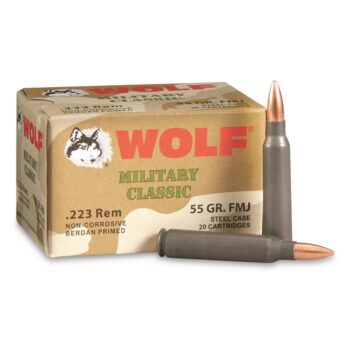
| Feature | Detail |
|---|---|
| Primary Use | Target shooting, training, plinking |
| Bullet Type | Full Metal Jacket (bimetal jacket, lead core) |
| Bullet Weight | 55 grain |
| Case Material | Steel (lacquer-coated) |
| Primer Type | Berdan (non-reloadable) |
| Packaging | 20 rounds per box |
| Typical Price | $10.44/box โ $0.52/round |
| Closest Competitors | Federal American Eagle .223 Rem 55gr FMJ, Tula .223 Rem 55gr FMJ, Hornady Steel Match .223 Rem 55gr HP |
Official Specs
| Spec | Value | Source |
|---|---|---|
| Muzzle Velocity (fps) | โ | Not published |
| Muzzle Energy (ft-lbs) | โ | Not published |
| Bullet Weight | 55 gr | Manufacturer |
| Bullet Type | Full Metal Jacket (bimetal) | Manufacturer |
| BC G1 | โ | Not published |
| BC G7 | โ | Not published |
| Manufacturer SKU | โ | Not published |
| UPC | โ | Not published |
| Reloadable | No | Manufacturer (Berdan-primed steel case) |
Note: Wolf does not publish muzzle velocity, muzzle energy, or ballistic coefficient data for the Military Classic line in standard retail documentation. The ballistics table below uses a commonly referenced industry estimate of 3,240 fps for a 55gr .223 FMJ from a 20″ barrel. All calculated values are labeled accordingly. Community-submitted chronograph data will be incorporated as it becomes available.
Ballistics Table
Calculated estimate. Real-world results vary by barrel length, temperature, altitude, and lot. Community submissions will provide measured muzzle velocity for comparison.
Estimated muzzle velocity: ~3,240 fps (industry reference for 55gr .223 FMJ, 20″ barrel). Sight height: 1.5″ above bore. Zero: 100 yards.
| Yards | Velocity (fps) | Energy (ft-lbs) | Trajectory (in) |
|---|---|---|---|
| 0 | ~3,240 | ~1,282 | -1.5 |
| 100 | ~2,954 | ~1,064 | 0.0 โ zero |
| 200 | ~2,682 | ~878 | -3.1 |
| 300 | ~2,425 | ~718 | -12.8 |
| 400 | ~2,182 | ~581 | -30.5 |
| 500 | ~1,954 | ~466 | -58.9 |
Key takeaway: At a 100-yard zero, this load holds a practical point-blank trajectory out to roughly 225 yards before drop becomes significant for target-sized precision. By 300 yards, the shooter must account for nearly 13 inches of drop, which limits its utility for precision work at distance but remains fully adequate for training and close-range drills. The 55-grain FMJ retains over 460 ft-lbs at 500 yards, though accuracy limitations from the steel case and bimetal jacket typically make that range academic for most applications. For high-volume range sessions, the trajectory is predictable enough to build consistent fundamentals within 200 yards.
Steel-Case Construction and Compatibility Considerations
Wolf Military Classic is built around a steel case rather than brass, which directly affects how this ammunition interacts with certain firearms and ranges. The case is coated with a polymer or lacquer finish to assist feeding and extraction. The bimetal jacket โ a steel core wrapped in a copper wash โ is the defining characteristic that separates this load from brass-cased, copper-jacketed alternatives.
Many indoor shooting ranges prohibit steel-core or bimetal-jacketed projectiles due to fire hazard from sparks at steel backstops. While the Wolf Military Classic bullet is not armor-piercing and contains a lead core, the bimetal jacket will attract a magnet, and range officers frequently use a magnet test to screen ammunition. Shooters should verify range rules before bringing this load.
Gas-operated rifles, particularly those with tight chambers or short gas systems, may experience slightly higher extraction forces with steel cases as the case does not expand and spring back the same way brass does. For the vast majority of mil-spec AR-15 platforms, this is a non-issue in practice.
Best Uses
Good fit:
- High-volume range training where per-round cost is the primary concern
- Plinking and informal target shooting at distances under 200 yards
- Rifle function testing and break-in where brass recovery is not a priority
- Shooters who do not reload and have no need for reusable brass
- Training drills where large quantities of ammunition are expended in a single session
Not the right tool for:
- Indoor ranges that prohibit bimetal or steel-jacketed projectiles (magnet test)
- Hunters โ FMJ bullets are prohibited for most game hunting in most U.S. states
- Precision or competitive shooting where consistent lot-to-lot velocity and tight groups are required
- Shooters who reload, as Berdan-primed steel cases are not practically reloadable
- Any application requiring documented, manufacturer-published ballistic data for formal records
Reliability Notes
No structured submissions yet.
Based on manufacturer claims and open-source user reports, the following observations are noted โ these come from open sources, not structured data:
- Wolf Military Classic is manufactured in Russia (historically) and has been widely distributed in the U.S. market for decades, suggesting established production consistency within its performance tier.
- The lacquer-coated steel case has been reported by some users to leave residue in chambers during high-volume fire in warm conditions, though this appears to be more common in tighter-tolerance chambers than mil-spec AR-15 chambers.
- Extraction reliability in standard AR-15 platforms is generally reported as consistent in open-source discussions, with failures more commonly associated with worn extractors or non-standard chambers.
- Wolf does not publish lot-to-lot consistency data; velocity spreads may be wider than premium brass-cased ammunition, which can affect group sizes at extended range.
Competitors
| Load | Weight | Bullet | BC G1 | Adv. Velocity | Price/box | Notes |
|---|---|---|---|---|---|---|
| Federal American Eagle .223 Rem 55gr FMJ | 55 gr | FMJ, copper jacket | ~0.243 | ~3,240 fps | ~$12โ14 | Brass case, Boxer-primed, reloadable; premium over Wolf |
| Tula .223 Rem 55gr FMJ | 55 gr | FMJ, bimetal | ~0.243 | ~3,241 fps | ~$9โ11 | Same bimetal/steel-case format; direct budget competitor |
| Hornady Steel Match .223 Rem 55gr HP | 55 gr | HP, steel case | ~0.270 | ~3,240 fps | ~$13โ15 | Steel case but higher-quality projectile; better BC |
| PMC Bronze .223 Rem 55gr FMJ | 55 gr | FMJ, copper jacket | ~0.243 | ~3,200 fps | ~$12โ14 | Brass case, Boxer-primed; mid-tier budget option |
| Winchester USA .223 Rem 55gr FMJ | 55 gr | FMJ, copper jacket | ~0.243 | ~3,240 fps | ~$13โ15 | Brass case; widely available; premium over Wolf |
| Aguila .223 Rem 55gr FMJ | 55 gr | FMJ, copper jacket | ~0.243 | ~3,215 fps | ~$11โ13 | Brass case; budget brass alternative to Wolf |
Price Reality
- Typical retail price: $10.44 per box of 20 rounds at the reference price point; case pricing (1,000 rounds) typically falls in the $48โ$60 range when available, representing meaningful per-round savings
- Per-round cost: approximately $0.52/round at $10.44/box
- Versus Tula .223 55gr FMJ: nearly identical price point โ the two are direct competitors at the budget steel-case tier, with selection often driven by local availability
- Versus Federal American Eagle .223 55gr FMJ: Federal typically runs $0.60โ$0.70/round, placing Wolf at roughly a $0.10โ$0.18/round savings โ meaningful at high volumes
- Versus Hornady Steel Match .223 55gr: Hornady’s steel-case offering typically runs $0.65โ$0.75/round, representing a significant premium for a higher-quality projectile
- Fair price benchmark: At or below $0.55/round, this load represents fair market value for steel-case .223 training ammunition. Prices above $0.65/round for this specific load should prompt comparison shopping, as brass-cased alternatives become competitive at that price level.
Prices change. Check the Where to Buy block for current listings.
Where to Buy
Wolf, Military Classic, .223 Remington, FMJ, 55 Grain, 20 Rounds
Affiliate links. These do not influence ratings, data, or any editorial content on this page.
FAQ
Is the Wolf Military Classic .223 55gr FMJ legal at indoor ranges?
Many indoor ranges prohibit ammunition with bimetal or steel-jacketed projectiles due to fire risk at steel backstops and increased wear on rubber trap systems. Wolf Military Classic uses a bimetal jacket that will attract a magnet, which is the standard test range officers use. This does not mean the bullet is steel-core or armor-piercing โ the core is lead โ but the jacket composition is enough to trigger a range ban at many facilities. Always check with the range before arriving, as policies vary widely.
How does the Wolf Military Classic compare to Tula .223 55gr FMJ for training?
Both loads share nearly identical construction โ steel case, Berdan primer, bimetal jacket, 55-grain FMJ โ and occupy the same price bracket, making them functionally interchangeable for most training purposes. The primary differences are manufacturing origin and minor variations in case coating (polymer vs. lacquer depending on production run). Neither offers published ballistic data, and both are non-reloadable. Choosing between them often comes down to which is in stock at the time of purchase.
Can this ammunition be used for hunting?
No. Full metal jacket bullets are prohibited for hunting most game species in virtually every U.S. state, as they do not expand on impact and are considered inhumane for clean kills. Beyond legal restrictions, a non-expanding FMJ projectile is ballistically inappropriate for ethical hunting use. Shooters looking to hunt with .223 Remington should select an appropriate expanding hunting bullet such as a soft point or polymer-tipped design rated for the intended game.
Why doesn’t Wolf publish muzzle velocity for Military Classic?
Wolf Performance Ammunition does not consistently publish detailed ballistic specifications for the Military Classic line in retail documentation. This is common among budget steel-case manufacturers, where production is optimized for cost and volume rather than precision marketing data. Velocity figures circulated online are typically derived from independent chronograph testing by reviewers or from general industry references for the caliber and bullet weight. Shooters requiring documented velocity data for a specific application should consider brass-cased loads from manufacturers who publish full spec sheets.
Does the steel case cause increased wear on AR-15 extractors or chambers?
Steel cases are dimensionally harder than brass and do not obturate (expand and spring back) in the same way, which can place slightly higher stress on the extractor over many thousands of rounds. In practice, most mil-spec AR-15 extractors handle steel-case ammunition without premature failure when the firearm is properly maintained and lubricated. Rifles with tighter match chambers or non-standard gas systems may experience more frequent extraction issues. For high-volume training use, periodic extractor inspection is a reasonable precaution regardless of ammunition type.
Submit Your Data ยท Real-World Results
Manufacturer velocity figures are measured under controlled lab conditions – barrel length, temperature, and lot number all affect real-world performance. The data below comes from community submissions tied to specific test conditions and reviewed before publishing.
Once this page reaches 3 approved submissions, aggregate velocity and confidence level will appear here automatically.
You need to login first.Results vary by firearm, barrel condition, ammunition lot, and environmental factors. Submitted data is for reference only. Ammo Reports does not guarantee accuracy of user-submitted results.