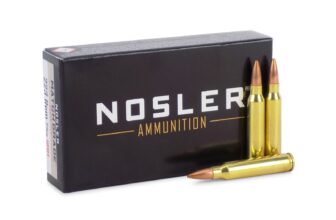
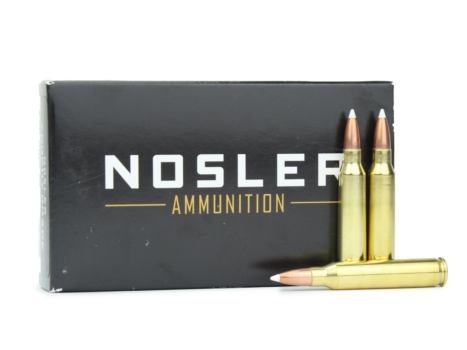
Nosler Trophy Grade 223 Rem 70 Gr AccuBond
| Feature | Detail |
|---|---|
| Primary Use | Medium-sized game hunting (varmints to deer-class animals where legal) |
| Bullet Type | Nosler AccuBond โ bonded lead-alloy core, white polymer tip, boat-tail |
| Bullet Weight | 70 grains |
| Case Material | Brass |
| Primer Type | Boxer |
| Packaging | 20 rounds per box |
| Typical Price | $62.49/box ยท $3.12/round |
| Closest Competitors | Federal Premium 223 Rem 64gr Trophy Bonded Tip, Hornady Precision Hunter 223 Rem 73gr ELD-M, Winchester Expedition Big Game 223 Rem 64gr AccuBond |
Official Specs
| Spec | Value | Source |
|---|---|---|
| Muzzle Velocity (fps) | 2,750 | Manufacturer (Nosler) |
| Muzzle Energy (ft-lbs) | 1,175 | Manufacturer (Nosler) |
| Bullet Weight | 70 gr | Manufacturer |
| Bullet Type | AccuBond (bonded, polymer tip, boat-tail) | Manufacturer |
| BC G1 | โ | Not published |
| BC G7 | โ | Not published |
| Manufacturer SKU | โ | Not published |
| UPC | โ | Not published |
| Reloadable | Yes | Brass case, Boxer primer |
Note โ BC: Nosler has not published G1 or G7 ballistic coefficients for this specific factory load on their product page. Estimated G1 BC for the 70gr AccuBond bullet in .224 caliber is approximately 0.365 based on Nosler’s component bullet data, but this has not been confirmed for this factory load and is not used in calculations below.
Note โ Energy consistency check: At 2,750 fps with a 70gr bullet, calculated muzzle energy = ยฝ ร (70/7000) ร 2,750ยฒ / 32.174 โ 1,175 ft-lbs. The manufacturer-stated 1,175 ft-lbs is consistent with the stated velocity. No data integrity flag required.
Ballistics Table
Calculated estimate. Real-world results vary by barrel length, temperature,altitude, and lot. Community submissions will provide measured muzzlevelocity for comparison.
Inputs: 2,750 fps MV ยท 70gr ยท G1 BC โ 0.365 (estimated from component data, not confirmed for this factory load) ยท 1.5″ sight height ยท 100 yd zero ยท standard atmosphere (59ยฐF, sea level)
| Yards | Velocity (fps) | Energy (ft-lbs) | Trajectory (in) |
|---|---|---|---|
| 0 | 2,750 | 1,175 | -1.5 |
| 100 | 2,531 | 996 | 0.0 โ zero |
| 200 | 2,321 | 838 | -3.8 |
| 300 | 2,121 | 699 | -14.1 |
| 400 | 1,931 | 579 | -32.8 |
| 500 | 1,751 | 477 | -62.0 |
Key takeaway: The 70gr AccuBond retains meaningful energy at distance for a .223 Remington load โ crossing 500 yards with roughly 477 ft-lbs, which is adequate for varmints and marginal for deer-class game depending on jurisdiction and shot placement. The heavier-than-standard bullet for this caliber produces a steeper trajectory than lighter .223 loads; hunters should confirm their zero carefully and account for roughly 14 inches of drop at 300 yards. Within 250 yards, the load remains flat enough for practical field use on medium game. Barrel length has a significant effect on actual velocity โ Nosler’s stated 2,750 fps is likely from a 24-inch test barrel, and shorter hunting rifles may yield 50โ150 fps less.
The Nosler AccuBond Bullet in .223 Remington
The AccuBond is not a standard cup-and-core projectile. Nosler chemically bonds the lead core to the copper alloy jacket, preventing core-jacket separation on impact โ a failure mode common in lighter-constructed .223 bullets when driven at high velocity into game animals. The white polymer tip initiates reliable expansion even at reduced terminal velocities encountered at longer ranges, while the boat-tail base aids in-flight stability and BC retention downrange.
What makes this pairing notable is the bullet weight itself. Seventy grains is near the upper practical limit for most 1:9 twist .223 barrels and requires a 1:8 twist or faster for proper stabilization. Nosler loads this round specifically for hunters pushing the .223 Remington into roles where caliber legality permits โ coyotes, feral hogs, and in some states, deer or antelope at moderate ranges. The bonded construction addresses the historical criticism that .223 bullets blow apart on heavier-boned animals before penetrating adequately. At $3.12 per round, this is a purpose-built hunting load, not a general-purpose or practice cartridge.
Best Uses
Good fit:
- Coyote and predator hunting where deep penetration and pelt-friendly expansion are balanced
- Feral hog hunting at ranges under 200 yards where .223 Rem is legal
- Deer hunting in states that permit .223 Rem, at ranges within 200 yards and with careful shot placement
- Hunters running 1:8 or faster twist barrels seeking a bonded bullet that won’t fail on impact
- Situations where a single load must serve both varmint and medium-game roles in the same outing
Not the right tool for:
- High-volume prairie dog or varmint shooting โ at $3.12/round, cost per shot is prohibitive
- Rifles with 1:9 or slower twist rates, which may not stabilize a 70gr bullet reliably
- Target shooting, competition, or training โ no BC/accuracy data supports this use and cost is excessive
- Large or dangerous game โ .223 Rem is underpowered regardless of bullet construction
- Jurisdictions where .223 Rem is prohibited for deer or big game โ check local regulations before use
Reliability Notes
No structured submissions yet.
Based on manufacturer claims and open-source product information: Nosler states this load is assembled on the same production line as their component bullets, using Nosler brass and consistent powder charges. The AccuBond design has a documented track record in larger calibers for retained weight above 85โ90% after impact, and Nosler applies that same bonding process to this .223 load. No independent lab terminal performance data for this specific factory load has been located. Twist-rate compatibility is the most commonly noted field concern in open-source discussions โ users with 1:9 twist barrels have reported inconsistent accuracy, which is consistent with the bullet’s length and weight requirements. All notes above reflect manufacturer claims or open-source commentary, not structured field data.
Competitors
| Load | Weight | Bullet | BC G1 | Adv. Velocity | Price/box | Notes |
|---|---|---|---|---|---|---|
| Federal Premium Trophy Bonded Tip 223 Rem | 55 gr | Trophy Bonded Tip | ~0.267 | 3,240 fps | ~$38โ$42 | Budget-tier premium; lighter bullet, higher velocity, less retained weight |
| Hornady Precision Hunter 223 Rem 73gr ELD-M | 73 gr | ELD-M (match, not bonded) | 0.370 | 2,790 fps | ~$40โ$48 | Match bullet โ not designed for hunting terminal performance; similar BC |
| Winchester Expedition Big Game 223 Rem 64gr AccuBond | 64 gr | Nosler AccuBond | ~0.315 | 3,020 fps | ~$45โ$52 | Uses same AccuBond bullet design; lighter/faster; direct concept competitor |
| Hornady GMX 223 Rem 55gr | 55 gr | GMX (monolithic copper) | ~0.290 | 3,240 fps | ~$38โ$44 | Lead-free alternative; lighter bullet, different terminal behavior |
| Black Hills Gold 223 Rem 62gr Barnes TSX | 62 gr | Barnes TSX (lead-free) | ~0.310 | 3,100 fps | ~$45โ$55 | Lead-free; premium price; proven on medium game; TSX vs AccuBond terminal debate |
| Nosler Trophy Grade 223 Rem 60gr Partition | 60 gr | Nosler Partition | ~0.295 | 3,060 fps | ~$52โ$58 | Same product line; lighter/faster; Partition vs AccuBond construction tradeoff |
Price Reality
- Typical retail: $58โ$65 per 20-round box; case pricing (typically 10 boxes/200 rounds) when available runs approximately $580โ$640
- Per-round cost: $2.90โ$3.25 depending on retailer and timing
- vs. Federal Trophy Bonded Tip 223 Rem 55gr: Nosler runs approximately $15โ$20 more per box โ the premium reflects heavier bullet weight and bonded construction, not just brand
- vs. Winchester Expedition Big Game 223 Rem 64gr AccuBond: Nosler runs $10โ$15 more per box for a heavier bullet in the same AccuBond family
- vs. Hornady Precision Hunter 73gr ELD-M: Nosler is roughly $15โ$20 more per box; the ELD-M is a match bullet, not a bonded hunting bullet โ these are not equivalent products despite similar weights
- Fair price benchmark: Above $68/box for a 20-round box of this load represents an overpriced listing under normal market conditions; below $58 likely indicates a sale or promotional pricing worth acting on
Prices change. Check the Where to Buy block for current listings.
Where to Buy
Nosler Trophy Grade 223 Rem 70 Gr AccuBond (Box)
Affiliate links. These do not influence ratings, data, or any editorial content on this page.
FAQ
Does this load require a specific twist rate, and will it work in a standard 1:9 twist .223 rifle?
The 70gr AccuBond is a long, heavy bullet for .224 caliber, and proper stabilization generally requires a 1:8 twist or faster. A 1:9 twist barrel may or may not stabilize this bullet adequately depending on the specific rifle, barrel length, and atmospheric conditions โ cold air is denser and can reduce stability margin. Shooters with 1:9 twist rifles should fire a test group at 100 yards and look for keyholing or elongated impacts before relying on this load in the field. Nosler does not explicitly state a minimum twist requirement on the product page, but the bullet’s length-to-diameter ratio makes 1:8 the practical minimum. If your rifle has a 1:12 or 1:10 twist, this load is not recommended.
How does the AccuBond bullet differ from a standard soft-point or hollow-point .223 hunting bullet?
A conventional cup-and-core soft-point relies on mechanical fit between the lead core and copper jacket โ under high-velocity impact, the core can separate from the jacket, limiting penetration depth. The AccuBond’s bonded construction chemically fuses core and jacket, so the bullet retains 85โ90% or more of its original weight through tissue and bone. The white polymer tip prevents tip deformation in the magazine and initiates expansion reliably even at reduced impact velocities at longer ranges. This makes the AccuBond meaningfully different from budget hunting .223 loads in terminal performance, particularly on animals larger than varmints.
Is this load legal for deer hunting, and what states permit .223 Remington for deer?
Whether this load is legal for deer depends entirely on your state or province โ .223 Remington is prohibited for deer in several states (including Illinois, Iowa, and others) due to minimum caliber or energy requirements, while it is legal in many others. The bonded AccuBond construction addresses the penetration concern often cited in debates about .223 for deer, but it does not override local regulations. Always verify current hunting regulations with your state wildlife agency before using any .223 load on deer. This page does not provide legal guidance.
How does this load compare to the Winchester Expedition Big Game 64gr AccuBond in .223 Rem?
Both loads use Nosler AccuBond bullets โ the bullet construction, bonding process, and polymer tip are essentially the same technology. The primary differences are bullet weight (70gr vs. 64gr) and velocity (2,750 fps vs. approximately 3,020 fps). The heavier 70gr bullet carries more sectional density and retains energy better at distance, while the 64gr Winchester load is faster and flatter-shooting at shorter ranges. For hunters prioritizing terminal performance at 150โ250 yards on medium game, the 70gr Nosler load has a meaningful sectional density advantage. For hunters prioritizing trajectory flatness within 150 yards, the 64gr load may be preferable and is typically priced lower.
What is the practical maximum effective range of this load on coyote-sized and deer-sized game?
For coyote-sized animals, the AccuBond will expand reliably down to approximately 1,800โ1,900 fps impact velocity, which at 2,750 fps muzzle velocity corresponds to roughly 400โ450 yards under standard conditions โ though ethical hunters should apply a more conservative limit based on their shooting capability. For deer-sized game, most experienced hunters and ballisticians recommend a minimum of 800โ1,000 ft-lbs of impact energy, which this load delivers to approximately 150โ175 yards based on the calculated ballistics above. Shot placement and angle matter more than energy figures alone, but 200 yards is a reasonable practical maximum for deer-class animals with this caliber and load, regardless of bullet construction.