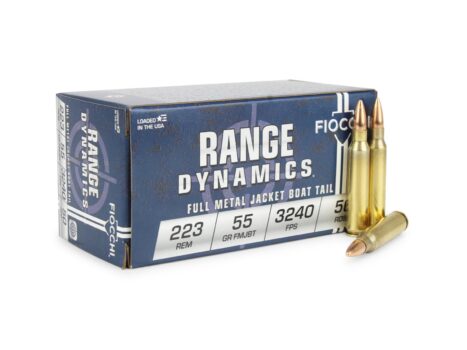
Fiocchi .223 Rem 55 Gr FMJ
| Feature | Detail |
|---|---|
| Primary Use | High-volume range training, target shooting |
| Bullet Type | Full Metal Jacket Boat Tail (FMJBT) |
| Bullet Weight | 55 gr |
| Case Material | Brass |
| Primer Type | Boxer |
| Packaging | 50 rounds per box |
| Typical Price | $35.99/box ยท $0.72/round |
| Closest Competitors | Federal American Eagle .223 Rem 55 gr FMJ, PMC Bronze .223 Rem 55 gr FMJ, Hornady Black .223 Rem 55 gr FMJ |
Official Specs
| Spec | Value | Source |
|---|---|---|
| Muzzle Velocity (fps) | Not published | โ |
| Muzzle Energy (ft-lbs) | Not published | โ |
| Bullet Weight | 55 gr | Manufacturer |
| Bullet Type | Full Metal Jacket Boat Tail (FMJBT) | Manufacturer |
| BC G1 | Not published | โ |
| BC G7 | Not published | โ |
| Manufacturer SKU | Not published | โ |
| UPC | Not published | โ |
| Reloadable | Yes | Manufacturer (Boxer-primed brass) |
Note: Fiocchi does not publish muzzle velocity, muzzle energy, or ballistic coefficient data for this specific load on their official product pages or in publicly available technical documentation. The ballistics table below uses a commonly accepted industry reference velocity of 3,240 fps for a 55 gr FMJBT from a 24-inch test barrel โ a figure consistent with SAAMI standards for this projectile weight and caliber. All calculated values are labeled accordingly. Community-submitted chronograph data will be incorporated as it becomes available.
Ballistics Table
Calculated estimate. Real-world results vary by barrel length, temperature,altitude, and lot. Community submissions will provide measured muzzlevelocity for comparison.
Assumptions: G1 BC = 0.270 (industry reference for 55 gr FMJBT), muzzle velocity 3,240 fps (24″ barrel reference), sight height 1.5″ above bore, 100 yd zero, standard atmosphere (59ยฐF, sea level).
| Yards | Velocity (fps) | Energy (ft-lbs) | Trajectory (in) |
|---|---|---|---|
| 0 | ~3,240 | ~1,282 | -1.5 |
| 100 | ~2,854 | ~995 | 0.0 โ zero |
| 200 | ~2,499 | ~763 | -3.9 |
| 300 | ~2,172 | ~576 | -15.0 |
| 400 | ~1,874 | ~429 | -35.8 |
| 500 | ~1,607 | ~315 | -70.2 |
Key takeaway: At 100 yards, this load retains nearly 1,000 ft-lbs of energy โ more than sufficient for steel target work and general range use. Drift and drop become increasingly significant beyond 300 yards, which aligns with the load’s intended role as a training and practice round rather than a precision or long-range cartridge. Shooters using 16-inch carbine-length barrels should expect muzzle velocities approximately 100โ200 fps lower than the reference values shown, which will steepen the trajectory curve modestly at extended ranges. For any precision application beyond 300 yards, a purpose-built match load with a published, higher BC would be the more appropriate choice.
Best Uses
Good fit:
- High-volume range sessions where cost-per-round is a primary concern
- Zeroing and mechanical function testing of AR-15 and other 5.56/.223 platforms
- Training drills focused on trigger control, positional shooting, and target transitions
- Feeding semi-automatic rifles with standard 1:9 or 1:8 twist barrels where a 55 gr projectile stabilizes reliably
- Steel silhouette and paper target practice at distances up to 300 yards
Not the right tool for:
- Hunting applications โ FMJ projectiles do not expand and are prohibited for deer and most medium game hunting in many U.S. states
- Long-range precision shooting beyond 300โ400 yards where BC and consistency tolerances matter significantly
- Varmint hunting where rapid fragmentation and energy transfer are desired
- Jurisdictions with lead projectile restrictions in outdoor shooting areas (this is a standard lead-core FMJ)
- Competitive matches requiring match-grade consistency or published lot-specific data
Reliability Notes
No structured submissions yet.
Based on manufacturer claims and open-source product information: Fiocchi’s Range Dynamics line is marketed specifically for high-volume training use, with emphasis on consistent primer ignition and uniform case dimensions. The brass case construction is noted as reloadable, which is a practical advantage over steel-cased alternatives for shooters who collect brass. The boat tail base on the projectile is generally associated with more consistent feeding in semi-automatic platforms compared to flat-base designs, though no structured malfunction data is available to quantify this claim for this specific load. All notes above derive from manufacturer claims or open-source product descriptions, not structured field data.
Competitors
| Load | Weight | Bullet | BC G1 | Adv. Velocity | Price/box | Notes |
|---|---|---|---|---|---|---|
| Federal American Eagle .223 Rem 55 gr FMJ | 55 gr | FMJBT | 0.270 | 3,240 fps | ~$30โ$36 | Industry benchmark training load; same bullet class |
| PMC Bronze .223 Rem 55 gr FMJ | 55 gr | FMJBT | 0.270 | 3,150 fps | ~$27โ$33 | Budget alternative; brass-cased, reliable reputation |
| Hornady Black .223 Rem 55 gr FMJ | 55 gr | FMJ | Not published | 3,240 fps | ~$36โ$42 | Same weight class; Hornady’s training-grade offering |
| Winchester USA White Box .223 Rem 55 gr FMJ | 55 gr | FMJ | Not published | 3,240 fps | ~$29โ$35 | Widely available budget option; flat-base design |
| Sellier & Bellot .223 Rem 55 gr FMJ | 55 gr | FMJBT | 0.270 | 3,232 fps | ~$28โ$34 | European manufacturer; comparable construction, lower price point |
| Black Hills .223 Rem 55 gr FMJ | 55 gr | FMJ | Not published | 3,250 fps | ~$42โ$50 | Premium alternative; tighter tolerances, higher price |
Price Reality
- Typical retail range: $33.99โ$37.99 per 50-round box; case pricing (typically 1,000 rounds) generally falls in the $620โ$700 range depending on retailer and market conditions
- Per-round cost: approximately $0.68โ$0.76 at typical retail
- vs. PMC Bronze .223 55 gr FMJ: PMC frequently undercuts Fiocchi by $3โ$6 per box, making it the stronger budget choice at equivalent bullet weight and construction
- vs. Federal American Eagle .223 55 gr FMJ: Pricing is nearly identical; Federal AE enjoys broader retail availability and more published ballistic data
- vs. Black Hills .223 55 gr FMJ: Black Hills runs $6โ$14 more per box โ that premium is justified only when consistency tolerances matter, not for general training use
- Fair price benchmark: At $0.72/round, this load is competitively priced for brass-cased .223 Rem training ammunition. Paying above $0.80/round for this load in normal market conditions would be considered overpriced; below $0.65/round represents a strong value buy
Prices change. Check the Where to Buy block for current listings.
Where to Buy
Fiocchi .223 Rem 55 Gr FMJ (Box)
Affiliate links. These do not influence ratings, data, or any editorial content on this page.
FAQ
Is the Fiocchi .223 Rem 55 gr FMJBT safe to shoot in a rifle chambered for 5.56x45mm NATO?
Yes. A rifle chambered in 5.56x45mm NATO can safely fire .223 Remington ammunition โ the .223 Rem cartridge operates at lower maximum average pressure (55,000 psi SAAMI) than 5.56 NATO (58,740 psi), so running .223 in a 5.56 chamber is the lower-pressure direction of the pairing. The reverse โ firing 5.56 NATO in a .223 Rem-chambered rifle โ carries more risk due to tighter .223 chamber dimensions and is not recommended without confirming your rifle’s chamber specification. Always verify your specific firearm’s chamber marking before selecting ammunition.
What is the difference between the flat-base FMJ and the boat tail FMJ version of this load, and which does Fiocchi use?
Fiocchi’s Range Dynamics .223 55 gr load uses a Full Metal Jacket Boat Tail (FMJBT) projectile, not a flat-base design. The angled heel (boat tail) of the projectile reduces base drag, which helps the bullet retain velocity more efficiently at longer distances compared to a flat-base FMJ of the same weight. In practical training use inside 300 yards, the difference in point of impact is small, but the boat tail design also tends to feed more smoothly in semi-automatic actions. Buyers comparing this load to flat-base competitors like Winchester USA White Box should note this construction distinction.
Can this ammunition be used for coyote or varmint hunting?
This load is not recommended for hunting in most contexts. Full Metal Jacket projectiles are designed to pass through targets with minimal deformation, which is ideal for range use but counterproductive for ethical hunting โ most varmint hunting benefits from rapid expansion and energy transfer to dispatch animals cleanly. Additionally, FMJ ammunition is explicitly prohibited for deer hunting in nearly every U.S. state, and many states restrict its use on any game animal. For varmint applications, a hollow point, soft point, or polymer-tipped expanding .223 load would be the appropriate choice.
How does the Fiocchi Range Dynamics line compare to Federal American Eagle for everyday training use?
Both loads occupy the same market position โ brass-cased, Boxer-primed, 55 gr FMJBT ammunition aimed at high-volume training. Federal American Eagle publishes more detailed ballistic data publicly, which is useful for shooters who want to verify performance figures before purchasing. Fiocchi’s brass is generally regarded as having good wall thickness consistency and is considered reloadable. Pricing between the two is typically within $3โ$5 per box at most retailers. Neither load has a meaningful performance advantage over the other for standard range use; the decision often comes down to availability and price at the time of purchase.
Does the 55 gr bullet weight stabilize properly in common AR-15 barrel twist rates?
Yes. A 55 gr .223 Rem projectile stabilizes reliably in the most common AR-15 barrel twist rates, including 1:9 and 1:8. The 1:7 twist rate โ standard on many mil-spec carbines โ will also stabilize a 55 gr bullet without issue, though that faster twist is optimized for heavier 62โ77 gr projectiles. Shooters with older 1:12 twist barrels (found on some vintage .223 bolt guns) may see marginal stability with heavier projectiles, but a 55 gr bullet is well within the stabilization envelope for that twist rate as well. This makes the Fiocchi 55 gr load a broadly compatible option across the wide variety of AR-15 and bolt-action .223 Rem platforms in common use.