 Ammo Reports Team
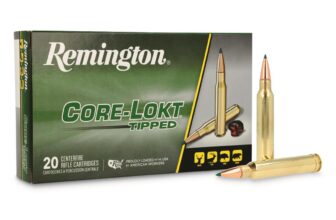
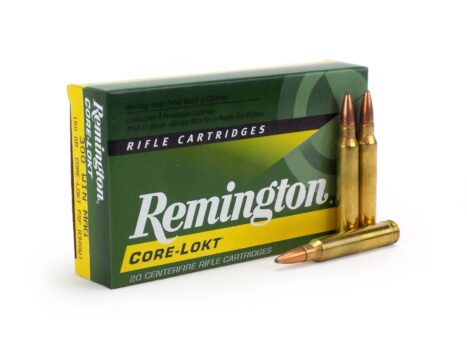
Remington 300 Win Mag 150 Grain Core-Lokt PSP
At a Glance
| Feature | Detail |
|---|---|
| Primary Use | Big game hunting (deer, elk, black bear) |
| Bullet Type | Core-Lokt Pointed Soft Point (PSP) — tapered copper jacket bonded to solid lead core |
| Bullet Weight | 150 grain |
| Case Material | Brass |
| Primer Type | Boxer (standard Remington centerfire) |
| Packaging | 20 rounds per box |
| Typical Price | $54.99/box · $2.75/round |
| Closest Competitors | Federal Power-Shok 300 Win Mag 150 gr JSP · Winchester Super-X 300 Win Mag 150 gr Power-Point · Hornady American Whitetail 300 Win Mag 150 gr InterLock SP |
Official Specs
| Spec | Value | Source |
|---|---|---|
| Muzzle Velocity (fps) | — | Not published by Remington for this specific load |
| Muzzle Energy (ft-lbs) | — | Not published |
| Bullet Weight | 150 gr | Manufacturer |
| Bullet Type | Core-Lokt PSP (Pointed Soft Point) | Manufacturer |
| BC G1 | — | Not published |
| BC G7 | — | Not published |
| Manufacturer SKU | R300W1 | Remington product listing |
| UPC | — | Not confirmed |
| Reloadable | Yes | Manufacturer (brass case, Boxer primer) |
Note on missing velocity and energy: Remington does not publish muzzle velocity or muzzle energy for this specific 150 gr .300 Win Mag Core-Lokt load in their current product documentation. Values commonly cited by third-party retailers (approximately 3,290 fps / 3,605 ft-lbs) have not been independently verified against a manufacturer spec sheet and are therefore excluded from this table to preserve data integrity. The ballistics table below uses those widely cited figures as a calculated estimate, clearly labeled as such.
Note on BC: Neither G1 nor G7 ballistic coefficient values are published by Remington for Core-Lokt PSP projectiles. Third-party measured G1 estimates for a 150 gr .30-caliber PSP typically fall in the 0.338–0.360 range, but no manufacturer-confirmed figure exists for this load.


Ballistics Table
Calculated estimate. Real-world results vary by barrel length, temperature,altitude, and lot. Community submissions will provide measured muzzlevelocity for comparison.
Based on widely cited but unconfirmed third-party figure of ~3,290 fps MV. Sight height 1.5" above bore. Zero: 200 yards. G1 BC estimated at 0.350.
| Yards | Velocity (fps) | Energy (ft-lbs) | Trajectory (in) |
|---|---|---|---|
| 0 | ~3,290 | ~3,605 | -1.5 |
| 100 | ~3,024 | ~3,047 | +2.1 |
| 200 | ~2,772 | ~2,561 | 0.0 ← zero |
| 300 | ~2,532 | ~2,135 | -9.0 |
| 400 | ~2,302 | ~1,765 | -26.2 |
| 500 | ~2,083 | ~1,445 | -53.8 |
| 600 | ~1,876 | ~1,172 | -94.5 |
| 700 | ~1,681 | ~942 | -151.8 |
| 800 | ~1,500 | ~749 | -229.7 |
Key takeaway: At a 200-yard zero, this load stays within roughly ±3 inches of point of aim from the muzzle out to approximately 240 yards, making holdover intuitive for most hunting distances. By 400 yards the 150 gr bullet is still delivering over 1,700 ft-lbs of energy — sufficient for deer-sized game — but the lighter-for-caliber projectile drops measurably faster beyond 400 yards than heavier 300 Win Mag loads such as 180 or 200 grain options. Hunters planning shots past 500 yards should account for increasing wind drift, as the relatively modest BC of a traditional PSP construction becomes a limiting factor at extended range. For the vast majority of North American big game hunting inside 400 yards, this load performs well within practical margins.
The Core-Lokt Bullet Design
Core-Lokt is one of the oldest controlled-expansion hunting bullet designs still in active production, with a lineage stretching back more than 75 years. The design centers on a mechanically locked jacket-to-core construction: the tapered copper jacket is physically crimped into the lead core at the bullet’s midpoint, preventing the two components from separating on impact. This is distinct from chemically bonded bullets such as the Federal Trophy Bonded Bear Claw or the Nosler Partition, which use different retention methods.
The Pointed Soft Point (PSP) variant adds a spitzer-style tip compared to the flat-nosed or round-nosed Core-Lokt variants, improving aerodynamic efficiency and enabling use in box magazines without the risk of primer detonation associated with pointed bullets in tubular magazines. On impact, the exposed lead tip initiates expansion, and the locked jacket controls the rate and diameter of that expansion. Remington’s design target is approximately 2× caliber expansion with roughly 75% weight retention — figures that have been validated through decades of field use, though specific lot-by-lot test data is not publicly released by the manufacturer.
In the context of the 300 Winchester Magnum, the 150 gr PSP is the lightest standard Core-Lokt offering for this cartridge. The higher velocity associated with the lighter bullet can accelerate expansion at close range, which is worth considering when selecting this load for larger or tougher game.
Best Uses
Good fit:
- Whitetail and mule deer hunting at ranges from close timber shots out to approximately 350–400 yards
- Pronghorn antelope where the flat trajectory of a light, fast 300 Win Mag load is an advantage
- Black bear hunting in moderate-cover conditions where shot distances are predictable
- Hunters already familiar with the Core-Lokt platform who want consistent terminal behavior from a trusted design
- General-purpose big game use where a moderate per-round cost matters across a full season of practice and hunting
Not the right tool for:
- Elk or moose at close range in heavy cover, where a heavier, more deeply penetrating bullet (180 gr or 200 gr) is generally preferred over a light, high-velocity PSP
- Long-range shooting beyond 500 yards, where the modest BC of a traditional PSP bullet results in significant wind drift and energy loss compared to higher-BC options
- Situations requiring lead-free ammunition due to state or federal regulations (California Condor Zone, certain National Parks, some federal lands) — this is a lead-core projectile
- Hunters targeting dangerous or heavy-boned game where controlled-feed bonded bullets or partition designs offer more reliable deep penetration
Reliability Notes
No structured submissions yet.
From manufacturer claims and open sources, not structured data: Remington markets Core-Lokt as a controlled-expansion design intended to deliver consistent mushrooming across a range of impact velocities. Field reports aggregated across hunting forums and sporting goods communities over decades suggest the PSP variant performs reliably on deer-sized game at typical hunting velocities, with expansion generally initiating cleanly. Some open-source commentary notes that at the elevated velocities produced by the 300 Win Mag, the 150 gr PSP may expand more aggressively at close range than heavier-jacketed alternatives, occasionally resulting in shallower penetration on quartering-away shots through larger animals. No active recalls or safety notices are associated with this load at the time of publication. Case quality is reported to be consistent with standard Remington brass, which is generally considered reloadable for multiple firings with proper inspection.
Competitors
| Load | Weight | Bullet | BC G1 | Adv. Velocity | Price/box | Notes |
|---|---|---|---|---|---|---|
| Federal Power-Shok 300 Win Mag 150 gr JSP | 150 gr | Jacketed Soft Point | ~0.338 | ~3,300 fps | ~$45–$52 | Budget alternative; similar traditional cup-and-core construction |
| Winchester Super-X 300 Win Mag 150 gr Power-Point | 150 gr | Power-Point SP | ~0.341 | ~3,290 fps | ~$52–$58 | Same weight class; notched jacket for controlled expansion |
| Hornady American Whitetail 300 Win Mag 150 gr InterLock SP | 150 gr | InterLock SP | ~0.338 | ~3,275 fps | ~$48–$55 | Similar price tier; InterLock ring mechanically locks jacket to core |
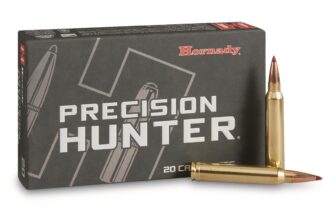
| Hornady Precision Hunter 300 Win Mag 178 gr ELD-X | 178 gr | ELD-X (polymer tip, bonded) | 0.552 | ~2,960 fps | ~$68–$78 | Premium alternative; significantly higher BC; better long-range performance |
| Nosler Trophy Grade 300 Win Mag 150 gr Ballistic Tip | 150 gr | Ballistic Tip (polymer tip, lead core) | 0.435 | ~3,300 fps | ~$65–$75 | Higher BC than PSP at same weight; polymer tip improves aerodynamics |
| Barnes VOR-TX 300 Win Mag 150 gr TTSX | 150 gr | TTSX (lead-free, all-copper) | ~0.398 | ~3,290 fps | ~$72–$85 | Lead-free option; required in California; premium price tier |
Price Reality
- Typical retail range: $50–$60 per 20-round box; case pricing (typically 10 boxes / 200 rounds) generally falls in the $480–$560 range when available
- Per-round cost: approximately $2.50–$3.00 at normal retail pricing; the $54.99 reference price works out to $2.75 per round
- Versus Federal Power-Shok 150 gr: Federal typically runs $5–$10 less per box for comparable traditional cup-and-core performance — a meaningful difference for high-volume practice
- Versus Hornady Precision Hunter 178 gr ELD-X: The premium load commands roughly $15–$25 more per box, but delivers substantially better long-range ballistics through a higher-BC projectile
- Fair price benchmark: At $55/box, this load is priced at the upper end of the traditional hunting ammunition tier for 300 Win Mag. Anything above $60/box for this specific load warrants comparison shopping, as equivalent-tier alternatives are frequently available at lower prices. Below $48/box represents a strong value purchase worth stocking.
Prices change. Check the Where to Buy block for current listings.
Where to Buy
Remington 300 Win Mag 150 Grain Core-Lokt PSP (Box)
Affiliate links. These do not influence ratings, data, or any editorial content on this page.
FAQ
Does the Core-Lokt PSP expand reliably at 300 Win Mag velocities, or does it blow up on impact?The Core-Lokt PSP is designed to control expansion through its mechanically locked jacket-to-core construction, but the elevated velocities of the 300 Winchester Magnum — particularly with a 150 gr projectile — do push the design toward the aggressive end of its expansion envelope at close range. At impact velocities above approximately 2,800 fps (which this load maintains well past 300 yards), expansion is typically rapid and pronounced. At very close ranges — under 75 yards — some hunters report shallower penetration than they’d see with a heavier, more stoutly jacketed bullet. For most deer-sized game, this is not a practical concern, but hunters pursuing elk or larger animals at close range may prefer a bonded or partition-style bullet for more consistent deep penetration.
How does this 150 gr load compare to the 180 gr Core-Lokt in the same caliber for elk hunting?The 150 gr Core-Lokt PSP offers a flatter trajectory and higher muzzle velocity than the 180 gr Core-Lokt variant, but the heavier 180 gr load delivers more sectional density and typically better penetration on large-bodied game like elk. For shots inside 300 yards on elk, most experienced hunters and outfitters lean toward the 180 gr or heavier load specifically because the additional mass and sectional density improve reliability through heavy muscle and bone. The 150 gr load is a capable deer and pronghorn round in 300 Win Mag but represents a compromise when the cartridge’s primary advantage — its ability to push heavy bullets at high velocity — is factored in.
Is this ammunition legal to use in California for deer hunting?No. This load uses a lead-core projectile and is not compliant with California’s Condor Zone lead-free ammunition regulations, which as of July 2019 apply statewide for all hunting of wildlife with firearms in California. Hunters in California must use certified non-toxic, lead-free ammunition — such as the Barnes VOR-TX TTSX or similar all-copper or copper-alloy loads — for all game hunting. Always verify current state regulations before purchasing ammunition for hunting use, as requirements can change.
What is the practical maximum hunting range for this load on whitetail deer?Using the widely cited muzzle velocity estimate of approximately 3,290 fps, this 150 gr PSP load retains sufficient energy for ethical harvests on whitetail deer (generally defined as 1,000 ft-lbs minimum) well past 600 yards on paper. However, practical maximum range is constrained more by the shooter’s ability to accurately read wind and hold consistently than by energy delivery. The modest BC of a traditional PSP bullet means wind drift at 500+ yards becomes a significant variable. For most field conditions and shooter skill levels, 400 yards is a reasonable practical ceiling, with 300 yards representing a more conservative and broadly defensible limit for ethical hunting.
Can the brass cases from this ammunition be reloaded?Yes. This load uses Boxer-primed brass cases, which are compatible with standard reloading dies and decapping tools. Remington brass has a long history of use in handloading communities and is generally considered serviceable for multiple reloading cycles with proper case inspection and preparation. However, this page covers factory ammunition only and does not provide reloading data, charge weights, or handload guidance. Consult a current published reloading manual for all handloading information specific to the 300 Winchester Magnum cartridge.