 Ammo Reports Team
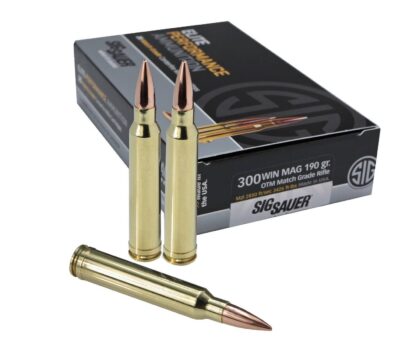
Sig Sauer 300 Win Mag 190 Grain OTM
At a Glance
| Feature | Detail |
|---|---|
| Primary Use | Long-range precision shooting, competition, tactical |
| Bullet Type | Sierra MatchKing Open Tip Match (OTM) |
| Bullet Weight | 190 grain |
| Case Material | Brass |
| Primer Type | Boxer (presumed; not explicitly stated by manufacturer) |
| Packaging | 20 rounds per box |
| Typical Price | $57.99/box · $2.90/round |
| Closest Competitors | Hornady Match 300 Win Mag 195 gr ELD-M · Federal Gold Medal Match 300 Win Mag 185 gr Juggernaut OTM · Berger Hybrid Target 300 Win Mag 185 gr Hybrid |
Official Specs
| Spec | Value | Source |
|---|---|---|
| Muzzle Velocity (fps) | — | Not published |
| Muzzle Energy (ft-lbs) | — | Not published |
| Bullet Weight | 190 gr | Manufacturer |
| Bullet Type | Sierra MatchKing OTM | Manufacturer |
| BC G1 | — | Not published |
| BC G7 | — | Not published |
| Manufacturer SKU | — | Not published |
| UPC | — | Not published |
| Reloadable | Yes | Brass case, Boxer primer |
Note: Sig Sauer does not publish muzzle velocity, muzzle energy, or ballistic coefficient data for this load on their product page. The Sierra MatchKing 190 gr bullet is a well-documented projectile with a published G7 BC of approximately 0.274 (Sierra Bullets), but because this value applies to the component bullet and not to this specific factory load as tested, it is not entered in the table above. Ballistic table estimates below use Sierra’s published component BC as the closest available reference and are clearly labeled as calculated.


Ballistics Table
Calculated estimate. Muzzle velocity is not published by Sig Sauer for this load. The table below uses an estimated muzzle velocity of 2,950 fps, which is consistent with industry norms for 190 gr loads in 300 Winchester Magnum from a 26-inch test barrel, and a G7 BC of 0.274 (Sierra component bullet reference). Real-world results vary by barrel length, temperature, altitude, and lot. Community submissions will provide measured muzzle velocity for comparison.
Zero: 200 yards | Sight height: 1.5" above bore
| Yards | ~Velocity (fps) | ~Energy (ft-lbs) | ~Trajectory (in) |
|---|---|---|---|
| 0 | ~2,950 | ~3,669 | −1.5 |
| 100 | ~2,798 | ~3,304 | +1.7 |
| 200 | ~2,650 | ~2,961 | 0.0 ← zero |
| 300 | ~2,506 | ~2,648 | −7.1 |
| 400 | ~2,366 | ~2,360 | −20.4 |
| 500 | ~2,229 | ~2,094 | −40.8 |
| 600 | ~2,096 | ~1,851 | −69.5 |
| 700 | ~1,966 | ~1,631 | −107.8 |
| 800 | ~1,840 | ~1,428 | −157.6 |
Key takeaway: At a 200-yard zero, the Sig Sauer 300 Win Mag 190 gr OTM stays within roughly ±2 inches of line of sight out to approximately 225 yards, giving a practical point-blank window well suited to long-range precision work. By 500 yards the bullet is still carrying over 2,000 ft-lbs of energy and retaining excellent velocity, a testament to the high sectional density of the 190 gr Sierra MatchKing. Wind drift — not shown here — is the dominant variable beyond 500 yards and warrants attention in field conditions. Because Sig has not published a factory-confirmed muzzle velocity, shooters should chronograph this load from their own barrel before building a precise firing solution.
The Sierra MatchKing OTM Bullet
The Sierra MatchKing is one of the most competition-proven match projectiles in the world and the defining component of this load. Its open tip match construction is a manufacturing artifact: the jacket is drawn from the tip downward, leaving a small open cavity at the nose that improves concentricity compared to traditional lead-tip bullets. This is not an expansion mechanism — the MatchKing is not designed or recommended for hunting by Sierra Bullets, as the thin jacket and match geometry do not provide controlled terminal expansion on game. The bullet’s value lies entirely in its dimensional consistency, which translates directly to reduced muzzle-to-muzzle velocity variation and tighter groups at distance. Sig Sauer’s decision to build their Match Grade line around this projectile signals a clear targeting of the precision rifle and long-range competition market rather than general hunting applications.
Best Uses
Good fit:
- Long-range precision rifle competition (PRS, NRL, F-Class) where consistent ballistic performance is the primary metric
- Tactical and law enforcement precision applications requiring verified accuracy at extended distances
- Andmark load for load development comparison — the MatchKing’s known BC allows shooters to isolate case and primer variables
- Dedicated range training for 300 Win Mag platforms where match-grade consistency is required across a full session
Not the right tool for:
- Big-game hunting — the Sierra MatchKing OTM is explicitly not recommended for hunting by Sierra Bullets due to unpredictable terminal performance on large animals
- Budget-sensitive shooters — at nearly $2.90 per round, this is a premium training and competition load
- Short-barrel carbine or compact rifle builds where magnum cartridges produce excessive blast and velocity loss that undercuts the precision advantage
- Jurisdictions with restrictions on open-tip or hollow-point rifle ammunition — verify local regulations before purchase or transport
Reliability Notes
No structured submissions yet.
Based on manufacturer claims and open-source information: Sig Sauer states that the Match Grade line uses temperature-stable propellants, which is a meaningful claim for a magnum cartridge — propellant temperature sensitivity in 300 Win Mag loads can shift point of impact by several inches at distance between cold-weather and hot-weather conditions. The use of precisely measured powder charges and tight dimensional tolerances on case neck and bullet seating depth is consistent with what match-grade ammunition manufacturers generally describe. No reliability complaints or failure patterns have been identified in open sources at time of publication. Notes sourced from manufacturer product description and general category knowledge — not structured user data.
Competitors
| Load | Weight | Bullet | BC G1 | Adv. Velocity | Price/box | Notes |
|---|---|---|---|---|---|---|
| Hornady Match 300 Win Mag 195 gr ELD-M | 195 gr | ELD-M | 0.640 | ~2,930 fps | ~$62–$68 | Premium alternative; Heat Shield tip; widely available |
| Federal Gold Medal Match 300 Win Mag 185 gr Juggernaut OTM | 185 gr | Berger Juggernaut OTM | ~0.552 | ~2,950 fps | ~$58–$65 | Direct competitor; same use case; slightly lighter bullet |
| Berger Hybrid Target 300 Win Mag 185 gr Hybrid | 185 gr | Berger Hybrid OTM | ~0.552 | ~2,950 fps | ~$65–$72 | Premium alternative; Hybrid ogive design; higher price |
| Winchester Match 300 Win Mag 190 gr HPBT | 190 gr | Sierra MatchKing HPBT | ~0.540 | ~2,950 fps | ~$45–$52 | Uses same Sierra MatchKing bullet; budget alternative |
| Nosler Match Grade 300 Win Mag 190 gr HPBT | 190 gr | Custom Competition HPBT | ~0.530 | ~2,900 fps | ~$55–$60 | Mid-range price; Nosler custom bullet, not Sierra |
| Black Hills Match 300 Win Mag 190 gr HPBT | 190 gr | Sierra MatchKing HPBT | ~0.540 | ~2,950 fps | ~$58–$65 | Uses same Sierra MatchKing bullet; respected match reputation |
Note: Winchester Match and Black Hills Match both use the same Sierra MatchKing 190 gr projectile as this Sig Sauer load. Differences in performance between those loads and the Sig offering would be attributable to propellant selection, case preparation, and quality control tolerances rather than bullet design.
Price Reality
- Typical retail price: $57.99 per box of 20 (~$2.90/round); case pricing not widely listed at time of publication
- Per-round cost of $2.90 places this firmly in the premium match ammunition tier
- Winchester Match 300 Win Mag 190 gr MatchKing runs approximately $45–$52/box (~$2.25–$2.60/round) — uses the same bullet at a meaningfully lower price point
- Hornady Match 300 Win Mag 195 gr ELD-M runs approximately $62–$68/box — a slightly higher price for a different bullet architecture
- Federal Gold Medal Match 300 Win Mag 185 gr runs approximately $58–$65/box — comparable pricing with a different bullet
- Fair price benchmark: Given that Winchester Match uses the identical Sierra MatchKing bullet at a lower price, the Sig Sauer load is competitive only if Sig’s case preparation and propellant consistency demonstrably outperform Winchester’s — a claim that would require chronograph data to validate. Paying above $65/box for this specific load would be difficult to justify without confirmed performance advantages
Prices change. Check the Where to Buy block for current listings.
Where to Buy
Sig Sauer 300 Win Mag 190 Grain OTM
Affiliate links. These do not influence ratings, data, or any editorial content on this page.
FAQ
Is the Sierra MatchKing OTM bullet legal for hunting with this load?Sierra Bullets explicitly states that the MatchKing is not recommended for hunting because its thin jacket and open-tip match design do not provide controlled expansion on game animals. Terminal behavior on tissue is inconsistent — the bullet may fail to expand, over-expand, or fragment unpredictably depending on impact velocity and angle. Several states also have regulations that restrict or require specific bullet constructions for big-game hunting. Hunters should select a dedicated hunting load with a controlled-expansion bullet for any legal or ethical harvest application.
How does this load compare to Winchester Match 300 Win Mag 190 gr, which uses the same bullet?Both the Sig Sauer and Winchester Match loads use the Sierra MatchKing 190 gr HPBT projectile, meaning the ballistic coefficient and in-flight behavior are governed by the same bullet. The meaningful differences — if any — lie in propellant selection, powder charge consistency, case preparation quality, and primer sensitivity. Sig Sauer claims temperature-stable propellants and tight manufacturing tolerances in their Match Grade line. Winchester Match has a long established reputation in competition circles. At roughly $0.30–$0.65 less per round, Winchester Match represents the stronger value proposition unless chronograph data from a specific barrel demonstrates a consistency advantage for the Sig load.
What barrel length does this load assume, and how much does barrel length affect velocity?Sig Sauer does not publish the test barrel length for this load, which is a significant data gap for precision shooters. The 300 Winchester Magnum is typically tested from a 26-inch barrel in factory conditions. Shooters using 24-inch barrels can expect to lose approximately 20–30 fps per inch of barrel removed, meaning a 24-inch barrel may yield roughly 40–60 fps less than a 26-inch test barrel figure. This shifts the ballistic drop curve measurably at distances beyond 400 yards. Until Sig publishes test barrel length and muzzle velocity, chronographing this load from your specific rifle is the only reliable way to build an accurate firing solution.
Can this load be used for tactical or law enforcement precision rifle applications?The Sig Sauer Match Grade line is engineered for precision applications, and the 190 gr MatchKing in 300 Win Mag is a well-established cartridge-bullet combination in the precision rifle community. The temperature-stable propellant claim is particularly relevant for tactical applications where ammunition may be stored and used across wide temperature ranges. However, agencies and end users should conduct their own accuracy and reliability testing from their specific platforms before adopting any load for operational use. The lack of published velocity data from Sig is a limitation for building verified firing solutions without independent chronograph work.
Is this ammunition reloadable, and are the cases suitable for precision reloading?The brass cases are Boxer-primed and fully reloadable, which is standard for premium match ammunition. Sig Sauer’s stated emphasis on precise case manufacturing suggests the brass may offer good consistency for reloaders, though this has not been independently verified in structured testing. That said, AmmoReports.com covers factory ammunition only — reloading data, charge weights, and handloading procedures are outside the scope of this page. Shooters interested in reloading fired Sig Match Grade brass should consult published reloading manuals and component data from reputable sources.