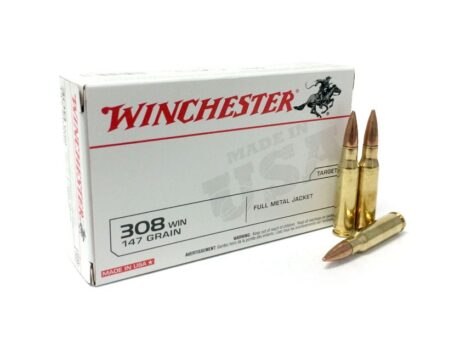
 Ammo Reports Team
| Official Spec | Value |
|---|---|
| Manufacturer | Winchester |
| Cartridge | 308 Winchester |
| Product Line | USA |
| Bullet Name / Type | Full Metal Jacket |
| Bullet Weight | 147 gr |
| SKU / Part Number | USA3081 |
| UPC | 020892212633 – retailer-listed |
| Rounds per Box | 20 |
| Muzzle Velocity | 2,800 fps |
| Muzzle Energy | 2,559 ft-lbs |
| Ballistic Coefficient G1 | Not found |
| Ballistic Coefficient G7 | Not found |
| Case Material | Brass – retailer-listed |
| Primer | Boxer – retailer-listed |
| Reloadable | Yes – retailer-listed |
| Test Barrel Length | Not found |
| Zero Distance | Not found |
| Sight Height | Not found |
| Intended Use | Target shooting; training |
| Product Status | Current |
| Closest Competitors | Federal American Eagle .308 Win 150 gr FMJ, PMC Bronze .308 Win 147 gr FMJ, Sellier & Bellot .308 Win 147 gr FMJ, Hornady American Gunner .308 Win 155 gr BTHP, Fiocchi .308 Win 150 gr FMJ, Lake City (Federal) .308 Win 149 gr FMJ M80 |
Data is based on official manufacturer sources. Found an error? Send us the source link.
Values labeled retailer-listed are retained only where the manufacturer does not publish the identifier or packaging detail.
Ballistics Table
Winchester manufacturer data. No calculated wind values are mixed into this table.
| Yards | Velocity (fps) | Energy (ft-lbs) |
|---|---|---|
| 0 | 2,800 | 2,559 |
Best Uses
Good fit:
- High-volume range training where cost-per-round matters
- Semi-automatic and bolt-action rifle function testing and break-in
- Military-format qualification practice requiring 147 gr FMJ projectiles
- Introductory long-range shooting at distances up to 300 yards
- Carbine and rifle courses where full metal jacket is required by range rules
Not the right tool for:
- Big game hunting — FMJ projectiles are illegal or ethically inappropriate for hunting in most jurisdictions due to lack of controlled expansion
- Precision competition requiring published and verified BC data
- Situations where terminal performance or energy transfer matters (self-defense, pest control)
- Environments with strict lead-core bullet restrictions (California condor zones, certain federal lands)
Reliability Notes
No structured submissions yet.
Based on manufacturer claims and open-source retailer information: Winchester describes this load as designed for consistent feeding and reliable extraction across a range of 308 Winchester chamber specifications. The brass case and Boxer primer combination is consistent with Winchester’s USA-branded training line, which is manufactured to meet standard pressure specifications. The boat tail base on the projectile is noted as a design feature intended to improve in-flight stability compared to flat-base FMJ designs. No product recalls or safety notices have been identified for this specific SKU (USA3081) at the time of publication. All notes above come from manufacturer claims and open retailer sources — not structured user-submitted data.
Competitors
The complete comparison set from the original report is preserved below. Internal links appear only where an exact published Ammo Reports review exists.
| Load | Weight | Bullet | BC G1 | Advertised Velocity | Notes |
|---|---|---|---|---|---|
| Federal American Eagle .308 Win 150 gr FMJ | 150 gr | FMJBT | Not verified | 2,820 fps | Budget alternative; widely available; 3 gr heavier |
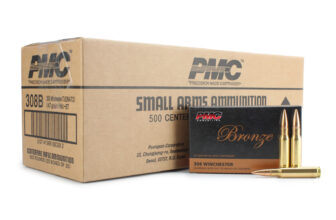
| PMC Bronze .308 Win 147 gr FMJ | 147 gr | FMJBT | Not verified | 2,780 fps | Same bullet weight; budget-tier pricing; South Korean manufacture |
| Sellier & Bellot .308 Win 147 gr FMJ | 147 gr | FMJBT | Not verified | 2,723 fps | Same weight class; European manufacture; slightly lower velocity |
| Hornady American Gunner .308 Win 155 gr BTHP | 155 gr | BTHP | 0.447 | 2,815 fps | Premium alternative; open-tip match; higher BC; not FMJ |
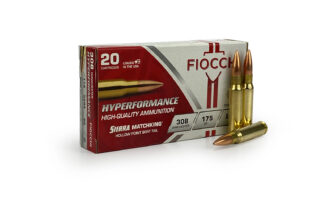
| Fiocchi .308 Win 150 gr FMJ | 150 gr | FMJBT | Not verified | 2,850 fps | Budget-to-mid tier; Italian manufacture; slightly higher velocity |
| Lake City (Federal) .308 Win 149 gr FMJ M80 | 149 gr | FMJBT | Not verified | 2,800 fps | Mil-spec equivalent; same velocity class; often sold in bulk |
Price and Availability
Retail availability changes by seller, location, and lot. Use the retailer links above to check current stock and checkout totals.
Where to Buy
FAQ
Does the boat tail base on this bullet actually matter for a training load?
The boat tail design reduces base drag compared to a flat-base FMJ, which provides a modest improvement in retained velocity and stability at longer ranges. For most range sessions inside 200 yards, the practical difference is minimal. Where the boat tail becomes more relevant is at 300–500 yards, where the slightly higher BC helps reduce wind drift and drop compared to a flat-base equivalent. For a training load, the boat tail is a useful feature rather than a critical one, but it does make this round more suitable for extended-range practice than many budget flat-base options.
Can this Winchester 147 gr FMJ be used for hunting deer or other big game?
No — full metal jacket ammunition is unsuitable and illegal for big game hunting in most U.S. states and many countries. FMJ projectiles are designed to pass through without expanding, which does not reliably produce the rapid energy transfer needed for ethical kills. Hunters seeking a 308 Winchester load should look at soft-point, bonded, or controlled-expansion projectiles designed specifically for terminal performance on game. This load is strictly a training and target round.
How does this load compare to military M80 ball ammunition?
The Winchester USA3081 at 147 gr and 2,800 fps is closely aligned with the NATO M80 ball specification, which calls for a 147–150 gr FMJ at approximately 2,750–2,850 fps from a 24-inch barrel. The two loads are functionally very similar in velocity, energy, and trajectory. The primary difference is that M80 is produced to military acceptance standards with specific lot-consistency requirements, while commercial loads like this Winchester product are built to SAAMI specifications for the civilian market. For training purposes, the two are interchangeable in most practical respects.
Is the brass case from this load worth saving for reloading?
Winchester brass cases from USA-branded training ammunition are generally considered good-quality, reloadable brass. The Boxer primer and single flash hole design make decapping and repriming straightforward with standard reloading tools. However, this report covers factory ammunition only and does not provide reloading data. If the goal is to collect brass for later use, this load’s cases are a reasonable choice compared to steel- or aluminum-cased alternatives that are not reloadable.
Why does this load use 147 grains instead of the more common 150 grain weight?
The 147 grain bullet weight is the NATO-standard projectile weight for 7.62×51mm ball ammunition, and Winchester has carried this specification into their commercial 308 Winchester training line to replicate the feel and recoil of military-format ammunition. The difference between 147 gr and 150 gr is negligible in practical shooting — velocities, trajectories, and recoil are essentially indistinguishable at typical range distances. Shooters training for military qualification standards or wanting to replicate service-rifle ballistics will find the 147 gr specification directly relevant, while general target shooters will notice no meaningful difference.