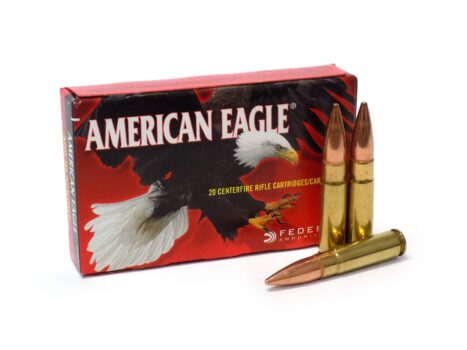
 Ammo Reports Team
| Official Spec | Value |
|---|---|
| Manufacturer | Federal |
| Cartridge | 300 Blackout |
| Product Line | American Eagle |
| Bullet Name / Type | Full Metal Jacket Boat-Tail |
| Bullet Weight | 150 gr |
| SKU / Part Number | AE300BLK1 |
| UPC | Not found |
| Rounds per Box | 20 |
| Muzzle Velocity | 1900 fps |
| Muzzle Energy | 1202 ft-lbs |
| Ballistic Coefficient G1 | 0.406 |
| Ballistic Coefficient G7 | Not found |
| Case Material | Brass |
| Primer | Not found |
| Reloadable | Yes |
| Test Barrel Length | 16 in |
| Zero Distance | 100 yd |
| Sight Height | 1.5 in |
| Intended Use | Competition, target shooting, and training |
| Product Status | Current product listing verified |
| Closest Competitors | Hornady Black 300 BLK 150 gr FMJ, PMC Bronze 300 BLK 147 gr FMJ, Magtech 300 BLK 123 gr FMJ, Winchester USA 300 BLK 125 gr FMJ, Sig Sauer Elite 300 BLK 125 gr FMJ, Remington UMC 300 BLK 150 gr OTFB |
Data is based on official manufacturer sources. Found an error? Send us the source link.
Official-data note: Federal publishes factory velocity, energy, 10 mph wind drift, and trajectory data for AE300BLK1. The trajectory column below uses Federal’s 100-yard-zero table with sights 1.5 inches above bore.
Manufacturer: Federal. Exact official product pages and technical documents are recorded in the editorial verification log. Any retailer-listed field is labeled.
Ballistics Table
Official Federal factory ballistics. Real-world results can vary by barrel length, temperature, altitude, and ammunition lot.
| Yards | Velocity (fps) | Energy (ft-lbs) | 10 mph Wind Drift (in) | Trajectory (in) |
|---|---|---|---|---|
| Muzzle | 1900 | 1202 | 0.0 | -1.5 |
| 100 | 1724 | 990 | 1.6 | 0.0 |
| 200 | 1561 | 811 | 6.1 | -10.3 |
| 300 | 1411 | 663 | 13.7 | -34.7 |
| 400 | 1282 | 547 | 25.3 | – |
| 500 | 1174 | 459 | 40.6 | – |
Key takeaway: AE300BLK1 is a verified 150 gr FMJ-BT training load at 1900 fps. Federal’s factory table shows substantial drop beyond 200 yards, consistent with the cartridge’s short- to medium-range role.
Related 300 Blackout factory loads on Ammo Reports: Remington UMC 150 Grain FMJ, Sellier & Bellot 147 Grain FMJ, and Winchester USA 147 Gr FMJ.
The 150 gr Supersonic in 300 Blackout Context
The 300 Blackout cartridge was engineered with two distinct performance windows: subsonic loads (typically 200–220 gr) optimized for suppressed use, and supersonic loads (typically 110–150 gr) intended to deliver rifle-class terminal performance from short barrels. The 150 gr supersonic occupies the heavier end of that supersonic window, trading some velocity for a heavier projectile that retains energy more efficiently at distance compared to 110–125 gr options.
Federal’s American Eagle line has historically served as a high-volume, consistent training platform across multiple calibers, and this 300 BLK offering follows that same approach: loaded in reloadable brass cases and intended for dependable function in AR-15 platforms without the premium price of hunting or defensive loads. The FMJ-BT construction is not designed for terminal expansion — it is explicitly a range and training bullet, which is consistent with the American Eagle brand identity across all calibers it covers.
Best Uses
Good fit:
- High-volume range sessions where cost-per-round matters
- Function testing and break-in for new 300 Blackout uppers or complete rifles
- Training drills requiring consistent cycling in AR-15 platforms
- Zeroing optics on 300 BLK builds before transitioning to hunting or defensive loads
- Brass recovery for shooters who reload (Federal explicitly lists reloadable brass cases)
Not the right tool for:
- Hunting applications that call for a controlled-expansion bullet; verify the applicable regulations before use
- Suppressed subsonic use — this is a supersonic load and will not cycle reliably or quietly in subsonic-optimized setups
- Home defense — non-expanding FMJ carries significant over-penetration risk
- Long-range precision work beyond 300 yards where trajectory management becomes demanding
- Situations requiring published, verified ballistic data for external ballistics calculations
Reliability Notes
No structured submissions yet.
Based on manufacturer claims and open-source information, this load is described as providing consistent cycling in AR-15 platforms chambered in 300 Blackout. The American Eagle line across other calibers has a long-standing reputation in the shooting community for reliable ignition and dimensional consistency, though these observations come from manufacturer marketing and general community commentary — not structured test data submitted to this database. No feeding, extraction, or ignition issues specific to this SKU have been identified in publicly available sources at time of publication. Shooters using pistol-length or SBR configurations should verify reliable cycling, as gas system tuning varies significantly between short-barrel 300 BLK builds.
Competitors
This is the full comparison set preserved from the article’s existing competitor list. A link is added only when an exact Published review exists on Ammo Reports. Unverified competitor fields are labeled accordingly.
| Competitor | Bullet Type | Weight | Muzzle Velocity | Primary Use |
|---|---|---|---|---|
| Hornady Black 300 BLK 150 gr FMJ | FMJ-BT – Not verified | 150 gr – Not verified | Not verified | Not verified |
| PMC Bronze 300 BLK 147 gr FMJ | FMJ – Not verified | 147 gr – Not verified | Not verified | Not verified |
| Magtech 300 BLK 123 gr FMJ | FMJ – Not verified | 123 gr – Not verified | Not verified | Not verified |
| Winchester USA 300 BLK 125 gr FMJ | FMJ – Not verified | 125 gr – Not verified | Not verified | Not verified |
| Sig Sauer Elite 300 BLK 125 gr FMJ | FMJ – Not verified | 125 gr – Not verified | Not verified | Not verified |
| Remington UMC 300 BLK 150 gr OTFB | Open-Tip Flat Base – Not verified | 150 gr – Not verified | Not verified | Not verified |
Price Reality
Retail prices and availability change. Compare the current store listings below and verify SKU AE300BLK1 and the exact 20-round package before purchase. Price is not used to determine the technical data or editorial conclusion.
Where to Buy
Affiliate links. These do not influence ratings, data, or any editorial content on this page.
FAQ
What muzzle velocity does Federal publish for AE300BLK1?
Federal lists 1,900 fps for the 150 gr FMJ-BT load. The official muzzle energy is 1,202 ft-lbs.
What ballistic coefficient does Federal list?
Federal’s current product specifications list a G1 BC of 0.406. Federal does not publish a G7 value for this load.
Is the brass reloadable?
Yes. Federal’s product overview specifically describes the load as using reloadable brass cases. This article covers factory ammunition and does not provide charge data.
Is AE300BLK1 intended for hunting?
No. Federal lists the usage as competition and target shooting, and the FMJ-BT projectile is not designed as a controlled-expansion hunting bullet.
What zero is used in the trajectory column?
The trajectory values shown use Federal’s factory 100-yard-zero table with sights 1.5 inches above the bore. The wind-drift figures are Federal’s 10 mph values.